Understanding Peptide Oxidation: 15 Powerful Ways to Prevent Costly Peptide Degradation

Understanding Peptide Oxidation
https://pubmed.ncbi.nlm.nih.gov/
Peptides are among the most valuable tools in modern biomedical research. Whether used in receptor studies, molecular biology, drug discovery, or analytical chemistry, their success depends on one critical factor: stability. Among all degradation pathways, Understanding Peptide Oxidation is one of the most important topics every researcher should master.
Unlike contamination, oxidation is often invisible. A peptide can appear perfectly clear, remain sterile, and still lose a significant portion of its biological activity because only a few oxygen atoms have been introduced into sensitive amino acid residues. These tiny molecular changes can dramatically alter peptide conformation, receptor affinity, analytical purity, and experimental reproducibility.
For experienced laboratories, preventing peptide oxidation begins long before a researcher opens a vial. It starts during peptide synthesis, continues through purification, lyophilization, packaging, cold-chain logistics, and extends to every step of laboratory handling.
At Peptide Amino Nation, we recognize that peptide quality is not defined solely by a certificate of analysis. Long-term research success depends on maintaining peptide integrity throughout its entire lifecycle—from manufacturing to final experimental use. Understanding peptide oxidation enables researchers to protect sample quality, reduce costly failures, and improve experimental consistency.
What Is Peptide Oxidation?
Understanding Peptide Oxidation at the Molecular Level
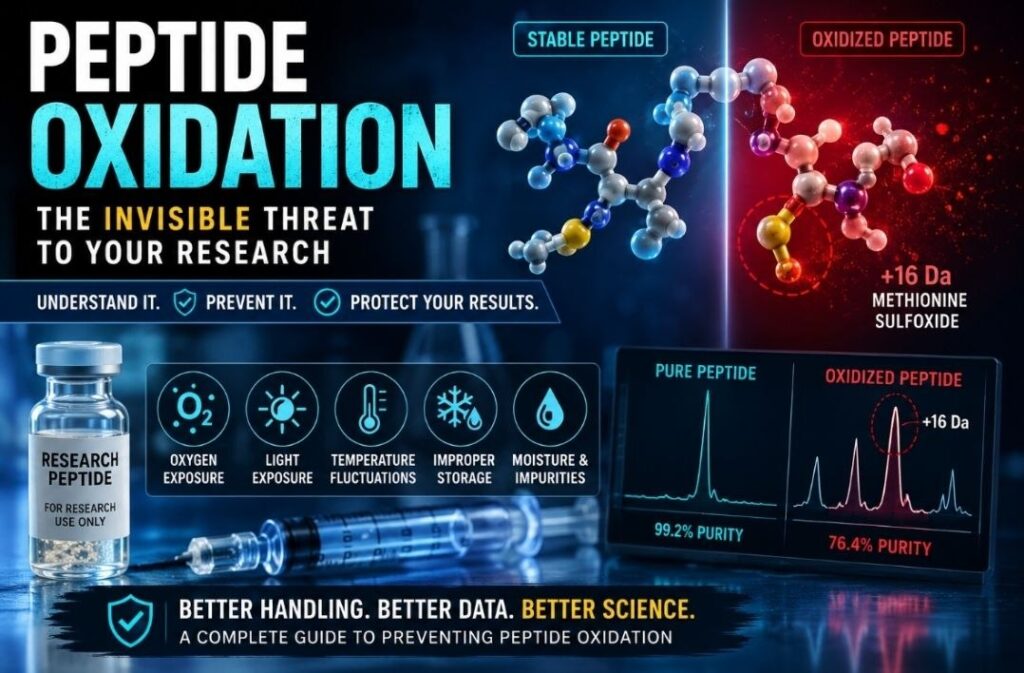
Peptide oxidation is a chemical reaction in which reactive oxygen species (ROS), dissolved molecular oxygen, peroxides, or other oxidizing agents modify susceptible amino acid side chains within a peptide sequence.
Unlike enzymatic degradation, oxidation is purely chemical. It may occur during:
• Peptide synthesis
• Cleavage from solid-phase resin
• Purification
• Lyophilization
• Packaging
• Shipping
• Storage
• Reconstitution
• Routine laboratory handling
Even when manufactured under strict quality standards, peptides remain chemically vulnerable whenever oxygen, moisture, light, heat, or metal contaminants are present.
The extent of oxidation depends on several factors, including:
• Amino acid composition
• Temperature
• Solution pH
• Dissolved oxygen concentration
• Exposure to ultraviolet light
• Presence of transition metals
• Storage duration
• Number of freeze-thaw cycles
Every laboratory working with research peptides should understand these variables before beginning an experiment.
Why Understanding Peptide Oxidation Matters
Many researchers assume that a peptide is stable simply because it has high analytical purity.
Unfortunately, this is one of the most expensive misconceptions in peptide research.
A freshly manufactured peptide may leave production at ≥99% purity, yet improper handling after shipment can significantly reduce its functional integrity within days or weeks.
Oxidation affects much more than appearance.
Its consequences include:
• Reduced receptor binding affinity
• Loss of biological activity
• Structural instability
• Increased aggregation
• Lower experimental reproducibility
• Shortened shelf life
• Failed analytical testing
• Financial losses due to discarded material
In regulated manufacturing environments, oxidation is one of the most closely monitored degradation pathways because even minor molecular modifications can affect research outcomes.
This is why experienced peptide suppliers invest heavily in:
• Stability studies
• HPLC purity analysis
• LC-MS confirmation
• Controlled lyophilization
• Oxygen-limiting packaging
• Cold-chain shipping
• Quality assurance programs
Understanding peptide oxidation helps researchers appreciate why these quality-control measures are essential rather than optional.
The Chemistry Behind Peptide Oxidation
Why Oxygen Is Not Always Harmless
Oxygen is essential for life, but from a chemical standpoint, it is also highly reactive under the right conditions.
When peptides encounter reactive oxygen species—including hydrogen peroxide, hydroxyl radicals, singlet oxygen, or trace peroxides—certain amino acids become preferred targets.
Oxidation often begins with a single oxygen atom attaching to a susceptible residue.
Although this change may seem insignificant, it can alter:
• Molecular weight
• Three-dimensional folding
• Hydrophobicity
• Hydrogen bonding
• Biological recognition
• Binding kinetics
One oxygen atom can transform a highly active peptide into a molecule with substantially reduced functionality.
From an analytical perspective, these modifications are commonly detected using High-Performance Liquid Chromatography (HPLC) and Liquid Chromatography–Mass Spectrometry (LC-MS).
| Oxidation Event | Typical Mass Shift |
| Methionine – Methionine Sulfoxide | +16 Da |
| Methionine – Methionine Sulfone | +32 Da |
| Tryptophan Hydroxylation | +16 Da |
| Formylkynurenine Formation | +32 Da |
Experienced analytical laboratories routinely monitor these mass shifts because they provide clear evidence of oxidative degradation.
Amino Acids Most Vulnerable to Oxidation
Understanding Peptide Oxidation Begins with the Sequence
Not every peptide has the same susceptibility to oxidation.
A peptide’s amino acid composition largely determines how stable it will remain during manufacturing, shipping, storage, and laboratory use.
1. Methionine (Met): The Most Common Oxidation Target
Methionine contains a sulfur atom that readily reacts with oxygen.
Unlike many other oxidation reactions, methionine oxidation occurs across a broad pH range, making it one of the most persistent challenges in peptide formulation.
Its primary oxidation product is methionine sulfoxide, producing the characteristic +16 Da mass increase observed during LC-MS analysis.
This seemingly minor modification can significantly reduce receptor binding, alter biological function, and compromise research results.
2. Tryptophan (Trp): Highly Sensitive to Light
Tryptophan possesses an electron-rich indole ring that is particularly vulnerable to ultraviolet radiation and free-radical attack.
Exposure to laboratory lighting, sunlight, or dissolved oxygen may produce oxidation products such as:
• Hydroxytryptophan
• Formylkynurenine
Researchers sometimes notice slight yellow discoloration in heavily oxidized solutions, but many oxidation events remain invisible without analytical testing.
3. Cysteine (Cys): The Structural Risk
Cysteine presents a different challenge.
Rather than simply gaining oxygen atoms, free cysteine residues often undergo unwanted disulfide bond formation or structural rearrangement.
Improper oxidation can produce:
• Misfolded peptides
• Aggregates
• Dimers
• Reduced biological activity
Maintaining appropriate pH, minimizing oxygen exposure, and controlling storage conditions are therefore essential for cysteine-containing peptides.
Why Even High-Purity Peptides Can Oxidize
A common misconception is that analytical purity guarantees long-term stability.
It does not.
A peptide may be manufactured under stringent GMP-inspired quality standards, pass HPLC purity testing, and receive LC-MS verification—yet still undergo oxidation after leaving the manufacturing facility.
This is because purity reflects a specific point in time, whereas stability depends on everything that happens afterward.
Factors such as shipping temperature fluctuations, residual moisture, repeated vial opening, dissolved oxygen in reconstitution buffers, and prolonged exposure to light can all initiate oxidative degradation.
Understanding peptide oxidation means recognizing that preserving peptide quality requires proper handling at every stage—not just high-quality manufacturing.
Where Peptide Oxidation Happens and How to Prevent It
Understanding Peptide Oxidation During Manufacturing
One of the biggest misconceptions in peptide research is that oxidation begins only after a peptide reaches the laboratory. In reality, Understanding Peptide Oxidation starts during manufacturing, where every step of the production process is carefully designed to minimize oxidative damage before the peptide is ever packaged.
From solid-phase peptide synthesis (SPPS) to purification and lyophilization, manufacturers continuously monitor oxygen exposure, solvent quality, temperature, and reactive impurities. Even under controlled conditions, oxidation remains one of the greatest challenges in producing high-purity research peptides.
Experienced peptide manufacturers invest heavily in process optimization because preventing oxidation is far easier than correcting it after degradation has occurred.
Stage 1: Peptide Synthesis – The First Opportunity for Oxidation
During Solid-Phase Peptide Synthesis (SPPS), amino acids are sequentially assembled on a solid resin. While this method provides excellent control over peptide construction, certain amino acid residues remain chemically vulnerable throughout the synthesis process.
The greatest concern involves amino acids such as:
• Methionine (Met)
• Tryptophan (Trp)
• Cysteine (Cys)
These residues can react with oxygen, free radicals, or trace oxidizing agents long before the peptide reaches the purification stage.
Although modern synthesis equipment operates under carefully controlled conditions, manufacturers still employ protective strategies to reduce oxidative stress throughout production.
Cleavage: One of the Most Critical Steps
After synthesis is complete, the peptide must be cleaved from the solid support resin.
This is commonly achieved using Trifluoroacetic Acid (TFA) together with specialized scavengers.
Without these scavengers, reactive intermediates generated during cleavage can attack oxidation-sensitive amino acids.
For this reason, manufacturers frequently include compounds such as:
• Triisopropylsilane (TIS)
• Ethanedithiol (EDT)
• Thioanisole
• Phenol
These scavengers rapidly neutralize reactive species before they can oxidize susceptible residues.
This seemingly simple precaution plays a major role in preserving peptide purity.
Real Manufacturing Example
A classic example involves the production of Glucagon-Like Peptide-1 (GLP-1) analogs and Adrenocorticotropic Hormone (ACTH).
Both peptide families contain oxidation-sensitive methionine residues.
If purification solvents are not properly degassed or contain trace peroxide contamination, analytical testing frequently detects a +16 Da mass increase corresponding to methionine sulfoxide formation.
Even though the peptide sequence itself is correct, oxidation significantly lowers product quality and may reduce biological activity.
This is one reason why professional peptide manufacturers continuously monitor solvent quality and dissolved oxygen throughout production.
Stage 2: Purification and Quality Control
Once synthesis is complete, crude peptides undergo purification.
High-performance liquid chromatography (HPLC) separates the desired peptide from impurities generated during synthesis.
However, purification itself can introduce oxidation if proper precautions are ignored.
Potential oxidation sources include:
• Dissolved oxygen in mobile phases
• Trace metal contamination
• Peroxide impurities
• Poor solvent storage
• Extended exposure to atmospheric oxygen
Experienced manufacturers routinely degas purification solvents before use.
Doing so significantly reduces dissolved oxygen levels and helps protect oxidation-sensitive residues throughout purification.
Why HPLC Alone Is Not Enough
Many researchers rely solely on HPLC purity percentages.
While HPLC is invaluable, it can not always identify the exact chemical modification responsible for a new impurity peak.
This is why experienced laboratories pair HPLC with Liquid Chromatography-Mass Spectrometry (LC-MS).
Together, these techniques provide two essential pieces of information:
HPLC reveals:
• Purity percentage
• Impurity profile
• Peak separation
• Batch consistency
LC-MS reveals:
• Exact molecular weight
• Oxidation products
• Mass shifts
• Chemical identity
For oxidation studies, LC-MS is particularly valuable because methionine oxidation produces a predictable +16 Da mass increase.
When additional oxidation occurs, methionine sulfone formation produces a +32 Da increase.
These analytical markers allow quality-control scientists to distinguish oxidation from unrelated manufacturing impurities.
Stage 3: Storage and Lyophilization
Why Dry Doesn’t Mean Immune
Many researchers believe that lyophilized peptides are completely protected against degradation.
Unfortunately, that is only partially true.
Lyophilization removes most water from the peptide, dramatically slowing hydrolysis.
However, oxidation can still occur if storage conditions are poorly controlled.
Residual moisture, oxygen trapped within the vial headspace, and unstable formulation components can all initiate oxidative degradation over time.
Understanding peptide oxidation means recognizing that “dry” does not mean “indestructible.”
The Hidden Risk of Residual Moisture
Even after freeze-drying, trace moisture remains within most lyophilized cakes.
If storage temperatures fluctuate repeatedly, that residual moisture becomes increasingly reactive.
Combined with oxygen, this creates ideal conditions for slow oxidation during long-term storage.
Professional manufacturers, therefore, focus on:
• Optimized lyophilization cycles
• Moisture-content testing
• Proper vial sealing
• Nitrogen or argon backfilling
• Temperature-controlled storage
Each measure extends peptide stability before shipment.
Excipients Can Become the Problem
Ironically, ingredients intended to protect peptides may eventually contribute to oxidation.
Surfactants such as Polysorbate 20 and Polysorbate 80 are frequently used to reduce surface adsorption and aggregation.
Over time, however, these compounds may undergo auto-oxidation.
As they degrade, peroxide compounds accumulate.
These peroxides then attack oxidation-sensitive amino acids, particularly methionine.
Because of this risk, high-quality manufacturers routinely evaluate excipient quality alongside peptide purity.
Real Storage Example: Teriparatide Stability
One of the best-documented examples involves Teriparatide (PTH 1-34).
This peptide contains two oxidation-sensitive methionine residues located at positions 8 and 18.
Studies have shown that oxidation at these sites significantly reduces receptor binding and biological activity.
Improper storage temperatures, oxygen exposure, or residual moisture accelerate the formation of methionine sulfoxide, making careful cold-chain storage essential.
This example highlights why long-term peptide stability depends on much more than initial purity testing.
Stage 4: Shipping – An Often Overlooked Source of Oxidation
Shipping is one of the least appreciated stages of peptide stability.
Even perfectly manufactured peptides can experience oxidative stress during transportation if environmental conditions are not properly controlled.
Potential shipping hazards include:
• Temperature fluctuations
• UV exposure
• Physical vibration
• Oxygen diffusion
• Package damage
• Extended transit times
Each of these factors contributes to oxidation in different ways.
Why Cold-Chain Logistics Matter
Temperature directly influences chemical reaction rates.
Higher temperatures accelerate oxidation, hydrolysis, and other degradation pathways.
Professional peptide supplier, therefore, emphasize reliable cold-chain logistics to reduce temperature fluctuations throughout transportation.
Appropriate shipping practices typically include:
• Insulated packaging
• Temperature-controlled transport
• Protective secondary containers
• Light-resistant packaging
• Rapid delivery schedules
These precautions help preserve peptide integrity until the shipment reaches the laboratory.
Laboratory Handling, Real-World Case Studies, and Proven Solutions
Understanding Peptide Oxidation During Laboratory Handling
After a peptide successfully passes manufacturing, purification, quality control, and shipping, one final stage determines whether it maintains its integrity—laboratory handling.
Surprisingly, many oxidation-related failures occur after a peptide reaches the researcher. Even peptides manufactured to the highest purity standards can lose biological activity because of avoidable handling mistakes.
This is why Understanding Peptide Oxidation is not only the responsibility of the manufacturer but also of every researcher handling the peptide.
The moment a lyophilized peptide vial is opened, it is exposed to atmospheric oxygen, moisture, light, and temperature fluctuations. Every subsequent handling step either protects the peptide—or accelerates its degradation.
How Peptide Oxidation Begins After Reconstitution
Reconstituting a lyophilized peptide transforms it from a relatively stable dry powder into a chemically active solution.
Although this step is necessary for most laboratory applications, it also marks the beginning of the peptide’s limited working lifespan.
Once dissolved, the peptide becomes increasingly susceptible to:
• Dissolved oxygen
• Reactive oxygen species (ROS)
• Light exposure
• Temperature fluctuations
• pH changes
• Trace metal contamination
• Repeated freeze-thaw cycles
This is why proper reconstitution techniques are just as important as purchasing a high-quality peptide.
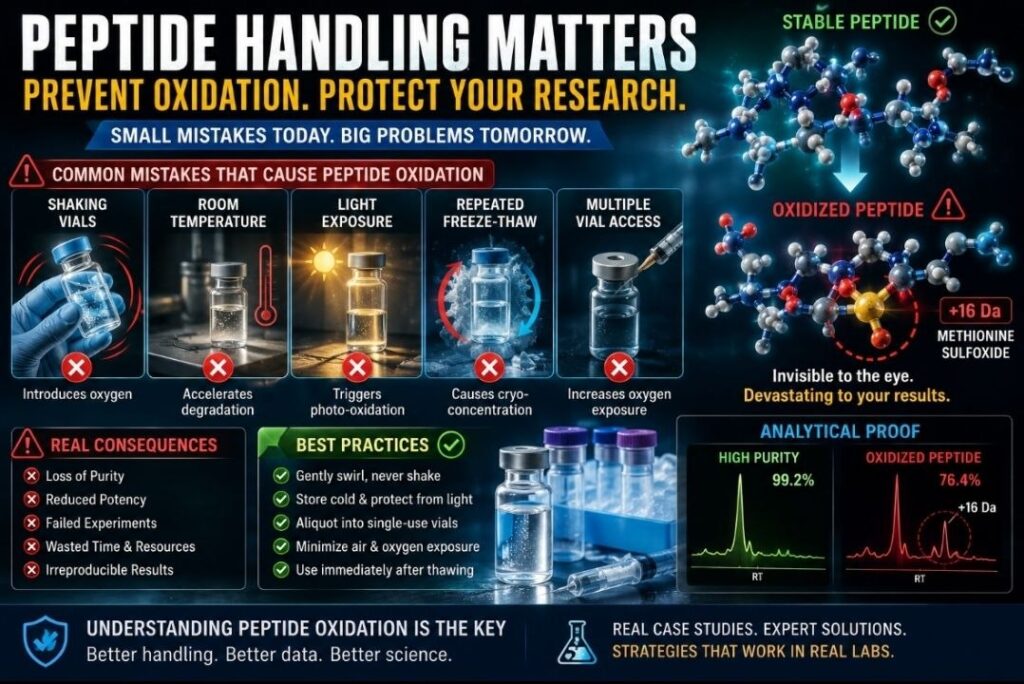
Common Laboratory Mistakes That Accelerate Peptide Oxidation
Over the years, several handling errors have consistently been associated with premature peptide degradation.
1. Repeated Freeze-Thaw Cycles
Every time a peptide solution is thawed and refrozen, its chemical environment changes.
As ice forms, water molecules crystallize first, forcing dissolved oxygen, salts, and peptides into highly concentrated microscopic pockets.
This phenomenon—known as cryo-concentration—accelerates oxidation and may also alter local pH.
After several freeze-thaw cycles, even peptides that initially showed excellent purity can exhibit measurable oxidation and reduced activity.
Best Practice: Immediately divide freshly reconstituted peptides into single-use aliquots. Freeze each aliquot only once and thaw it only when needed.
2. Leaving Peptides at Room Temperature
Temperature has a direct impact on reaction rates.
The longer a peptide remains at room temperature, the greater the opportunity for oxidation and hydrolysis.
Researchers sometimes leave peptide solutions on the laboratory bench while preparing experiments, assuming a short delay is harmless.
Repeated exposure over days or weeks, however, can significantly reduce peptide stability.
Best Practice: Return peptides to their recommended storage temperature immediately after use.
3. Exposure to Light
Many researchers focus on temperature while overlooking another major degradation pathway—photo-oxidation.
Ultraviolet light and even prolonged exposure to fluorescent laboratory lighting can oxidize amino acids such as:
• Tryptophan
• Tyrosine
• Cysteine
Photo-oxidation may lead to structural changes, yellow discoloration, reduced purity, and decreased biological activity.
Best Practice: Store reconstituted peptides in amber vials or wrap containers in aluminum foil to minimize light exposure.
4. Using Improper Reconstitution Solvents
The solvent chosen for reconstitution plays a critical role in peptide stability.
Buffers containing dissolved oxygen or inappropriate pH values can accelerate oxidation.
Researchers working with oxidation-sensitive peptides should always select solvents compatible with the peptide’s chemical properties.
Whenever possible, laboratories reduce dissolved oxygen by degassing reconstitution buffers before use.
5. Poor Vial Handling
Every time a vial is opened, fresh atmospheric oxygen enters the container.
Repeated needle punctures into multi-dose vials also introduce additional oxygen over time.
While these exposures may appear insignificant individually, their cumulative effect can substantially increase oxidation.
Best Practice: Minimize unnecessary vial access and prepare single-use aliquots whenever practical.
Case Study 1: The Failed Quality Control Batch
When a Hidden Excipient Caused an Entire Batch to Fail
One manufacturing facility producing an Interleukin-2 (IL-2) mutein encountered an unexpected quality-control failure.
Routine HPLC analysis showed abnormal impurity peaks.
Follow-up LC-MS analysis revealed a characteristic +16 Da mass increase—clear evidence of methionine oxidation.
Initially, investigators suspected oxygen leakage during manufacturing.
However, the synthesis had been performed under nitrogen-purged conditions.
The source of oxidation was eventually traced to an unexpected culprit:
Polysorbate 80.
Although added to prevent peptide aggregation, the particular batch of Polysorbate 80 had slowly undergone auto-oxidation during storage.
Residual hydroperoxides formed within the excipient.
Once incorporated into the formulation, these peroxides oxidized methionine residues throughout the peptide.
Corrective Actions
The manufacturer implemented several important improvements:
• Purchased Polysorbate 80 in single-use containers.
• Stored excipients under nitrogen or argon.
• Introduced peroxide testing before formulation.
• Tightened supplier qualification procedures.
These changes eliminated recurring oxidation problems and significantly improved batch consistency.
Key Lesson: Sometimes the peptide isn’t the problem—the formulation ingredients are.
Case Study 2: Poor Storage Reduced Biological Activity
Teriparatide Stability Failure
A clinical research site observed an unexpected reduction in the biological activity of Teriparatide (PTH 1–34).
Although analytical testing initially confirmed acceptable purity, biological assays demonstrated reduced receptor activation.
Further LC-MS investigation revealed oxidation of Methionine⁸ and Methionine¹⁸.
The investigation identified several storage problems:
• Refrigerators frequently exceeded recommended temperatures.
• Poor airflow created warm zones.
• Vials were stored in transparent containers.
• Continuous fluorescent lighting promoted photo-oxidation.
The peptide gradually lost activity despite remaining visually unchanged.
Corrective Actions
The facility implemented:
• Strict temperature monitoring.
• Improved refrigerator organization.
• Amber secondary packaging.
• Enhanced staff training on peptide storage.
Following these improvements, peptide stability returned to acceptable levels.
Key Lesson: A peptide can appear perfectly normal while experiencing significant chemical degradation.
Case Study 3: Rewriting Laboratory Procedures Restored Production Yields
A contract research laboratory specializing in custom peptides experienced severe oxidation while synthesizing tryptophan-rich sequences.
Approximately 30% of production yield was consistently lost during the final cleavage stage.
LC-MS identified oxidation products, including:
• Hydroxytryptophan (+16 Da)
• Formylkynurenine (+32 Da)
The investigation revealed several procedural weaknesses:
• Cleavage mixtures were prepared in open laboratory containers.
• Water contained dissolved atmospheric oxygen.
• Oxygen-rich cleavage solutions remained exposed before use.
Rather than changing the peptide sequence, the laboratory completely redesigned its operating procedures.
The New Standard Operating Procedure
The laboratory introduced several process improvements:
Degassed Solvents
All aqueous solutions were sparged with argon before use.
Closed Reaction Systems
Cleavage reactions were transferred into sealed nitrogen-purged vessels.
Improved Scavenger Formulations
The cleavage cocktail was optimized by increasing ethanedithiol (EDT) concentration and incorporating triisopropylsilane (TIS) to rapidly neutralize reactive intermediates.
The Results
The improvements were dramatic.
Oxidation levels fell from approximately 30% to less than 2%.
Production yields increased substantially without modifying peptide design or synthesis chemistry.
This case illustrates an important principle:
Understanding Peptide Oxidation often leads to better laboratory procedures—not simply better analytical testing.
Expert Insight: Why HPLC and LC-MS Remain Essential
At an experienced peptide supplier, visual inspection is never used to assess peptide quality.
A peptide solution may remain:
• Crystal clear
• Colorless
• Sterile
Free of visible particles
…and still contain significant oxidative degradation.
This is why analytical testing remains the gold standard.
Routine quality-control programs commonly include:
• High-Performance Liquid Chromatography (HPLC)
• Liquid Chromatography-Mass Spectrometry (LC-MS)
• Peptide purity analysis
• Stability studies
• Batch consistency testing
These techniques allow scientists to detect oxidation long before visible changes occur.
For researchers, relying on analytical data rather than appearance is one of the most important lessons in Understanding Peptide Oxidation.
The Most Oxidation-Sensitive Peptides, Common Myths, and Expert Prevention Strategies
Understanding Peptide Oxidation Starts with Knowing Which Amino Acids Are Most Vulnerable
Not every peptide has the same level of oxidative stability.
One of the most important aspects of Understanding Peptide Oxidation is recognizing that a peptide’s amino acid sequence largely determines how easily it can degrade. Some peptides remain relatively stable under routine laboratory conditions, while others require exceptionally careful handling from the moment they leave the manufacturer until they are used in research.
The three amino acids that deserve the greatest attention are:
• Methionine (Met)
• Tryptophan (Trp)
• Cysteine (Cys)
Each undergoes oxidation through different chemical pathways and presents unique stability challenges.
1. Methionine (Met): The Chemical Magnet
Among all oxidation-prone amino acids, methionine is often the most problematic.
Its sulfur-containing side chain reacts readily with oxygen, hydrogen peroxide, and other reactive oxygen species.
Unlike some oxidation reactions that depend heavily on pH, methionine oxidation occurs across a broad range of laboratory conditions.
The primary oxidation product is:
Methionine → Methionine Sulfoxide (+16 Da)
With continued oxidation, methionine sulfoxide may further convert into:
Methionine Sulfone (+32 Da)
Although these molecular changes appear small, they can dramatically alter peptide function by affecting receptor binding, structural stability, and biological activity.
Because methionine oxidation is often invisible, laboratories rely on LC-MS to identify these characteristic mass shifts.
Why Methionine Oxidation Matters
Methionine residues frequently participate in maintaining the correct three-dimensional structure of peptides.
Oxidation may result in:
• Reduced receptor affinity
• Lower biological potency
• Altered molecular conformation
• Decreased experimental reproducibility
• Increased batch variability
This explains why methionine-containing peptides demand strict quality control throughout manufacturing, storage, and laboratory handling.
2. Tryptophan (Trp): The Photo-Oxidation Target
Tryptophan contains an electron-rich indole ring that makes it especially vulnerable to ultraviolet light and free-radical attack.
Unlike methionine, which often oxidizes through dissolved oxygen or peroxide exposure, tryptophan degradation is frequently accelerated by light.
Common oxidation products include:
• Hydroxytryptophan (+16 Da)
• Formylkynurenine (+32 Da)
In severe cases, researchers may notice slight yellow discoloration of peptide solutions.
However, most oxidation remains invisible and is detectable only through analytical testing.
Why Laboratories Protect Tryptophan from Light
Many laboratories underestimate the cumulative effects of ordinary lighting.
Prolonged exposure to:
• Sunlight
• UV lamps
• Fluorescent lighting
Bright laboratory benches
can gradually oxidize tryptophan-containing peptides.
This is why experienced laboratories routinely use:
• Amber glass vials
• Opaque storage containers
• Aluminum foil wrapping
• Light-protective secondary packaging
These simple precautions substantially improve peptide stability.
3. Cysteine (Cys): The Structural Challenge
Cysteine behaves differently from methionine and tryptophan.
Instead of simply incorporating oxygen atoms, cysteine frequently forms unwanted disulfide bonds.
When oxidation occurs under uncontrolled conditions, peptides may develop:
• Incorrect disulfide bridges
• Aggregates
• Dimers
• Structural rearrangements
• Reduced biological activity
Peptides containing free cysteine residues therefore require careful control of both oxygen exposure and solution pH.
Maintaining solutions below neutral pH, when appropriate, can reduce unwanted disulfide scrambling.
Research Peptides That Require Extra Care
Certain research peptides are especially susceptible to oxidative degradation because of their amino acid composition.
Examples include:
Teriparatide (PTH 1–34)
This peptide contains two oxidation-sensitive methionine residues.
Oxidation at Met⁸ significantly reduces receptor binding and biological activity.
Oxytocin
Oxytocin contains a critical disulfide bridge formed by two cysteine residues.
Improper handling may disrupt this essential structural feature, resulting in reduced biological function.
Melanotan II and PT-141 (Bremelanotide)
These peptides contain tryptophan residues within their receptor-binding regions.
Light exposure and oxygen can gradually reduce purity and activity.
Triptorelin and Other GnRH Analogs
These peptides contain aromatic amino acids that require careful protection from photo-oxidation during storage and laboratory handling.
Reduced Glutathione (GSH)
Although technically a tripeptide, glutathione remains one of the classic examples of oxidation-sensitive peptides.
Its free sulfhydryl group readily forms oxidized glutathione (GSSG) when exposed to oxygen.
Five Dangerous Myths About Peptide Oxidation
The growing popularity of research peptides has resulted in an explosion of online advice.
Unfortunately, much of it is scientifically inaccurate.
Here are some of the most common misconceptions.
Myth 1: “Shaking a Peptide Breaks the Peptide Bonds”
Reality
Human hands cannot generate enough mechanical force to break covalent peptide bonds.
However, vigorous shaking is still harmful.
Why?
Because it introduces thousands of microscopic air bubbles.
This dramatically increases the air-liquid interface, exposing peptides to much more atmospheric oxygen and accelerating oxidation.
Expert Recommendation
Always dissolve peptides by gently swirling or rolling the vial.
Avoid vigorous shaking whenever possible.
Myth 2: “Bacteriostatic Water Prevents Peptide Degradation”
Reality
Bacteriostatic water contains benzyl alcohol to suppress bacterial growth.
It does not prevent:
• Oxidation
• Hydrolysis
• Photo-degradation
• Chemical instability
A sterile peptide can still oxidize rapidly.
Sterility and chemical stability are entirely different concepts.
Myth 3: “Freezing Liquid Peptides Makes Them Last Forever”
Reality
Repeated freezing and thawing accelerates degradation through cryo-concentration.
Each cycle concentrates dissolved oxygen and alters the local chemical environment.
Over time, this promotes:
• Oxidation
• Aggregation
• Structural instability
Expert Recommendation
Prepare single-use aliquots immediately after reconstitution.
Each aliquot should be frozen once and thawed only once.
Myth 4: “Lyophilized Peptides Last for Years in Any Freezer”
Reality
Many household frost-free freezers periodically warm themselves to remove ice.
These automatic defrost cycles produce repeated temperature fluctuations.
Tiny amounts of condensation may gradually accumulate inside storage containers.
Moisture is one of the primary drivers of peptide degradation.
Expert Recommendation
Whenever possible, store peptides in:
• Manual-defrost laboratory freezers
• Ultra-low temperature freezers
• Moisture-controlled storage containers
• Desiccated secondary packaging
Myth 5: “If the Solution Looks Clear, the Peptide Is Fine”
Reality
This is perhaps the most dangerous misconception.
Methionine oxidation produces no visible color change.
A peptide may lose a substantial percentage of its biological activity while remaining perfectly:
• Clear
• Colorless
• Transparent
The only reliable way to confirm peptide integrity is through analytical testing using HPLC and LC-MS.
Professional Strategies Used by Experienced Peptide Suppliers
Years of peptide manufacturing have demonstrated that preventing oxidation requires attention to every stage of the product lifecycle.
Professional peptide suppliers typically employ several complementary strategies.
Advanced Packaging
High-quality peptide manufacturers often package peptides in oxygen-limiting containers designed to reduce environmental exposure.
Cold-Chain Shipping
Temperature-controlled logistics help minimize degradation during transportation.
Reliable cold-chain management remains one of the most effective methods for preserving peptide stability.
Optimized Lyophilization
Carefully validated freeze-drying cycles reduce residual moisture while preserving peptide structure.
Antioxidant Precautions
Manufacturers frequently incorporate optimized scavenger systems during synthesis and cleavage to reduce oxidation before purification.
High Purity Standards
Every production batch should undergo rigorous analytical verification before release.
Stability Testing
Long-term and accelerated stability studies help identify degradation pathways before products reach researchers.
Comprehensive Quality Assurance
Experienced peptide suppliers rely on integrated quality systems combining:
•HPLC purity analysis
• LC-MS identity confirmation
• Stability monitoring
• Environmental controls
• Batch documentation
• Supplier qualification
• Packaging validation
Together, these practices significantly reduce the likelihood of oxidation-related quality issues.
The Ultimate Peptide Stability Protocol, Frequently Asked Questions, and Final Expert Recommendations
The Ultimate Peptide Stability Protocol
\A Professional Laboratory SOP for Understanding Peptide Oxidation
If researchers remember only one section of this guide on Understanding Peptide Oxidation, it should be this protocol.
Years of peptide manufacturing, quality assurance, stability testing, and analytical chemistry have demonstrated that oxidation is largely preventable when proper laboratory procedures are followed consistently.
The following Standard Operating Procedure (SOP) summarizes the best practices used by experienced peptide manufacturers and research laboratories to maximize peptide stability and minimize oxidative degradation.
Step 1: Before Opening the Peptide Vial
Proper handling begins before the vial is opened.
✔ Allow Frozen Vials to Reach Room Temperature
Never remove a peptide from the freezer and immediately puncture the stopper.
Allow the sealed vial to equilibrate to room temperature for approximately 20–30 minutes.
Opening a cold vial immediately can cause atmospheric moisture to condense inside the container, introducing water that promotes both oxidation and hydrolysis.
✔ Protect Against Moisture
Whenever possible:
• Keep lyophilized peptides in their original sealed containers.
• Store with desiccants when appropriate.
• Minimize unnecessary exposure to humid laboratory environments.
Moisture is one of the greatest long-term threats to peptide stability.
Step 2: Reconstitution Best Practices
Proper reconstitution has a significant impact on peptide longevity.
✔ Use High-Quality Reconstitution Solutions
Whenever appropriate for your research protocol:
• Use freshly prepared buffers.
• Avoid contaminated solvents.
• Minimize dissolved oxygen whenever practical.
Many advanced laboratories degas aqueous solutions before reconstitution to reduce oxidative stress.
✔ Avoid Foam Formation
Never shake peptide solutions vigorously.
Instead:
Gently swirl the vial.
Roll it slowly between your hands.
Allow the peptide to dissolve naturally.
Reducing foam minimizes the air-liquid interface, where oxidation occurs most rapidly.
✔ Select an Appropriate pH
For peptides containing free cysteine residues, avoid unnecessarily alkaline conditions unless required by your experimental protocol.
Maintaining appropriate pH helps reduce unwanted oxidation and disulfide scrambling.
Step 3: Storage Best Practices
Proper storage dramatically extends peptide stability.
✔ Store Lyophilized Peptides Correctly
General laboratory recommendations include:
• Short-term storage: 2–8°C when appropriate.
• Long-term storage: −20°C or below for many research peptides.
• Ultra-long-term storage: −80°C when required for highly sensitive materials.
Always follow the manufacturer’s storage recommendations for the specific peptide.
✔ Minimize Oxygen Exposure
Professional peptide manufacturers often reduce oxygen exposure by:
• Nitrogen backfilling
• Argon backfilling
• Oxygen-limiting packaging
• Proper vial sealing
Once the vial reaches the laboratory, researchers should continue minimizing unnecessary exposure to air.
✔ Protect from Light
Store peptides in:
• Amber glass vials
• Opaque storage containers
• Aluminum foil wrapping when necessary
Light protection is especially important for peptides containing tryptophan or tyrosine residues.
Step 4: Aliquoting
Aliquoting is one of the simplest and most effective methods for preserving peptide quality.
Immediately after reconstitution:
• Divide the solution into single-use aliquots.
• Label each aliquot clearly.
• Freeze only the aliquots that will not be used immediately.
Each aliquot should ideally experience only one freeze-thaw cycle.
This simple practice significantly reduces oxidation and aggregation.
Step 5: Monitor Stability
Experienced laboratories never assume stability.
Instead, they verify it.
Routine analytical testing may include:
• High-Performance Liquid Chromatography (HPLC)
• Liquid Chromatography-Mass Spectrometry (LC-MS)
• Peptide purity analysis
• Stability studies
• Batch comparison testing
Analytical verification remains the most reliable method for detecting oxidation before it affects research results.
The Golden Rules of Understanding Peptide Oxidation
Remember these five principles whenever handling research peptides:
Rule 1: Dry peptides are generally more stable than reconstituted solutions.
Rule 2: Sterility does not equal chemical stability.
Rule 3: Oxygen, moisture, heat, and light work together to accelerate degradation.
Rule 4: Freeze-thaw cycles are among the most common avoidable causes of peptide oxidation.
Rule 5: Trust analytical data—not visual appearance.
Frequently Asked Questions (FAQ)
What is peptide oxidation?
Peptide oxidation is a chemical process in which reactive oxygen species or other oxidizing agents modify susceptible amino acids such as methionine, tryptophan, or cysteine. These changes can reduce peptide stability, purity, and biological activity.
Which amino acids are most susceptible to peptide oxidation?
Methionine, tryptophan, and cysteine are generally the most oxidation-sensitive amino acids because of their sulfur-containing or electron-rich side chains.
How can peptide oxidation be detected?
The most reliable analytical methods include:
• HPLC
• LC-MS
• Stability studies
• Peptide purity analysis
Mass shifts such as +16 Da and +32 Da are common indicators of oxidation.
Can oxidation occur in lyophilized peptides?
Yes.
Although lyophilization greatly improves stability, oxidation may still occur if peptides are exposed to moisture, oxygen, improper storage temperatures, or unstable excipients.
Does bacteriostatic water prevent oxidation?
No.
Bacteriostatic water helps inhibit microbial growth but does not prevent chemical oxidation or hydrolysis.
Why are freeze-thaw cycles harmful?
Repeated freezing and thawing concentrates dissolved oxygen and alters the local chemical environment, increasing the risk of oxidation, aggregation, and structural degradation.
Can I identify oxidation by looking at the peptide solution?
Not reliably.
Many oxidized peptides remain completely clear and colorless.
Analytical testing is the only dependable method for confirming peptide integrity.
How do experienced peptide suppliers reduce oxidation?
Professional manufacturers use a combination of:
• Optimized peptide synthesis
• Controlled cleavage procedures
• Degassed solvents
• Rigorous HPLC and LC-MS testing
• Validated lyophilization cycles
• Oxygen-limiting packaging
• Cold-chain shipping
• Long-term stability studies
• Comprehensive quality assurance systems
Final Thoughts on Understanding Peptide Oxidation
Understanding Peptide Oxidation is one of the most valuable skills a researcher can develop. Oxidation is rarely caused by a single mistake. Instead, it is often the cumulative result of small exposures to oxygen, moisture, heat, light, and improper handling throughout a peptide’s lifecycle.
The good news is that most oxidation-related problems are preventable. By applying proper manufacturing controls, selecting high-quality peptides, following recommended storage and reconstitution practices, minimizing freeze-thaw cycles, and verifying quality through HPLC and LC-MS analysis, researchers can significantly improve peptide stability and experimental reliability.
Ultimately, preserving peptide integrity is not just about extending shelf life—it is about protecting the accuracy, reproducibility, and value of scientific research.
Read Related Article Below to Boost Your Knowledge About Peptide
Light Exposure vs Peptide Stability: 9 Powerful Truths to Prevent Costly Research Failures
Peptide Purity Above 99% isn’t always the best choice for peptide research.
Understanding Peptide Hydrophobicity: 9 Powerful Insights That Prevent Costly Research Failures.
The Role of pH in Peptide Solubility:
Understanding Syringe Units for Peptide Research Calculations
How Laboratories Test Peptide Identity: 6 Powerful Methods That Protect You From Costly Mistakes
Why Quality Matters
At Peptide Amino Nation, we understand that successful peptide research starts with uncompromising quality. Every research peptide should be sourced from a supplier that prioritizes rigorous manufacturing standards, analytical testing, stability monitoring, and reliable cold-chain handling.
Whether you are conducting receptor studies, pharmacological research, molecular biology experiments, or peptide characterization, choosing high-quality research peptides can help reduce avoidable degradation and improve experimental consistency.
Visit https://peptideaminonation.com to explore our growing collection of premium research-use peptides, educational resources, and expert guidance designed to support laboratories and researchers committed to excellence.
Key Takeaway
If you remember only one lesson from this guide on Understanding Peptide Oxidation, let it be this:
Sterility does not equal stability. A peptide can remain perfectly sterile, crystal clear, and visually unchanged, while invisible oxidation silently reduces its purity and biological activity. The best defense against peptide oxidation is to minimize oxygen and moisture exposure at every stage—from manufacturing and shipping to storage, reconstitution, and laboratory handling. Following these principles will help protect your peptides and produce more reliable, reproducible research outcomes.
