Understanding Syringe Units for Peptide Research Calculations: 7 Powerful Mistakes That Can Ruin Your Results

If you’re struggling with understanding syringe units for peptide research calculations, you’re not alone.
After helping more than 10,000 researchers, peptide buyers, laboratory professionals, and peptide enthusiasts since 2003, I’ve discovered that one of the most common causes of peptide calculation errors is misunderstanding syringe units.
Many researchers mistakenly believe syringe units represent a fixed amount of peptide. Others confuse milligrams (mg), micrograms (mcg), milliliters (mL), and insulin syringe units. These mistakes can lead to inaccurate dosing, wasted peptide material, failed research protocols, and unreliable data.
The good news is that understanding syringe units for peptide research calculations is much easier once you understand the relationship between concentration, volume, and syringe calibration.
In this guide, you’ll learn exactly how syringe units work, how to calculate them correctly, and how to avoid the most common mistakes that researchers make when working with peptides such as BPC-157, TB-500, CJC-1295, Ipamorelin, Tirzepatide, Semaglutide, and Retatrutide.
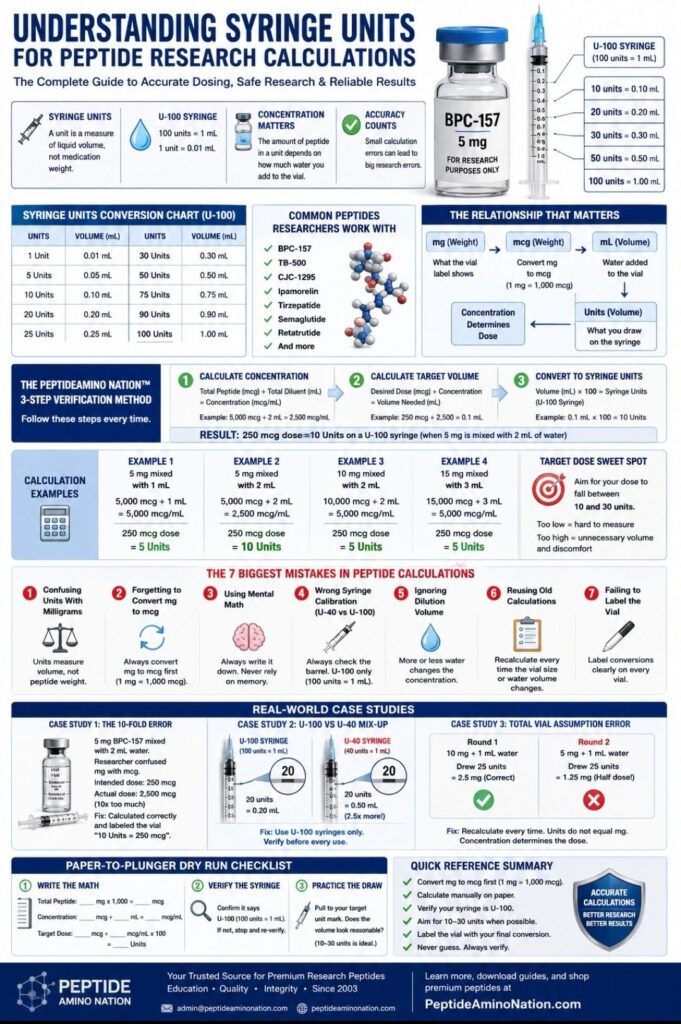
Table of Contents
1. What Are Syringe Units?
2. Why Understanding Syringe Units for Peptide Research Calculations Matters
3. U-100 Syringes Explained
4. Syringe Units Conversion Chart
5. The Relationship Between mg, mcg, mL, and Units
6. The PeptideAmino Nation
3-Step Verification Method
7. Real Calculation Examples
8. The 7 Biggest Syringe Calculation Mistakes
9. Real-World Case Studies
10. Frequently Asked Questions
11. The Paper-to-Plunger Dry Run
12 Conclusion
What Are Syringe Units?
https://pubmed.ncbi.nlm.nih.gov/
The first step in understanding syringe units for peptide research calculations is understanding what a syringe unit actually represents.
A syringe unit is not a measurement of peptide weight.
A syringe unit is a measurement of liquid volume.
On a standard U-100 insulin syringe:
• 100 units = 1 mL
• 50 units = 0.5 mL
• 25 units = 0.25 mL
• 10 units = 0.1 mL
• 1 unit = 0.01 mL
This distinction is critical.
A syringe unit tells you how much liquid is being drawn into the syringe—not how much peptide is contained within that liquid.
The amount of peptide delivered depends entirely on the concentration of the solution inside the vial.
Why Understanding Syringe Units for Peptide Research Calculations Matters
Proper understanding syringe units for peptide research calculations directly impact research accuracy.
Over the years, I have reviewed countless peptide calculation mistakes involving:
• BPC-157
• TB-500
• CJC-1295
• Ipamorelin
• Tirzepatide
• Semaglutide
• Retatrutide
In nearly every case, the error wasn’t advanced mathematics.
The problem was misunderstanding concentration.
Researchers often assume:
• 10 units always equals a specific dose.
• The same syringe calculation works for every vial.
• Changing the amount of bacteriostatic water doesn’t affect calculations.
•Syringe units equal milligrams.
None of these assumptions are correct.
Understanding concentration eliminates these mistakes.
Understanding U-100 Syringes
Most peptide researchers use U-100 insulin syringes.
The “U-100” designation means:
100 units = 1 mL
Because of their precision, U-100 syringes are ideal for measuring small liquid volumes commonly used in peptide research.
Why U-100 Syringes Are Popular
U-100 syringes offer:
• Accurate measurement
• Easy readability
• Consistent calculations
• Wide availability
However, problems occur when researchers accidentally use U-40 syringes.
A U-40 syringe follows a completely different calibration system.
This mistake has caused countless dosing errors in peptide research environments.
Always verify the syringe barrel before performing calculations.
Syringe Units Conversion Chart
| Syringe Units | Volume (ml) |
| 1 Unit | 0.01 ml |
| 5 Units | 0.05 ml |
| 10 Units | 0.10 ml |
| 20 Units | 0.20 ml |
| 25 Units | 0.25 ml |
| 30 Units | 0.30 ml |
| 50 Units | 0.50 ml |
| 100 Units | 1.00 ml |
Bookmark this chart because it simplifies understanding syringe units for peptide research calculations significantly.
The Relationship Between mg, mcg, mL, and Units
Many beginners struggle because they are dealing with four different measurements simultaneously.
Milligrams (mg)
Milligrams represent peptide weight.
Examples:
• 5 mg vial
• 10 mg vial
• 15 mg vial
Micrograms (mcg)
Micrograms are smaller weight measurements.
Conversion:
1 mg = 1,000 mcg
Examples:
• 5 mg = 5,000 mcg
• 10 mg = 10,000 mcg
• 15 mg = 15,000 mcg
Milliliters (mL)
Milliliters measure liquid volume.
This is the amount of bacteriostatic water added to the vial.
Syringe Units
Units measure liquid volume on a U-100 syringe.
Remember:
1 Unit = 0.01 mL
Once researchers understand these four measurements, peptide calculations become dramatically easier.
The PeptideAmino Nation 3-Step Verification Method
After helping more than 10,000 researchers, I’ve found that virtually every successful calculation follows the same three-step process.
Step 1: Calculate Concentration
Total Peptide ÷ Total Diluent = Concentration
Example:
5,000 mcg ÷ 2 mL = 2,500 mcg/mL
Step 2: Calculate Target Volume
Desired Dose ÷ Concentration = Volume Required
Example:
250 mcg ÷ 2,500 mcg/mL = 0.1 mL
Step 3: Convert to Syringe Units
Volume × 100 = Syringe Units
Example:
0.1 mL × 100 = 10 Units
Result:
250 mcg = 10 Units
This simple framework removes guesswork from peptide calculations.
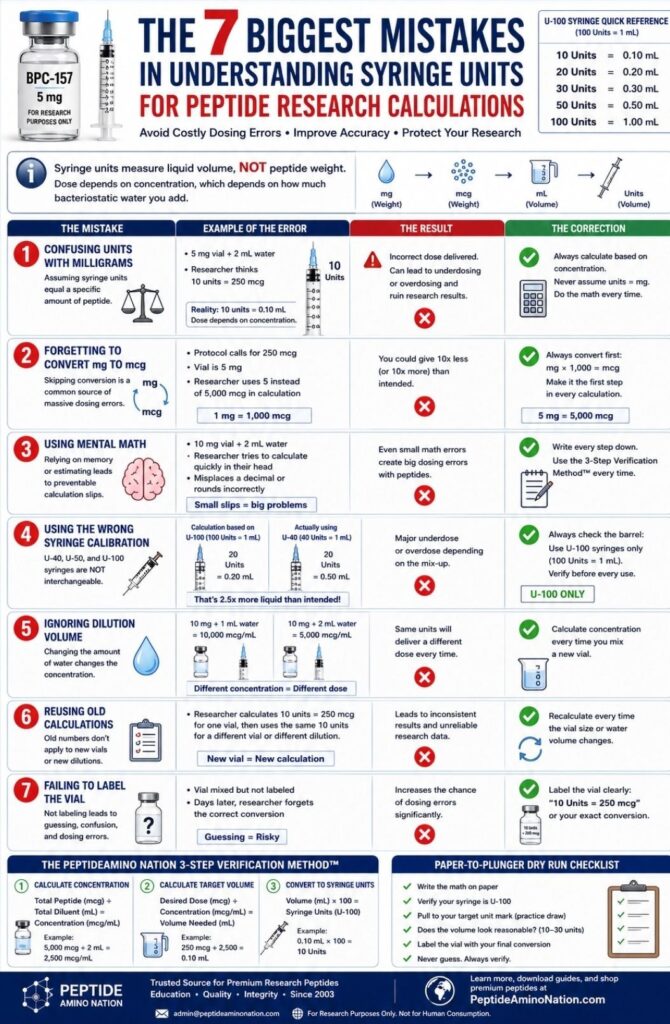
The 7 Biggest Mistakes in Understanding Syringe Units for Peptide Research Calculations
Even experienced researchers can make mistakes when working with peptide calculations. After helping more than 10,000 researchers since 2003, I’ve found that the majority of errors fall into seven categories.
1. Confusing Syringe Units With Milligrams
This is the most common mistake in peptide research.
Many people assume that 10 units automatically equals a specific number of milligrams.
It does not.
Ten units only represents 0.1 mL of liquid.
The actual peptide amount depends entirely on the concentration of the solution.
2. Forgetting to Convert mg to mcg
Many peptide protocols use micrograms, while peptide vials are labeled in milligrams.
Always remember:
• 1 mg = 1,000 mcg
• 5 mg = 5,000 mcg
• 10 mg = 10,000 mcg
• 15 mg = 15,000 mcg
Converting first prevents decimal-point mistakes.
3. Using Mental Math
One of the fastest ways to make a dosing error is relying on memory.
Always write calculations down.
Even experienced researchers can make mistakes when tired, distracted, or rushing.
4. Assuming Every Syringe Uses the Same Calibration
Not every insulin syringe is U-100.
Using U-40 calculations on a U-100 syringe—or vice versa—can create major dosing errors.
Always inspect the barrel before drawing any solution.
5. Ignoring Dilution Volume
The amount of bacteriostatic water added directly affects concentration.
A 10 mg vial mixed with 1 mL is not the same concentration as a 10 mg vial mixed with 2 mL.
The peptide amount remains the same.
The concentration changes.
6. Reusing Old Calculations
Many researchers calculate one vial correctly and then assume future vials will use the same numbers.
This is dangerous.
Every time the vial size or dilution volume changes, calculations must be redone.
7. Failing to Label the Vial
One simple habit can prevent countless errors.
Write the final conversion directly on the vial:
“10 Units = 250 mcg”
This eliminates guesswork later.
Real-World Case Study #1: The 10-Fold Microgram vs. Milligram Error
One independent researcher was working with BPC-157.
The protocol required a daily dose of 250 mcg.
A 5 mg vial was reconstituted with 2 mL of bacteriostatic water.
The researcher quickly calculated:
5 mg ÷ 2 mL = 2.5 mg/mL
Unfortunately, they confused milligrams and micrograms.
Looking at the syringe, they assumed 10 units would equal 250 mcg.
The actual amount delivered was approximately 2,500 mcg.
The research subject received ten times the intended dose.
What Went Wrong?
The researcher guessed.
They never completed the concentration-to-volume conversion.
The Solution
The vial was labeled:
“10 Units = 250 mcg”
This eliminated future confusion.
Lesson Learned
Never estimate peptide calculations.
Always calculate them.
Real-World Case Study #2: The U-100 vs. U-40 Syringe Mix-Up
A laboratory assistant was following a GHRP-6 research protocol.
The calculations were based on a U-100 insulin syringe.
Unfortunately, U-40 syringes had been mistakenly purchased.
The assistant drew to the 20-unit mark, assuming all syringes measured volume the same way.
They do not.
The Result
20 units on a U-100 syringe equals:
0.2 mL
20 units on a U-40 syringe equals:
0.5 mL
The subject received approximately 2.5 times the intended amount.
The Fix
The laboratory removed all U-40 syringes from inventory.
Researchers were instructed to verify syringe calibration before every protocol.
Lesson Learned
A syringe is not just a syringe.
Calibration matters.
Real-World Case Study #3: The Total Vial Assumption Error
A staff member was preparing Tirzepatide for a research protocol.
The first vial contained:
• 10 mg peptide
• 1 mL bacteriostatic water
Drawing 25 units correctly delivered 2.5 mg.
Later, a 5 mg vial was prepared using the same volume of water.
The staff member repeated the exact same draw:
25 units
This time, the concentration was different.
The result was only 1.25 mg.
The study’s data became inconsistent.
The Investigation
The researcher had unknowingly treated syringe units as fixed peptide amounts.
They ignored concentration.
Lesson Learned
Syringe units never determine dose.
Concentration determines dose.
Practical Peptide Calculation Examples
Example 1: 5 mg Mixed With 1 mL
5 mg = 5,000 mcg
5,000 mcg ÷ 1 mL = 5,000 mcg/mL
250 mcg dose:
250 ÷ 5,000 = 0.05 mL
0.05 mL × 100 = 5 Units
Result:
250 mcg = 5 Units
Example 2: 5 mg Mixed With 2 mL
5,000 mcg ÷ 2 mL = 2,500 mcg/mL
250 mcg dose:
250 ÷ 2,500 = 0.1 mL
0.1 mL × 100 = 10 Units
Result:
250 mcg = 10 Units
Example 3: 10 mg Mixed With 2 mL
10,000 mcg ÷ 2 mL = 5,000 mcg/mL
250 mcg dose:
250 ÷ 5,000 = 0.05 mL
0.05 mL × 100 = 5 Units
Result:
250 mcg = 5 Units
Example 4: 15 mg Mixed With 3 mL
15,000 mcg ÷ 3 mL = 5,000 mcg/mL
250 mcg dose:
250 ÷ 5,000 = 0.05 mL
0.05 mL × 100 = 5 Units
Result:
250 mcg = 5 Units
Basics topics to learn in the peptide industry
- Common Storage Mistakes That Reduce Peptide Quality
- Why Different Peptides Have Different Shelf Lives
- Why Peptide HPLC Purity and Biological Activity Are Different: 7 Powerful Truths That Can Save Your Research
- Why Research Peptides Results Differ Between Laboratories
- How Humidity Affects Lyophilized Peptides: 10 Critical Risks That Can Secretly Destroy Peptide Stability
Frequently Asked Questions About Understanding Syringe Units for Peptide Research Calculations
How Many Milligrams Are in One Syringe Unit?
There is no universal answer.
A syringe unit measures liquid volume, not peptide weight.
The amount depends on concentration.
Does the Amount of Bacteriostatic Water Matter?
Yes.
The total amount of peptide remains unchanged, but the concentration changes.
Different concentrations create different syringe calculations.
Can I Trust Online Peptide Calculators?
Calculators are useful for verification.
However, you should always understand the underlying math and manually confirm your input.
Why Do Most Researchers Use U-100 Syringes?
U-100 syringes provide precise measurements and are widely used for peptide research calculations.
What Is the Safest Way to Prevent Calculation Errors?
Follow the PeptideAmino Nation 3-Step Verification Method and label every vial after calculating your dosage.
The Paper-to-Plunger Dry Run
Before beginning any peptide protocol, perform this simple safety exercise.
Step 1: Write the Math
Total Peptide:
_ mg × 1,000 = _ mcg
Concentration:
_ mcg ÷ _ mL = _ mcg/mL
Target Dose:
_ mcg ÷ _ mcg/mL × 100 = _ Units
Step 2: Verify the Syringe
Check the barrel.
Confirm it says:
U-100
If it doesn’t, stop and verify your calculations.
Step 3: Practice the Draw
Without drawing liquid, pull the plunger back to the target mark.
Ask yourself:
Does this volume look reasonable?
Most peptide protocols typically fall between 10 and 30 units.
If the draw is extremely tiny or unusually large, review your calculations.
CONCLUSION
Understanding Syringe Units for Peptide Research Calculations is one of the most valuable skills any peptide researcher can master. Whether you’re working with BPC-157, TB-500, CJC-1295, Ipamorelin, Tirzepatide, Semaglutide, Retatrutide, or other research peptides, a solid understanding of syringe measurements can significantly improve dosing accuracy and research consistency.
After helping more than 10,000 researchers, laboratory professionals, and peptide enthusiasts since 2003, I’ve found that the biggest mistakes rarely come from complex mathematics. Instead, they happen when researchers overlook the fundamentals of understanding syringe units for peptide research calculations, concentration, dilution, and syringe calibration.
Before every protocol, remember these essential principles:
– Syringe units measure liquid volume, not peptide weight.
– Concentration always determines the actual dose.
– Convert milligrams (mg) to micrograms (mcg) before performing calculations.
– Verify that your syringe is a U-100 syringe.
– Never rely exclusively on mental math.
– Label every vial with its correct dosage conversion.
Mastering understanding syringe units for peptide research calculations helps reduce preventable errors, protects valuable research materials, and improves the reliability of your experimental outcomes. A few extra minutes spent verifying your calculations today can save days or weeks of troubleshooting later.
If you’re looking to deepen your knowledge of understanding syringe units for peptide research calculations, peptide reconstitution methods, laboratory testing, Certificates of Analysis (CoAs), peptide purity reports, and advanced research protocols, visit peptitdeaminonation.com for expert educational resources and practical research guides.
Ultimately, successful peptide research isn’t about guessing—it’s about precision. The most accurate result comes from understanding syringe units for peptide research calculations and verifying every calculation before the plunger ever moves.
