Light Exposure vs Peptide Stability: 9 Powerful Truths to Prevent Costly Research Failures

Every researcher expects a research-grade peptide to perform according to its Certificate of Analysis (CoA). Yet, countless experiments fail—not because the peptide was poorly synthesized, but because it was unintentionally damaged after the vial was opened.
As an experienced peptide supplier supporting researchers for many years, I’ve found that Light Exposure vs Peptide Stability is one of the most misunderstood topics in peptide research. Many researchers focus heavily on purity percentages while overlooking how routine laboratory lighting, improper storage, and unnecessary handling can silently compromise peptide integrity.
In many investigations, what initially appeared to be a manufacturing defect was ultimately traced back to environmental handling. Light exposure, particularly after reconstitution, has repeatedly proven to be an overlooked factor affecting peptide stability, reproducibility, and experimental reliability.
Understanding Light Exposure vs Peptide Stability isn’t simply about following storage recommendations. It’s about protecting months of research, preserving valuable reagents, and ensuring every experiment begins with the highest possible peptide integrity.
This guide explains the science behind light-induced peptide degradation, identifies which peptide structures are most vulnerable, dispels common misconceptions, and shares practical recommendations drawn from real-world experience supporting research laboratories.
Table of Contents
1. What Does Light Exposure vs Peptide Stability Really Mean?
2. Why Light Causes Peptide Degradation
3. The Molecular Science Behind Photodegradation
4. Which Amino Acids Are Most Vulnerable to Light?
5. Why Some Peptides Degrade Faster Than Others
6. Expert Insight from Years Supporting Researchers
7. Case Studies from Real Research Laboratories
8. Common Myths About Light Exposure
9. Building a Professional 10 Dark-Chain Workflow
11. Frequently Asked Questions
12. Conclusion
What Does Light Exposure vs Peptide Stability Really Mean? https://pubmed.ncbi.nlm.nih.gov/
When discussing Light Exposure vs Peptide Stability, we’re examining how different wavelengths of light influence the chemical and structural integrity of peptide molecules over time.
Unlike many small-molecule compounds, peptides are complex chains of amino acids whose biological activity depends on maintaining their precise molecular structure. Even subtle chemical modifications can reduce binding affinity, alter folding behavior, or render a peptide unsuitable for research applications.
Light is a form of energy. When high-energy photons strike susceptible amino acid residues, they can initiate photochemical reactions that permanently alter the peptide.
These reactions may include:
• Photo-oxidation
• Radical formation
• Cross-linking
• Side-chain oxidation
• Bond cleavage
• Structural rearrangement
Many of these changes are invisible to the naked eye. A peptide solution may remain perfectly clear while its biological activity steadily declines.
This is precisely why understanding Light Exposure vs Peptide Stability is essential for producing reliable and reproducible research data.
Why Light Causes Peptide Degradation
https://peptideaminonation.com/how-humidity-affects-lyophilized-peptides/
Many researchers assume that room lighting is harmless because peptide degradation isn’t immediately visible.
Unfortunately, photochemical damage begins long before obvious changes appear.
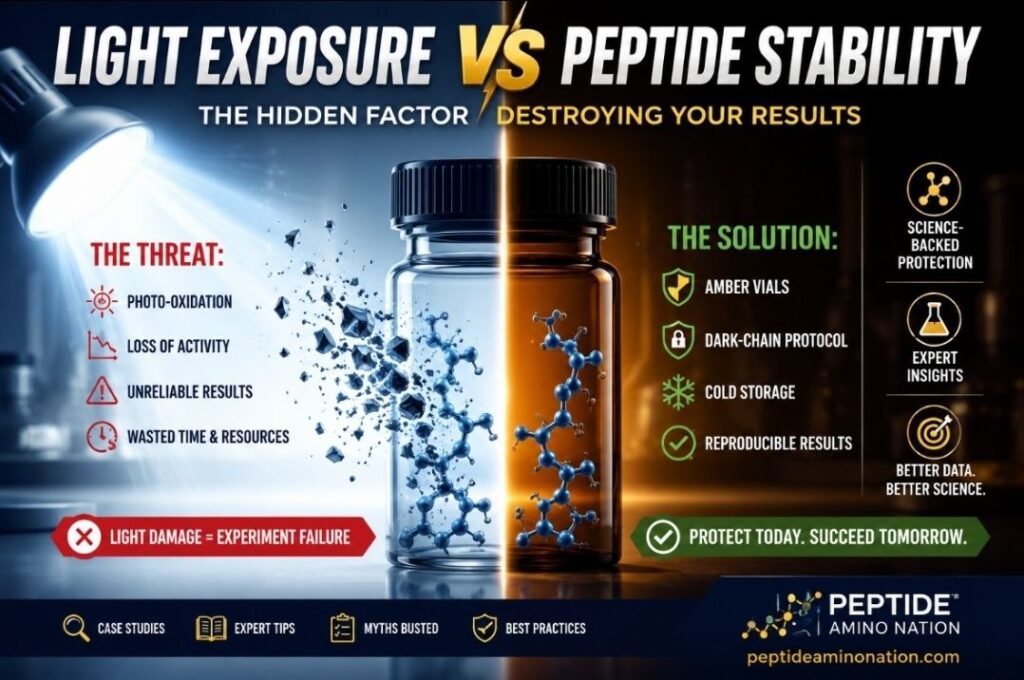
Certain wavelengths—especially ultraviolet (UV) and high-energy blue light—contain enough energy to excite electrons within sensitive amino acid residues.
Once these electrons absorb light energy, they transition into unstable excited states.
These excited molecules may then:
• React directly with oxygen
• Produce reactive oxygen species (ROS)
• Generate free radicals
• Attack neighboring amino acids
• Trigger chain reactions throughout the peptide
This process is known as photo-oxidation, one of the most significant mechanisms influencing Light Exposure vs Peptide Stability.
Unlike thermal degradation, photochemical reactions can begin almost instantly after sufficient light exposure.
Even when peptides are refrigerated, repeated exposure to laboratory lighting during handling can gradually reduce structural integrity.
The Molecular Science Behind Photodegradation
Understanding the chemistry helps explain why peptide storage recommendations are so important.
Photodegradation generally follows four stages.
Stage 1: Photon Absorption
Aromatic amino acids absorb UV and short-wavelength visible light.
This excites their electrons into higher-energy states.
Stage 2: Excited-State Formation
The excited molecule becomes highly reactive.
Instead of returning safely to its original state, it may transfer energy to surrounding oxygen molecules.
Stage 3: Reactive Oxygen Species Formation
This energy transfer produces highly reactive oxygen species, including:
• Singlet oxygen
• Superoxide radicals
• Hydroxyl radicals
These oxidizing molecules rapidly attack peptide bonds and amino acid side chains.
Stage 4: Structural Damage
As oxidation progresses, researchers may observe:
• Reduced biological activity
• Lower receptor binding
• Altered chromatographic profiles
• Additional impurity peaks during HPLC analysis
• Changes in molecular weight detected by mass spectrometry
At this stage, the peptide may still appear visually unchanged, yet its research performance can be significantly compromised.
This is why experienced laboratories don’t rely solely on appearance when evaluating Light Exposure vs Peptide Stability.
Which Amino Acids Are Most Vulnerable to Light?
Not every peptide responds to light in the same way.
A peptide’s susceptibility depends largely on its amino acid composition.
Some residues naturally absorb light more efficiently, making them far more vulnerable to photo-induced reactions.
Tryptophan (Trp)
Tryptophan is among the most light-sensitive amino acids.
After absorbing UV light, it readily forms reactive intermediates that can oxidize into compounds such as kynurenine derivatives.
Even limited exposure may reduce peptide functionality.
Tyrosine (Tyr)
Tyrosine can undergo photo-oxidation, producing reactive radicals.
These radicals may combine to form dityrosine cross-links that alter the peptide’s natural structure and biological behavior.
Methionine (Met)
Methionine is highly susceptible to oxidation by reactive oxygen species generated during light exposure.
Oxidation converts methionine into methionine sulfoxide, which may significantly affect peptide activity.
Cysteine (Cys)
Cysteine residues are especially vulnerable because reactive oxygen species can promote unintended disulfide bond formation.
Improper disulfide pairing may dramatically alter peptide folding and stability.
Phenylalanine (Phe)
Although less reactive than tryptophan or tyrosine, phenylalanine can still participate in photochemical reactions under prolonged exposure to UV or intense blue light.
Why Some Peptides Degrade Faster Than Others
One question I hear frequently is:
“If two peptides are stored under identical conditions, why does one lose activity while the other remains stable?”
The answer lies in molecular structure.
Several factors influence Light Exposure vs Peptide Stability, including:
• Amino acid composition
• Peptide length
• Three-dimensional conformation
• Presence of fluorophores or chromophores
• Buffer composition
• Oxygen availability
• Storage temperature
• Light intensity and exposure duration
For example, peptides containing multiple aromatic residues—such as Tryptophan and Tyrosine—are generally more susceptible to photochemical damage than sequences lacking these residues.
Similarly, peptide conjugates carrying fluorescent labels can be even more vulnerable because the fluorophore itself may act as a photosensitizer, accelerating oxidation under laboratory lighting.
Expert Insight from Years Supporting Researchers
After supporting thousands of researchers, one lesson has become remarkably clear:
Most perceived peptide failures are not caused by synthesis quality. They are caused by what happens after the vial is opened.
Researchers often concentrate on purity percentages while unintentionally overlooking environmental factors such as light, temperature, oxygen, moisture, pH, and reconstitution technique.
A peptide that leaves the manufacturer with exceptional purity can still lose significant biological performance if it is repeatedly exposed to bright laboratory lighting, stored in clear containers, or handled without appropriate protection.
Understanding Light Exposure vs Peptide Stability is therefore not just about preserving a molecule—it’s about protecting the reliability, reproducibility, and scientific value of every experiment.
Light Exposure vs Peptide Stability: Why Some Peptides Degrade Faster Than Others
https://pubmed.ncbi.nlm.nih.gov/
One of the most common questions researchers ask is:
“If all peptides are stored under the same conditions, why do some remain stable while others lose activity?”
The answer lies in peptide chemistry.
Every peptide has a unique amino acid sequence, molecular conformation, and physicochemical profile. These characteristics determine how susceptible it is to Light Exposure vs Peptide Stability challenges.
Several factors influence how quickly a peptide undergoes light-induced degradation:
• Amino acid composition
• Aromatic residue content
• Presence of sulfur-containing amino acids
• Peptide folding and tertiary structure
• Conjugated fluorophores or dyes
• Oxygen concentration
• Storage buffer composition
• Light intensity
• Duration of exposure
Peptides containing multiple light-sensitive amino acids such as Tryptophan, Tyrosine, Methionine, or Cysteine generally require greater protection than simpler sequences.
One peptide that deserves particular attention is GHK-Cu.
Because of its copper complex, GHK-Cu is especially sensitive to environmental conditions. Improper exposure to light may accelerate oxidation reactions, potentially affecting structural integrity and experimental reproducibility. For this reason, experienced laboratories routinely protect GHK-Cu using amber containers and minimal light exposure throughout storage and handling.
Understanding these molecular differences is a critical part of managing Light Exposure vs Peptide Stability effectively.
Case Study #1: When “Low Purity” Was Actually Light Damage
Over the years, I have learned that researchers are often quick to suspect manufacturing defects whenever experimental results become inconsistent.
One memorable case perfectly illustrates why understanding Light Exposure vs Peptide Stability is so important.
The Situation
A research laboratory contacted us regarding an antimicrobial peptide containing multiple aromatic amino acids, including Tryptophan and Tyrosine.
Their assays suddenly showed:
• Reduced biological activity
• Unexpected HPLC impurity peaks
• Lower binding affinity
• Mass spectrometry profiles inconsistent with the Certificate of Analysis
The research team believed the peptide had arrived degraded.
Our Investigation
Instead of immediately assuming a manufacturing issue, our technical team reviewed the laboratory’s handling procedures.
The Certificate of Analysis still showed excellent purity.
Retained samples from the same production batch were analyzed again using HPLC and mass spectrometry.
The retained samples remained fully compliant with their original specifications.
This strongly suggested the degradation occurred after delivery.
Discovering the Real Cause
During our technical consultation, one detail immediately stood out.
The researcher explained that reconstituted peptide aliquots remained inside clear laboratory vials on an open bench beneath fluorescent lighting throughout a multi-day experimental workflow.
Although the laboratory maintained appropriate temperatures, continuous exposure to ambient light created ideal conditions for photo-oxidation.
The aromatic amino acids repeatedly absorbed light energy, generating reactive intermediates that slowly altered the peptide structure.
This perfectly explained:
• Reduced biological activity
• New impurity peaks
• Decreased receptor binding
• Apparent “loss of purity”
The peptide itself had never been defective.
The laboratory environment had unintentionally initiated photochemical degradation.
The Solution
We recommended a simple protocol:
Prepare a fresh aliquot.
• Reconstitute under reduced lighting.
• Transfer immediately into amber glass vials.
• Wrap backup aliquots in aluminum foil.
• Store inside an opaque secondary container.
The researcher repeated the experiment.
The peptide performed exactly as expected.
No synthesis issues.
No manufacturing defects.
Only improved handling.
Lesson Learned
This case reinforced one important truth:
Many apparent peptide quality problems are actually handling problems.
Understanding Light Exposure vs Peptide Stability can save weeks of troubleshooting and prevent unnecessary replacement orders.
Case Study #2: The Oncology Laboratory That Nearly Rejected a Perfect Batch
Another investigation remains one of the clearest demonstrations of how environmental factors influence Light Exposure vs Peptide Stability.
The Complaint
A multi-site oncology research team contacted us regarding a custom fluorophore-conjugated peptide vaccine.
According to the lead investigator:
• Binding affinity dropped by more than 80%
• Activity declined within three days
• HPLC revealed broad degradation peaks
• The peptide appeared unsuitable for further research
The team requested a complete replacement.
Quality Assurance Review
Before authorizing a remake, our quality assurance department analyzed retained archive samples from the exact production batch.
Results showed:
• Purity above specification
• Correct molecular weight
• No degradation peaks
• Stable chromatographic profile
Everything indicated the peptide had left our facility in excellent condition.
The degradation had occurred later.
Mapping the Laboratory Workflow
Rather than assigning blame, we worked alongside the researchers to examine every step of their workflow.
Questions included:
• Which solvent was used?
• How often was the sample thawed?
• What storage temperature was maintained?
• Where did the peptide remain during experiments?
One answer immediately attracted our attention.
The peptide remained inside clear microcentrifuge tubes sitting on ice beside a biosafety cabinet throughout the working day.
The Environmental Blind Spot
The laboratory believed keeping samples on ice provided complete protection.
Temperature was well controlled.
Light was not.
The biosafety cabinet continuously illuminated the bench with bright fluorescent lighting.
Even more importantly, the peptide carried a fluorescent label.
That fluorophore absorbed light energy and acted as a photosensitizer.
Instead of remaining chemically inactive, it generated singlet oxygen that aggressively oxidized nearby amino acids.
The peptide was effectively being damaged throughout the experiment.
Confirming the Diagnosis
To eliminate uncertainty, we suggested a controlled comparison.
Sample A
• Clear tube
• Standard laboratory lighting
• Original workflow
Sample B
• Amber tube
• Wrapped in aluminum foil
• Protected from unnecessary light
After twenty-four hours:
Sample A displayed substantial degradation.
Sample B retained nearly all of its original purity and biological activity.
The investigation confirmed that Light Exposure vs Peptide Stability—not manufacturing quality—explained the inconsistent results.
Outcome
The laboratory updated its standard operating procedures.
Every light-sensitive peptide is now:
• Stored in amber containers
• Protected during transport
• Shielded while on ice
• Exposed to light only when absolutely necessary
Their experimental reproducibility improved significantly without changing peptide supplier or synthesis process.
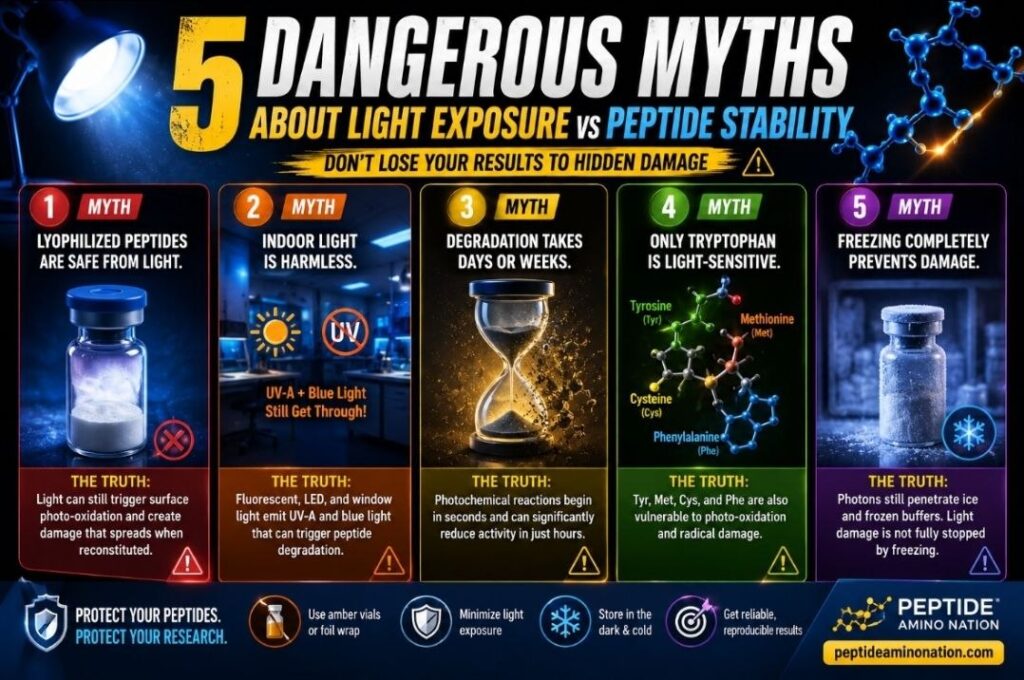
Five Dangerous Myths About Light Exposure vs Peptide Stability
Despite advances in peptide science, several misconceptions continue to compromise valuable research.
Myth 1: Lyophilized Peptides Are Immune to Light
Many researchers assume freeze-dried peptides cannot undergo photochemical damage.
While lyophilization greatly slows chemical reactions, surface photo-oxidation can still occur when powders remain exposed to UV or high-energy visible light.
Proper storage remains essential.
Myth 2: Indoor Laboratory Lighting Is Harmless
Many fluorescent lamps, white LEDs, and window-filtered sunlight still emit wavelengths capable of initiating photo-oxidation.
Repeated daily exposure may gradually reduce peptide integrity.
Myth 3: Light Damage Takes Weeks
Photochemical reactions begin almost immediately after photon absorption.
Although visible performance changes may require time, the underlying chemical reactions start within fractions of a second.
Myth 4: Only Tryptophan Is Sensitive
While Tryptophan is highly susceptible, other amino acids—including Tyrosine, Methionine, Cysteine, and Phenylalanine—may also undergo oxidation or structural modification.
Each peptide should be evaluated according to its complete sequence.
Myth 5: Freezing Completely Prevents Light Damage
Cold temperatures slow many chemical reactions.
They do not block photons.
If clear vials are repeatedly exposed to laboratory lighting inside glass-door refrigerators or during routine handling, photochemical degradation may still occur.
Expert Perspective: The Lesson Most Suppliers Never Talk About
After years of supporting researchers and investigating peptide performance concerns, one lesson stands above all others:
Most peptide failures don’t begin in the manufacturing facility—they begin the moment researchers start handling the peptide.
Many suppliers emphasize purity percentages and Certificates of Analysis, but those are only part of the story.
A peptide can leave the manufacturing facility with outstanding purity and still produce disappointing results if it is repeatedly exposed to unnecessary light, oxygen, unsuitable buffers, or poor reconstitution practices.
In my experience, successful peptide research depends on controlling the peptide’s microenvironment just as carefully as selecting a high-quality product.
That’s why educating researchers is just as important as supplying premium research peptides.
When researchers understand Light Exposure vs Peptide Stability, they don’t simply preserve a molecule—they protect the accuracy, reproducibility, and credibility of their scientific work.
Build a Professional Dark-Chain Workflow for Maximum Light Exposure vs Peptide Stability
https://www.sciencedirect.com/
After supporting researchers across numerous peptide research projects, I have found that one simple change consistently improves peptide integrity:
Treat light-sensitive peptides as if they are never supposed to see daylight.
This approach is what I call the Dark-Chain Workflow—a continuous process designed to minimize unnecessary light exposure from the moment a peptide leaves the manufacturer until the final experimental use.
Unlike a traditional cold chain that focuses only on temperature, a Dark-Chain Workflow protects peptides from both thermal stress and photochemical degradation.
Below is the protocol I recommend to researchers who want to maximize Light Exposure vs Peptide Stability and improve experimental reproducibility.
Step 1: Store Peptides in Amber Containers
The first line of defense is proper storage.
Whenever possible, transfer reconstituted peptides into amber glass vials or amber polypropylene tubes.
Amber containers significantly reduce exposure to ultraviolet and high-energy blue light, which are the wavelengths most responsible for photochemical reactions.
If amber containers are unavailable:
• Wrap clear vials completely with aluminum foil.
• Ensure no transparent areas remain exposed.
• Label the outside of the foil clearly to avoid unnecessary unwrapping.
This simple step can dramatically improve Light Exposure vs Peptide Stability, especially for peptides containing light-sensitive amino acids.
Step 2: Reconstitute Under Low-Light Conditions
Many researchers unknowingly expose peptides to their highest light dose during reconstitution.
Instead:
• Work under dim ambient lighting whenever practical.
• Avoid direct sunlight.
• Minimize exposure beneath bright fluorescent fixtures.
• Complete the procedure efficiently.
Remember:
The longer the peptide remains exposed during preparation, the greater the opportunity for photo-oxidation.
Step 3: Aliquot Immediately
Repeatedly thawing and reopening the same vial exposes peptides to:
• Light
• Oxygen
• Moisture
• Temperature fluctuations
Instead, divide freshly prepared peptide solutions into single-use aliquots.
Benefits include:
• Reduced cumulative light exposure
• Fewer freeze-thaw cycles
• Lower contamination risk
• Better experimental consistency
Aliquoting is one of the simplest ways to improve Light Exposure vs Peptide Stability.
Step 4: Store Inside Opaque Secondary Containers
Even amber vials benefit from additional protection.
Store peptides inside:
• Opaque laboratory storage boxes
• Foil-lined containers
• Closed freezer racks
• Light-blocking storage pouches
This creates another barrier against accidental exposure whenever refrigerators or freezers are opened.
Step 5: Protect Peptides During Transportation
Laboratory handling doesn’t begin when the shipment arrives.
Protection starts during shipping.
Professional peptide suppliers should use:
• Insulated packaging
• Cold-chain shipping
• Opaque shipping materials
• Protective secondary packaging
• Minimal unnecessary handling
At Peptide Amino Nation, protecting peptide quality extends beyond synthesis. Every shipment is carefully prepared using protective packaging designed to help maintain product integrity during transit, reducing unnecessary exposure to environmental stress whenever possible.
Common Laboratory Mistakes That Reduce Light Exposure vs Peptide Stability
Many laboratories unknowingly shorten peptide lifespan through routine handling habits.
Avoid these common mistakes.
Leaving Peptides on the Laboratory Bench
One of the most common errors is allowing reconstituted peptides to remain under fluorescent laboratory lighting for extended periods.
Even if samples remain cold, prolonged light exposure can gradually initiate photo-oxidation.
Using Clear Storage Containers
Transparent tubes provide virtually no protection against harmful wavelengths.
Whenever possible, replace clear containers with amber alternatives.
Repeatedly Opening the Same Vial
Every time a vial is opened, peptides experience:
• Light exposure
• Oxygen exposure
• Moisture exchange
• Temperature changes
Single-use aliquots dramatically reduce these risks.
Storing Samples Near Windows
Many researchers assume window glass blocks harmful radiation.
While standard glass blocks much of UV-B radiation, significant amounts of UV-A and visible blue light still pass through.
Avoid storing peptides near windows.
Forgetting About Light During Experiments
Researchers often focus on long-term storage while overlooking what happens during the experiment itself.
Samples sitting beside microscopes, biosafety cabinets, imaging systems, or laboratory lighting may experience hours of unnecessary exposure.
Protect samples throughout the entire workflow—not just inside the freezer.
How We Help Protect Light Exposure vs Peptide Stability Before Your Order Arrives
As an experienced peptide supplier, I believe peptide protection begins long before a package reaches the research laboratory.
That philosophy influences every stage of our handling process.
Whenever appropriate, our packaging protocols include:
• Amber-compatible storage options
• Protective foil wrapping
• Cold-chain shipping methods
Insulated packaging materials
• Minimal unnecessary handling during preparation
• Careful packaging designed to reduce environmental stress during transit
Supplying high-quality peptides involves more than producing excellent purity.
It also means helping researchers receive products that have been handled with the same level of care expected inside professional laboratories.
Frequently Asked Questions About Light Exposure vs Peptide Stability
Does every peptide require protection from light?
No.
Some peptide sequences are naturally more resistant than others.
However, because sequence-specific stability is not always obvious, minimizing unnecessary light exposure is considered good laboratory practice for virtually all research peptides.
Which peptides are generally more light-sensitive?
Peptides containing amino acids such as:
• Tryptophan
• Tyrosine
• Methionine
• Cysteine
are generally more susceptible to photo-oxidation.
Certain conjugated peptides, including fluorophore-labeled molecules and copper-containing peptides like GHK-Cu, may also require additional protection.
Is a lyophilized peptide completely safe from light?
No.
Lyophilization greatly improves stability but does not eliminate photochemical risk.
Long-term exposure to UV or intense visible light may still initiate surface oxidation.
Can refrigeration replace light protection?
No.
Temperature control and light protection work together.
Refrigeration slows many degradation pathways but does not stop photons from initiating photochemical reactions.
Should I wrap peptide vials in aluminum foil?
Yes.
If amber containers are unavailable, tightly wrapping clear vials in aluminum foil provides an effective temporary barrier against light.
Does light exposure always produce visible changes?
No.
Many degraded peptides remain perfectly clear.
Loss of biological activity often occurs before visible discoloration or precipitation appears.
How can I maximize peptide stability after reconstitution?
The best approach combines several practices:
• Reconstitute under low-light conditions.
• Use amber containers.
• Prepare single-use aliquots.
Store samples in opaque secondary containers.
• Limit unnecessary handling.
• Follow recommended storage temperatures.
Together, these practices significantly improve Light Exposure vs Peptide Stability.
Related Content To Boost Your Knowledge About Peptide As a Whole
Peptide Reconstitution: The Science Behind Proper Mixing
Why Research Peptides Results Differ Between Laboratories
Why Impurities Form During Peptide Synthesis: 7 Critical Mistakes Every Researcher Must Avoid
Common Storage Mistakes That Reduce Peptide Quality
Why Different Peptides Have Different Shelf Lives
How Laboratories Test Peptide Identity: 6 Powerful Methods That Protect You From Costly Mistakes.
Understanding Syringe Units for Peptide Research Calculations
Understanding Peptide Hydrophobicity: 9 Powerful Insights That Prevent Costly Research Failures.
Peptide Purity Above 99% isn’t always the best choice for peptide research.
Conclusion
Protect Your Research by Understanding Light Exposure vs Peptide Stability
Light Exposure vs Peptide Stability is far more than a storage recommendation—it is a critical factor that directly influences peptide integrity, experimental reproducibility, and research success.
Throughout my experience supporting researchers, I have discovered that many apparent peptide failures are not caused by poor synthesis or inadequate purity. Instead, they result from avoidable handling practices after the vial is opened.
Simple changes—such as using amber containers, reducing unnecessary light exposure, preparing single-use aliquots, and maintaining a consistent Dark-Chain Workflow—can preserve peptide quality and help generate more reliable scientific results.
Researchers invest significant time, resources, and effort into every experiment. Protecting peptides from light is one of the easiest and most effective ways to safeguard that investment.
If you’re looking for research-grade peptides handled with quality, care, and attention to proper storage practices, visit Peptide Amino Nation at peptideaminonation.com. Our goal is not only to supply premium research peptides but also to provide the educational resources researchers need to improve peptide handling, maximize stability, and achieve more consistent experimental outcomes.
