Peptide Purity Above 99%: 7 Powerful Reasons It Isn’t Always Necessary for Peptide Research

Peptide Purity Above 99% is often viewed as the gold standard in peptide research. Many researchers automatically assume that the highest purity always produces the best scientific results. In reality, that assumption is one of the most expensive mistakes researchers make.
After years of supplying research peptides and helping laboratories, universities, and individual researchers select the right peptide specifications, we’ve found that purchasing peptide purity above 99% frequently increases costs, extends production timelines, and offers little or no scientific advantage for many applications.
In this guide, you’ll discover when peptide purity above 99% is essential, when it becomes unnecessary, how peptide purification actually works, and how to choose the optimal purity level for your research without wasting your budget.
Whether you’re ordering BPC-157, TB-500, Melanotan II, Semaglutide, or custom peptides, this guide will help you make smarter purchasing decisions.
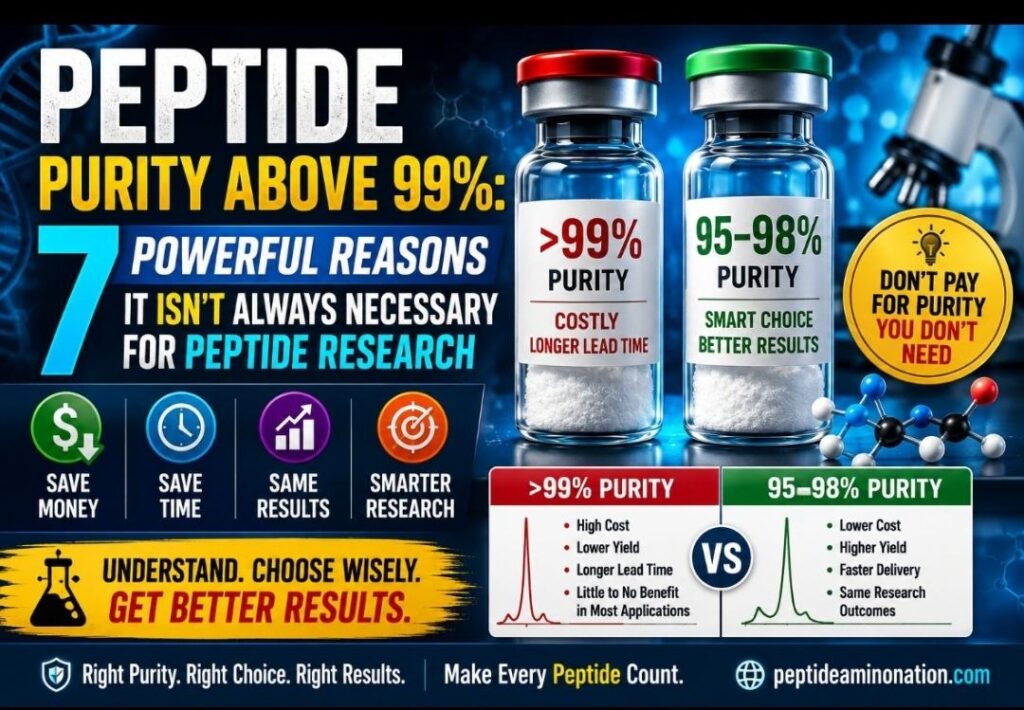
Table of Contents
1. What Does Peptide Purity Above 99% Actually Mean?
2. Why Researchers Automatically Choose Peptide Purity Above 99%
3. The Truth About Peptide Impurities
4. When Peptide Purity Above 99% Is Truly Necessary
5. When 95–98% Peptide Purity Is the Better Choice
6. Real Case Study: Saving Thousands on BPC-157
7. The Hidden Cost of Hyper-Purification
8. Three Common Myths About Peptide Purity Above 99%
9. Why Storage and Handling Matter More Than Purity
10. How Professional Researchers Choose Peptide Purity
11. Practical Decision Checklist
12. Frequently Asked Questions
13. Final Thoughts
What Does Peptide Purity Above 99% Actually Mean?
https://pubmed.ncbi.nlm.nih.gov/
Many first-time researchers misunderstand what peptide purity above 99% actually measures.
A purity value reported on an HPLC Certificate of Analysis simply indicates that more than 99% of the detected peptide material consists of the intended peptide.
It does not mean:
• 99% active peptide by weight
• Zero moisture
• Zero counter-ions
• Zero water
• Perfect biological activity
Instead, chromatographic purity compares your target peptide with closely related peptide fragments generated during synthesis.
Understanding this distinction prevents costly purchasing mistakes.
Why Researchers Automatically Choose Peptide Purity Above 99%
Many researchers request peptide purity above 99% simply because it sounds scientifically superior.
In reality, this habit often develops from:
• Fear of reviewer criticism
• Laboratory purchasing traditions
• Misunderstanding HPLC reports
• Believing “higher is always better”
Professional peptide suppliers regularly advise customers that the highest purity isn’t always the smartest investment.
The Truth About Peptide Impurities
Why Impurities Form During Peptide Synthesis: 7 Critical Mistakes Every Researcher Must Avoid
One of the biggest misconceptions about peptide purity above 99% involves impurities.
Researchers often imagine impurities are dangerous chemicals.
They aren’t.
After peptide synthesis, chemicals such as:
• Piperidine
• DMF
• TFA
• Cleavage reagents
are removed through extensive washing, precipitation, purification, and lyophilization.
The remaining impurities found in a typical 95–98% pure peptide are usually:
• truncated peptide sequences
• deletion peptides
• incomplete amino acid chains
These fragments closely resemble the intended peptide and are generally biologically insignificant for routine in vitro and in vivo research.
When Peptide Purity Above 99% Is Truly Necessary
There are situations where peptide purity above 99% is absolutely worth the investment.
Structural Biology
Researchers performing:
• NMR
• X-ray crystallography
• Cryo-EM
Require extremely homogeneous samples because even tiny impurities may interfere with structural determination.
Analytical Standards
Reference materials used for assay validation require exceptionally high purity.
Regulatory Validation
Clinical development and GMP manufacturing often demand stringent purity specifications.
Precision Binding Studies
Applications measuring:
• EC50
• IC50
• SPR
• ITC
Benefit from extremely pure peptide preparations.
In these situations, peptide purity above 99% is scientifically justified.
When 95–98% Peptide Purity Is the Better Choice https://www.ich.org/
For most biological experiments, 95–98% purity provides outstanding performance.
Typical applications include:
• Cell culture
• Western blot controls
• ELISA development
• Animal studies
• PK/PD research
• Antibody generation
• Initial screening
Professional researchers often prefer investing saved funds into:
• larger sample sizes
• additional replicates
• more peptide candidates
rather than purchasing unnecessary purity.
Real Case Study: How One Laboratory Saved Over 40%
One university laboratory planned a tendon regeneration study using BPC-157.
Initially, the researchers requested:
• 5 grams
• 99% purity
The manufacturer explained that achieving peptide purity above 99% required multiple aggressive preparative HPLC purification rounds because of the peptide’s challenging sequence containing consecutive Proline residues.
Producing the requested material would require nearly three times more crude peptides.
The recommendation
The laboratory reviewed an analytical HPLC profile showing:
• 97% purity
• Remaining impurities consisted only of truncated peptide fragments
Since the study involved animal tendon healing rather than structural biology, the researchers accepted a revised specification of 95–98% purity.
The outcome
| Before | After |
| >99% purity | 95-99% purity |
| Highest production cost | Over 40% lower cost |
| Longer manufacturing time | Three weeks faster delivery |
| Same biological outcome | Robust statistically significant tendon healing |
The experiment produced results consistent with published literature while saving considerable time and research funding.
Why Peptide Purity Above 99% Becomes So Expensive
Many researchers wonder why moving from 95% purity to peptide purity above 99% dramatically increases pricing.
The answer lies in preparative reverse-phase HPLC.
Technicians isolate only the narrowest “heart cut” of the chromatographic peak.
Large quantities of perfectly usable peptide are discarded simply because they fall slightly outside the desired purity window.
Typical manufacturing impact
| Purity | Relative Cost | Production Yield | Delivery Time |
| 90% | Lowest | Highest | Fastest |
| 95% | Moderate | High | Standard |
| 98% | High | Moderate | Longer |
| >99% | Lowest | Lowest | Lowest |
This explains why peptide purity above 99% may double or even triple manufacturing costs.
Three Biggest Myths About Peptide Purity Above 99%
Myth 1: Lower purity means toxic chemicals
False.
Most remaining impurities are shortened peptide fragments—not dangerous synthesis chemicals.
Myth 2: Higher purity means more peptide
False.
Chromatographic purity differs from Net Peptide Content.
Water and counter-ions reduce the actual peptide percentage by weight.
Always calculate concentrations using Net Peptide Content whenever possible.
Myth 3: A beautiful HPLC peak proves the peptide identity
False.
HPLC demonstrates purity.
Only LC-MS confirms molecular identity.
Always review both reports together.
Sometimes Purity Isn’t the Real Problem
Peptide Reconstitution: The Science Behind Proper Mixing
One neuroscience laboratory purchased Amyloid-Beta (1-42) at >98% purity.
Despite exceptional purity, experiments repeatedly failed.
The causes included:
• poor solvent selection
• rapid aggregation
• oxidation during storage
• repeated freeze-thaw cycles
The peptide itself wasn’t the problem.
Handling procedures were.
This illustrates an important lesson:
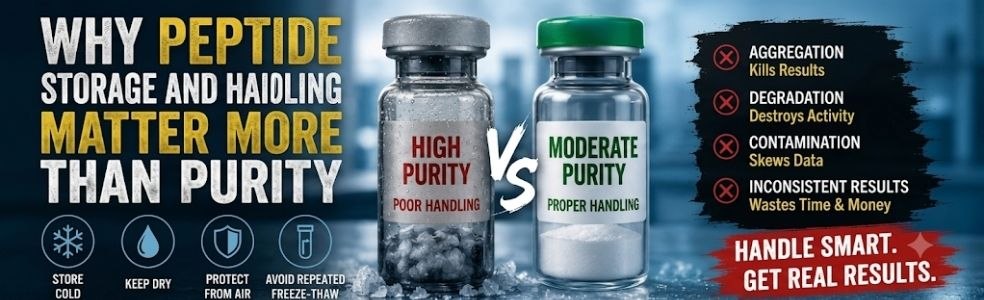
Storage, solubility, oxidation, aggregation, and sequence chemistry often influence experimental success far more than increasing purity from 97% to peptide purity above 99%.
Explaining Peptide Purity to First-Time Buyers
Imagine ordering 100 chocolate chip cookies.
With 95% purity:
95 cookies are perfect.
Five have slightly fewer chocolate chips.
They’re still cookies.
They’re still safe.
They still satisfy the purpose.
Now imagine demanding absolute perfection.
The bakery throws away dozens of nearly perfect cookies simply to deliver only flawless ones.
The result?
• Higher price
• Longer wait
• Same eating experience
Peptide purification works much the same way.
How Professional Researchers Choose Peptide Purity
Before ordering peptide purity above 99%, experienced researchers ask:
What is my experiment measuring?
Biological response?
Choose 95–98%.
Atomic structure?
Choose >99%.
Are impurities likely to matter?
Most truncated peptide fragments have minimal biological activity.
For routine assays, they rarely influence results.
Is my peptide difficult to manufacture?
Hydrophobic sequences, cysteine-rich peptides, and aggregation-prone molecules often suffer major yield losses during aggressive purification.
Am I paying for purity or useful data?
Many successful laboratories would rather test:
• more animals
• more cell replicates
• more peptide candidates
than spend the entire budget pursuing unnecessary purity.
Professional Recommendation
Based on years of supporting peptide researchers, one pattern appears repeatedly:
The most successful projects rarely begin by requesting the highest purity available.
Instead, they begin by selecting the purity appropriate for the experiment.
That simple decision frequently saves thousands of dollars while accelerating project timelines without sacrificing scientific quality.
If you’re uncertain which purity level best fits your application, consult an experienced peptide supplier before placing your order.
At Peptide Amino Nation, we help researchers choose the right peptide specifications based on their scientific objectives—not simply the highest number on a Certificate of Analysis. Our goal is to help you maximize research value, avoid unnecessary costs, and obtain peptides that match your experimental needs.
Frequently Asked Questions
Is peptide purity above 99% always better?
No. For many in vitro and in vivo studies, 95–98% purity performs just as effectively while reducing cost and delivery time.
What are peptide impurities?
They are usually shortened peptide fragments produced during synthesis rather than toxic chemicals.
Why does peptide purity above 99% cost so much?
Achieving ultra-high purity requires multiple rounds of preparative HPLC, which dramatically reduces yield and increases manufacturing time.
Does HPLC purity measure peptide content?
No. HPLC purity measures chromatographic purity. Net Peptide Content accounts for water, counter-ions, and other non-peptide components.
Should beginners always buy peptide purity above 99%?
Not necessarily. The appropriate purity depends on the intended application, not on the assumption that higher is always better.
Explore Related Article Below That will Boost Your Knowledge About Peptide As a whole
Click
Understanding Peptide Hydrophobicity: 9 Powerful Insights That Prevent Costly Research Failures.
The Role of pH in Peptide Solubility:
Understanding Syringe Units for Peptide Research Calculations
How Laboratories Test Peptide Identity
Why Different Peptides Have Different Shelf Lives
Common Storage Mistakes That Reduce Peptide Quality
Final Thoughts
Peptide Purity Above 99% is an essential specification for certain highly specialized peptide research applications, but it is not a universal requirement for every experiment. For most routine peptide research, choosing Peptide Purity Above 99% offers little additional scientific benefit compared with 95–98% peptide purity, which delivers reliable, reproducible results while significantly reducing manufacturing costs and shortening production timelines.
Understanding what Peptide Purity Above 99% actually measures is critical for making informed purchasing decisions. Researchers should distinguish chromatographic purity from net peptide content, evaluate the intended application, and select the appropriate peptide purity rather than automatically requesting the highest specification. In many in vitro and in vivo studies, 95–98% peptide purity provides the same biological performance as Peptide Purity Above 99% while offering a much better return on investment.
Whether you are ordering custom peptides, research peptides, BPC-157, or other synthetic peptides, matching the peptide purity to your experimental goals will improve efficiency, protect your research budget, and help keep your project on schedule.
If you are unsure whether Peptide Purity Above 99% is necessary for your application, consult an experienced peptide supplier before placing your order. At Peptide Amino Nation, we help researchers choose the right peptide purity based on scientific requirements—not marketing claims—so you receive high-quality research peptides that deliver dependable results while avoiding unnecessary costs.
