Why Peptide HPLC Purity and Biological Activity Are Different: 7 Powerful Truths That Can Save Your Research

Introduction
Why Peptide HPLC Purity and Biological Activity Are Different is one of the most important questions every peptide researcher should understand before purchasing, analyzing, or using peptides in biological studies.
After more than 10 years as a peptide supplier and educator, I have seen researchers become obsessed with a single number on a Certificate of Analysis (CoA): HPLC purity.
Many believe that a peptide showing 98%, 99%, or even 99.5% purity will automatically deliver excellent biological results.
Unfortunately, that assumption has caused failed experiments, inaccurate dosing, misleading conclusions, wasted research budgets, and months of lost work.
The truth is simple:
A peptide can be 99% pure by HPLC and still perform poorly in biological systems.
Likewise, a peptide showing lower HPLC purity may still demonstrate outstanding biological activity.
Understanding why peptide HPLC purity and biological activity are different allows researchers to make smarter purchasing decisions, interpret CoAs correctly, and avoid costly laboratory mistakes.
Introduction
Why Peptide HPLC Purity and Biological Activity Are Different is one of the most important questions every peptide researcher should understand before purchasing, analyzing, or using peptides in biological studies.
After more than 10 years as a peptide supplier and educator, I have seen researchers become obsessed with a single number on a Certificate of Analysis (CoA): HPLC purity.
Many believe that a peptide showing 98%, 99%, or even 99.5% purity will automatically deliver excellent biological results.
Unfortunately, that assumption has caused failed experiments, inaccurate dosing, misleading conclusions, wasted research budgets, and months of lost work.
The truth is simple:
A peptide can be 99% pure by HPLC and still perform poorly in biological systems.
Likewise, a peptide showing lower HPLC purity may still demonstrate outstanding biological activity.
Understanding why peptide HPLC purity and biological activity are different allows researchers to make smarter purchasing decisions, interpret CoAs correctly, and avoid costly laboratory mistakes.
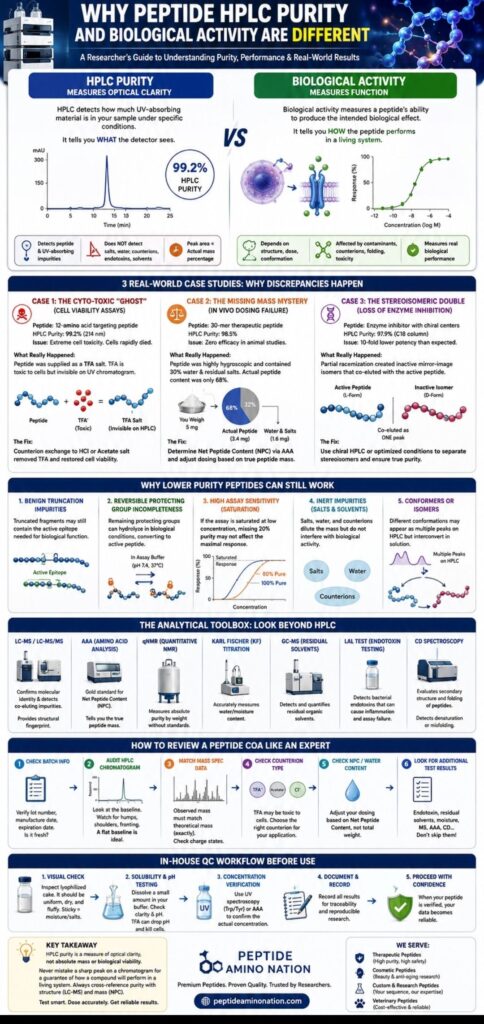
Table of Contents
1. What Is HPLC Purity?
2. What Is Biological Activity?
3. Why Peptide HPLC Purity and Biological Activity Are Different
4. Common HPLC Purity Myths
5. The Hidden Limitations of HPLC
6. Case Study #1: The Cytotoxic Ghost
7. Case Study #2: The Missing Mass Mystery
8. Case Study #3: The Stereoisomeric Double
9. Why Lower Purity Peptides Can Still Work
10. The Analytical Methods Researchers Should Use
11. How to Review a Peptide CoA Like an Expert
12. The Recommended In-House QC Workflow
13 Frequently Asked Questions
14 Final Thoughts
What Is HPLC Purity?
https://peptideaminonation.com/blog/how-to-read-a-peptide-coa-10-critical-things-to-learn/
High-Performance Liquid Chromatography (HPLC) is a powerful analytical technique used to separate and quantify compounds within a sample.
In peptide manufacturing, HPLC purity represents the percentage of UV-detectable material attributed to the target peptide peak under specific analytical conditions.
This measurement helps researchers estimate chemical cleanliness.
However, HPLC purity does not directly measure:
• Biological activity
• Receptor binding
• Potency
• Toxicity
• Net peptide content
• Water content
• Counterion concentration
• Endotoxin contamination
• Residual solvents
This limitation is the foundation of understanding why peptide HPLC purity and biological activity are different.
What Is Biological Activity?
Biological activity refers to a peptide’s ability to perform its intended function inside a biological system.
Examples include:
• Receptor activation
• Hormone signaling
• Enzyme inhibition
• Tissue repair stimulation
• Cellular communication
• Growth factor regulation
Unlike HPLC purity, biological activity measures functional performance rather than chromatographic appearance.
A biologically active peptide requires:
• Correct sequence
• Correct structure
• Correct stereochemistry
• Proper folding
• Adequate concentration
• Minimal harmful contaminants
A perfect chromatogram does not guarantee any of these factors.
Why Peptide HPLC Purity and Biological Activity Are Different
https://www.sciencedirect.com/
Understanding why peptide HPLC purity and biological activity are different starts with recognizing that they measure entirely different properties.
HPLC evaluates what the detector sees.
Biological systems evaluate what cells, tissues, receptors, and enzymes experience.
These are fundamentally different measurements.
HPLC Measures Optical Purity
HPLC relies on UV absorbance.
If a contaminant absorbs UV light poorly, it may be largely invisible.
Examples include:
• Counterions
• Water
• Salts
• Endotoxins
• Residual solvents
A peptide may appear extremely pure despite containing significant hidden contaminants.
Biology Measures Functional Performance
Cells do not care how beautiful a chromatogram looks.
Cells respond to:
• Structure
• Dose
• Toxicity
• Folding
• Stability
• Receptor affinity
This is exactly why peptide HPLC purity and biological activity are different.
Common HPLC Purity Myths
https://pubmed.ncbi.nlm.nih.gov/
Over the years, I have repeatedly encountered several dangerous misconceptions.
Myth #1: A Single Peak Means 100% Purity
A single peak only indicates that compounds co-eluted under specific chromatographic conditions.
Hidden impurities may still exist.
Myth #2: Peak Area Equals Mass Percentage
Area percentage reflects detector response.
It does not necessarily reflect actual weight percentage.
Myth #3: HPLC Purity Equals Assay Purity
These measurements are not interchangeable.
A peptide may show high HPLC purity while containing substantial water or salt content.
Myth #4: Pure at 254 nm Means Pure Everywhere
Different molecules absorb UV light differently.
One wavelength can not reveal every impurity.
Myth #5: A Published Method Guarantees Accuracy
Every peptide behaves differently.
A method validated for one peptide may fail completely for another.
The Hidden Limitations of HPLC
HPLC is essential, but it has limitations.
It can not reliably detect:
• Water
• Counterions
• Endotoxins
• Residual solvents
• Many stereoisomers
• Conformational variants
Researchers who rely exclusively on HPLC often overlook critical quality issues.
Case Study #1: The Cytotoxic Ghost
The Peptide
A 12-amino acid targeting peptide intended for receptor-binding studies.
Reported Purity
99.2% HPLC purity.
The Problem
Every cell culture experiment failed.
Cells rapidly died following peptide exposure.
Investigation
The peptide itself was highly pure.
However, substantial TFA counterions remained attached.
TFA was nearly invisible on the chromatogram but highly toxic to mammalian cells.
The peptide peak looked excellent.
The biological outcome was disastrous.
Solution
The peptide underwent counterion exchange to acetate or hydrochloride form.
Cell viability immediately improved.
This is one of the clearest examples of why peptide HPLC purity and biological activity are different.
Case Study #2: The Missing Mass Mystery
The Peptide
A hydrophobic 30-mer therapeutic peptide.
Reported Purity
98.5%.
The Problem
Animal studies showed no biological response.
Investigation
Researchers assumed 5 mg of powder contained 5 mg of active peptide.
Amino Acid Analysis revealed:
• 30% water
• Residual salts
• Net peptide content only 68%
The consumer received substantially less peptide than intended.
Solution
Dosing calculations were corrected using Net Peptide Content.
Biological activity returned.
Again, this demonstrates why peptide HPLC purity and biological activity are different.
Case Study #3: The Stereoisomeric Double
The Peptide
A synthetic enzyme inhibitor containing D- and L-amino acids.
Reported Purity
97.9%.
The Problem
The peptide showed potency nearly ten times lower than expected.
Investigation
Partial racemization occurred during synthesis.
Inactive stereoisomers co-eluted with the desired peptide.
The chromatogram displayed a beautiful peak.
The biology told a different story.
Nearly 40% of the peak consisted of inactive stereochemical impurities.
Solution
A specialized chiral analytical method was implemented.
True impurity levels became visible.
This example perfectly illustrates why peptide HPLC purity and biological activity are different.
Why Lower Purity Peptides Can Still Work
Interestingly, lower HPLC purity does not always mean poor biological performance.
Benign Truncation Impurities
Some truncated fragments still contain the active region responsible for biological function.
Reversible Protecting Groups
Certain impurities may convert into active peptide during biological testing.
Assay Saturation
Highly potent peptides may achieve maximal response even when purity is lower.
Inert Salts and Water
Some impurities affect weight but not biological activity.
Conformational Isomers
Multiple HPLC peaks may represent different shapes of the same peptide.
Once dissolved, these forms often interconvert naturally.
The Analytical Methods Every Researcher Should Use
LC-MS
Confirms molecular identity.
Detects hidden co-eluting compounds.
Amino Acid Analysis (AAA)
The gold standard for Net Peptide Content.
Determines actual peptide mass.
Quantitative NMR (qNMR)
Measures absolute purity by weight.
Karl Fischer Titration
Measures moisture content.
GC-MS
Detects residual solvents.
Endotoxin Testing (LAL)
Detects bacterial endotoxins invisible to HPLC.
Circular Dichroism (CD)
Evaluates peptide folding and structural integrity.
Ideal Analytical Suite for Peptide Quality Control
| Method | Purpose | What It Detect |
| HPLC | Chemical Purity | UV-detectable impurity |
| LC-MS | Identity Confirmation | Molecular mass |
| AAA | Net Peptide Content | True peptide quantity |
| qNMR | Absolute Purity | Weight purity |
| Karl Fischer | Water Content | Hidden moisture |
| GC-MS | Residual Solvents | Manufacturing residues |
| LAL | Endotoxins | Biological contaminant |
| CD Spectroscopy | Structural Integrity | Folding abnormalities |
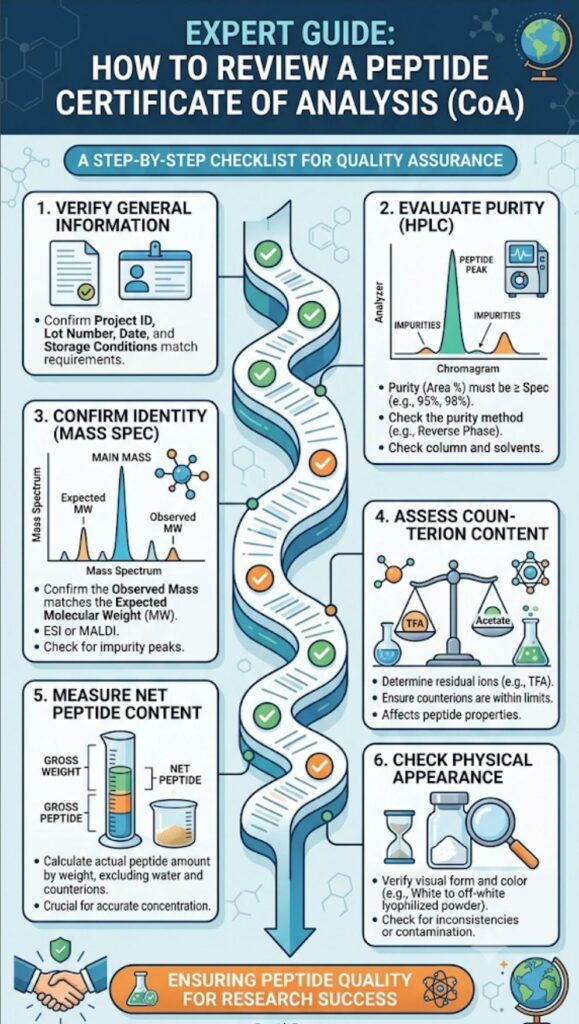
How to Review a Peptide CoA Like an Expert
When reviewing a Certificate of Analysis, never focus only on purity percentage.
Follow this workflow.
Step 1: Check Batch Information
Verify:
• Lot number
• Production date
• Expiration date
Step 2: Audit the HPLC Baseline
Look beyond the main peak.
Watch for:
• Broad humps
• Peak shoulders
• Baseline drift
• Fronting
These often indicate hidden impurities.
Step 3: Verify Mass Spectrometry Data
https://peptideaminonation.com/peptide-dosing-molar-concentration-mg-to-mm/
Ensure observed mass matches theoretical mass.
Even a 1 Da discrepancy deserves investigation.
Step 4: Review Counterions
Determine whether the peptide contains:
• TFA
• Acetate
• HCl
This information matters significantly for biological applications.
Step 5: Check Net Peptide Content
If NPC equals 80%, dosing calculations must be adjusted accordingly.
Recommended In-House QC Workflow
Before using any peptide:
Visual Inspection
Check whether the lyophilized cake appears:
• Uniform
• Dry
• Fluffy
Sticky material may indicate excess moisture.
Solubility Testing
Dissolve a small sample.
Monitor:
• Solubility
• Clarity
• pH
Concentration Verification
Use:
• UV Spectroscopy
• AAA
Never assume label concentration is correct.
Frequently Asked Questions
Is 99% HPLC Purity Always Better Than 95%?
Not necessarily.
Biological activity depends on far more than HPLC purity.
Can HPLC Detect Endotoxins?
No.
Endotoxin testing requires specialized assays.
Why Does My 99% Pure Peptide Not Work?
Possible causes include:
• Incorrect folding
• TFA contamination
• Low NPC
• Endotoxins
• Stereochemical impurities
Which Test Is Most Important After HPLC?
LC-MS and Amino Acid Analysis are typically the most valuable complementary methods.
Final Thoughts
After more than a decade supplying and educating researchers about peptides, I have learned one lesson repeatedly:
A chromatogram is not a biological assay.
The single most important lesson to remember is this:
HPLC purity is a measure of optical clarity, not absolute mass or biological viability.
A peptide showing 98% or 99% purity on a Certificate of Analysis may still contain hidden contaminants, inactive stereoisomers, excess counterions, residual water, or other factors capable of destroying biological performance.
Never judge peptide quality using HPLC alone.
Always combine HPLC results with LC-MS, Net Peptide Content determination, and application-specific quality testing.
If you are serious about peptide quality, peptide education, and understanding advanced peptide analytics, continue learning through trusted resources and supplier education platforms such as peptideaminonation.com.
The researchers who understand why peptide HPLC purity and biological activity are different consistently make better purchasing decisions, design stronger experiments, and generate more reliable scientific results.
