How Laboratories Test Peptide Identity: 6 Powerful Methods That Protect You From Costly Mistakes

How Laboratories Test Peptide Identity is a critical topic that every peptide buyer, researcher, and supplier should understand. Whether you’re purchasing BPC-157, Semaglutide, Tirzepatide, or custom research peptides, verifying peptide identity is just as important as verifying purity.
One of the biggest mistakes in the peptide industry is assuming that a high purity percentage automatically means the peptide is genuine. In reality, a peptide can be extremely pure and still be the wrong molecule entirely.
As a peptide supplier and research educator, I’ve reviewed countless Certificates of Analysis (CoAs) and laboratory reports. Over the years, I’ve learned a simple rule:
Purity tells you how clean a peptide is. Identity tells you whether it is actually the correct peptide.
This guide explains how laboratories test peptide identity, the technologies involved, common industry misconceptions, and the red flags every buyer should know.
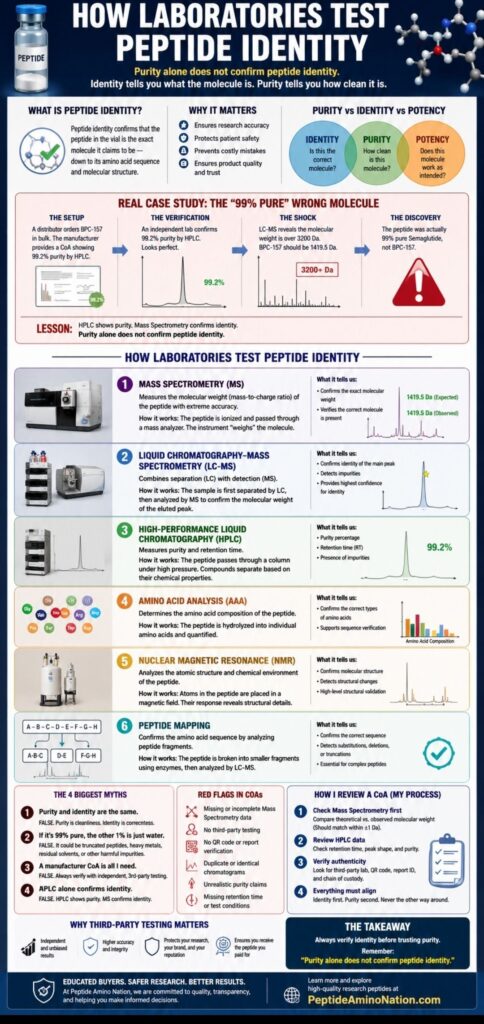
Table of Contents
1. What Is Peptide Identity?
2. Why Peptide Identity Matters
3. Purity vs Identity: Understanding the Difference
4. Real Case Study: The 99% Pure Wrong Molecule
5. How Laboratories Test Peptide Identity
• Mass Spectrometry (MS)
• Liquid Chromatography-Mass Spectrometry (LC-MS)
• High-Performance Liquid Chromatography (HPLC)
• Amino Acid Analysis (AAA)
• Nuclear Magnetic Resonance (NMR)
• Peptide Mapping
6. How I Personally Review Peptide Identity Data
7. The 4 Biggest Myths About Peptide Identity Testing
8. Red Flags in Peptide CoAs
9. Why Third-Party Testing Matters
10. Frequent Asked Question & Answers
11. Final Thoughts
What Is Peptide Identity?
https://pubmed.ncbi.nlm.nih.gov/
Before understanding how laboratories test peptide identity, it’s important to understand what peptide identity actually means.
Peptide identity refers to confirmation that a peptide sample contains the exact amino acid sequence and molecular structure it claims to contain.
For example:
A vial labeled BPC-157 should contain BPC-157.
A vial labeled Semaglutide should contain Semaglutide.
A vial labeled Tirzepatide should contain Tirzepatide.
Identity testing answers one simple question:
“Is this actually the molecule written on the label?”
Without identity testing, there is no scientific proof that the peptide matches its label.
Why Peptide Identity Matters
Peptide identity verification protects:
• Researchers
• Clinics
• Distributors
• Suppliers
• End users
Incorrect peptide identity can result in:
• Failed research studies
• Inaccurate experimental results
• Product recalls
• Financial losses
• Safety concerns
Understanding how laboratories test peptide identity helps prevent these problems before they occur.
Purity vs Identity: Understanding the Difference
https://peptideaminonation.com/why-research-peptides-results-differ-between-laboratories/
This is where many buyers become confused.
| Testing Parameter | What It Measures |
| Identity | Is this the correct molecule? |
| Purity | How clean is the molecule? |
| Potency | Does the molecule perform it intended function? |
A peptide can be:
• 99% pure
• Correctly synthesized
• Completely wrong
That may sound surprising, but it happens more often than many people realize.
Real Case Study: The 99% Pure Wrong Molecule
https://peptideaminonation.com/peptide-reconstitution-measurement-errors/
One of the most important lessons I’ve encountered as a peptide supplier involved a batch that appeared perfect on paper.
The Setup
A distributor ordered bulk BPC-157 from an overseas manufacturer.
The manufacturer provided a Certificate of Analysis showing:
• 99.2% purity
• Clean HPLC chromatogram
• Excellent appearance
Everything looked perfect.
The Verification
Before vialing the peptide, the distributor sent a sample to an independent laboratory.
The HPLC results confirmed:
99.2% purity
At this stage, many buyers would stop testing.
However, the laboratory proceeded with LC-MS identity testing.
The Shock
BPC-157 should have a molecular weight of approximately:
1419.5 Da
The observed molecular weight was:
Over 3200 Da
The peptide was not BPC-157.
The Discovery
The sample was actually highly purified Semaglutide.
A manufacturing or labeling error had occurred during production.
The peptide was incredibly pure.
But it was the wrong peptide.
Without identity testing, the distributor could have unknowingly sold Semaglutide as BPC-157.
This case perfectly demonstrates why understanding how laboratories test peptide identity is essential.
How Laboratories Test Peptide Identity
Several advanced laboratory methods are used to verify peptide identity.
Each method provides a different piece of the puzzle.
H2: Mass Spectrometry (MS)
Why Mass Spectrometry Is the Gold Standard
When discussing how laboratories test peptide identity, Mass Spectrometry is often the most important tool.
Mass Spectrometry measures the molecular weight of a peptide with exceptional accuracy.
The instrument essentially “weighs” the molecule.
What Scientists Compare
• Theoretical molecular weight
• Observed molecular weight
If the values match closely, identity is confirmed.
For many peptide suppliers, Mass Spectrometry is the first section reviewed in any CoA.
H2: Liquid Chromatography-Mass Spectrometry (LC-MS)
https://peptideaminonation.com/peptide-dosing-molar-concentration-mg-to-mm/
LC-MS combines two powerful technologies:
• Liquid Chromatography
• Mass Spectrometry
This method helps laboratories:
• Separate compounds
• Identify compounds
• Detect contaminants
• Confirm molecular weight
LC-MS is among the most trusted methods used when laboratories test peptide identity.
Because it combines separation and identification, it provides significantly more confidence than HPLC alone.
H2: High-Performance Liquid Chromatography (HPLC)
https://peptideaminonation.com/powerful-signs-of-a-reliable-peptide-research-report/
HPLC is commonly misunderstood.
Many people believe HPLC confirms identity.
Not exactly.
What HPLC Actually Does
HPLC measures:
• Purity
• Retention time
• Impurity levels
HPLC can suggest identity when compared against known standards.
However, HPLC alone cannot definitively prove identity.
This distinction is crucial when understanding how laboratories test peptide identity.
H2: Amino Acid Analysis (AAA)
Amino Acid Analysis verifies the amino acid composition of a peptide.
The laboratory:
1. Breaks the peptide apart.
2. Measures individual amino acids.
3. Compares results with expected values.
AAA provides additional evidence that the peptide sequence is correct.
It is especially useful for confirming complex peptide products.
H2: Nuclear Magnetic Resonance (NMR)
NMR examines molecular structure at the atomic level.
This technique helps laboratories verify:
• Structural integrity
• Molecular arrangement
• Chemical composition
Although NMR is not used for every routine batch, it provides valuable structural confirmation.
For high-value peptides, NMR can provide another layer of identity verification.
H2: Peptide Mapping
Peptide Mapping is one of the most advanced identity-testing methods available.
The process involves:
• Breaking the peptide into fragments
• Analyzing fragment patterns
• Comparing patterns with reference standards
If the fragment map matches the reference sequence, identity is confirmed.
Peptide mapping is widely used for biologics and complex peptide products.
How I Personally Review Peptide Identity Data
https://peptideaminonation.com/blog/how-to-read-a-peptide-coa-10-critical-things-to-learn/
As a peptide supplier and research educator, I follow a simple review process.
Step 1: Check Mass Spectrometry
I immediately compare:
• Expected molecular weight
• Observed molecular weight
If these values don’t align, the investigation stops.
Step 2: Review HPLC Data
I examine:
• Main peak shape
• Retention time
• Peak symmetry
Irregular peaks can indicate synthesis issues.
Step 3: Look for Third-Party Verification
Independent testing provides far greater confidence than manufacturer-generated reports.
Step 4: Verify Report Authenticity
I check:
• QR codes
• Report IDs
•Chain-of-custody information
Authentic reports should always be traceable.
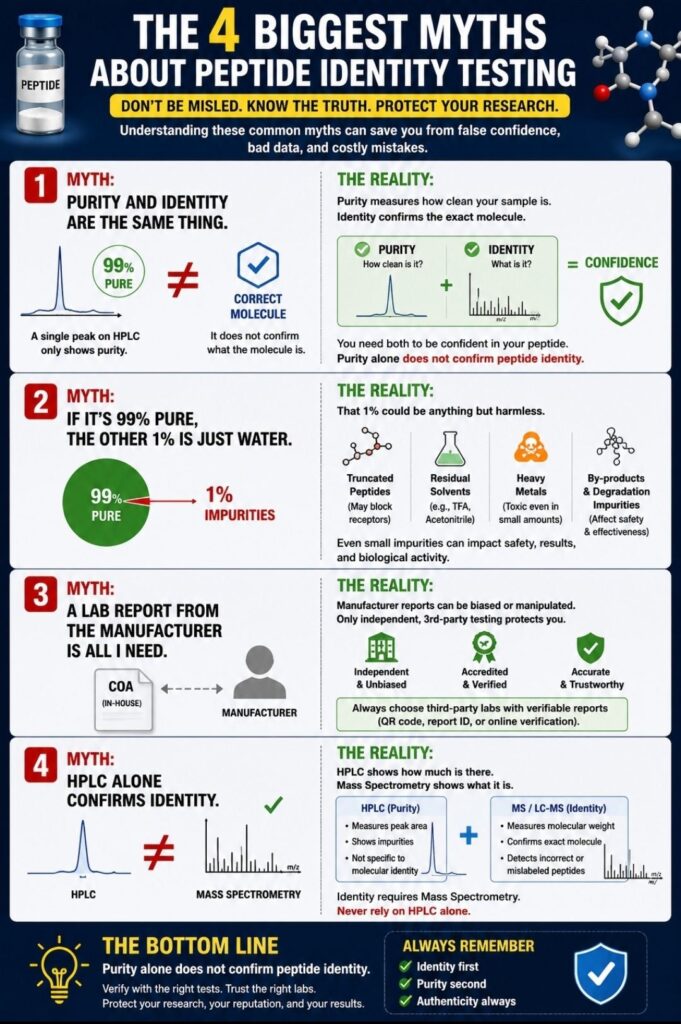
The 4 Biggest Myths About Peptide Identity Testing
Myth #1: Purity and Identity Are the Same Thing
Reality:
Purity measures cleanliness.
Identity confirms correctness.
They are not the same.
Myth #2: The Remaining 1% Is Just Water
Reality:
Impurities may include:
• Truncated peptides
• Residual solvents
• Heavy metals
- Manufacturing by-products
Even tiny impurity levels can matter.
Myth #3: A Manufacturer CoA Is Always Reliable
Reality:
Reports should be independently verified whenever possible.
Third-party testing eliminates conflicts of interest.
Myth #4: HPLC Alone Confirms Identity
Reality:
HPLC primarily evaluates purity.
Mass Spectrometry remains essential for definitive identity confirmation.
Red Flags in Peptide CoAs
Watch for these warning signs:
• Missing Mass Spectrometry data
• No third-party testing
• No report verification system
• Duplicate chromatograms
• Missing molecular weight information
• Incomplete testing records
These issues should always trigger additional scrutiny.
Why Third-Party Testing Matters
Independent testing laboratories have no financial incentive to approve a batch.
This makes their results far more trustworthy.
Whenever possible, peptide buyers should prioritize products supported by independent verification.
At peptideaminonation.com, we strongly encourage buyers to understand laboratory testing methods and review analytical data before making purchasing decisions.
Educated buyers make safer and smarter choices.
Frequently Asked Questions (FAQ)
How do laboratories test peptide identity?
Laboratories test peptide identity using advanced analytical techniques such as Mass Spectrometry (MS), Liquid Chromatography-Mass Spectrometry (LC-MS), Amino Acid Analysis (AAA), Nuclear Magnetic Resonance (NMR), and Peptide Mapping. These methods verify that a peptide matches its expected molecular structure and amino acid sequence.
What is the most accurate method for peptide identity testing?
Mass Spectrometry (MS) is generally considered the gold standard for peptide identity testing because it accurately measures molecular weight. When combined with LC-MS, laboratories can both separate and identify compounds with a high degree of confidence.
Can HPLC confirm peptide identity?
HPLC can provide clues about peptide identity through retention time comparisons, but HPLC alone cannot definitively confirm identity. HPLC primarily measures purity, while Mass Spectrometry is needed to verify the actual molecular weight and identity of the peptide.
Why is peptide identity testing important?
Peptide identity testing ensures that the molecule inside a vial is actually the peptide listed on the label. Without identity testing, researchers risk working with mislabeled, contaminated, or completely different compounds that could invalidate research results.
What is the difference between peptide purity and peptide identity?
Peptide purity measures how much of a sample consists of a single compound versus impurities. Peptide identity confirms that the compound is the correct peptide. A sample can be 99% pure and still be the wrong molecule.
How can I verify a peptide Certificate of Analysis (CoA)?
Start by reviewing the Mass Spectrometry section to compare the theoretical and observed molecular weights. Next, examine the HPLC chromatogram, retention time, purity percentage, testing date, report number, and any QR code or verification system provided by the testing laboratory.
What are common red flags in peptide testing reports?
Common red flags include missing Mass Spectrometry data, absent third-party testing, duplicate chromatograms, missing report verification numbers, unrealistic purity claims, and incomplete laboratory documentation.
Why is third-party peptide testing better than manufacturer testing?
Third-party laboratories have no financial interest in selling the peptide being tested. This independence helps ensure objective results and reduces the risk of biased or manipulated reports.
Can two different peptides have the same HPLC purity?
Yes. Two completely different peptides can both show 99% purity on HPLC. Purity only measures how clean a sample is, not whether it is the correct molecule. This is why Mass Spectrometry remains essential for identity verification.
What should peptide buyers check first on a CoA?
The first thing buyers should check is the Mass Spectrometry data. Comparing the expected molecular weight with the observed molecular weight provides the strongest evidence that the peptide is actually what the label claims.
Final Thoughts
Understanding how laboratories test peptide identity is one of the most valuable skills a peptide buyer can develop.
The most important lesson is simple:
Purity alone does not confirm peptide identity.
A peptide may appear exceptionally pure while still being the wrong molecule.
That is why professional laboratories combine Mass Spectrometry, LC-MS, HPLC, Amino Acid Analysis, NMR, and Peptide Mapping to verify identity from multiple angles.
As a peptide supplier and research educator, I always recommend reviewing molecular weight data before focusing on purity percentages. Identity must come first.
The next time you review a Certificate of Analysis, remember this question:
Has the laboratory proven what the molecule is, or only how clean it is?
That single distinction can save researchers, suppliers, and buyers from expensive mistakes and unreliable peptide products.
