Avoiding Measurement Errors During Peptide Reconstitution: 9 Critical Mistakes That Can Devastate Your Research

Table of Contents
1. What Is Avoiding Measurement Errors During Peptide Reconstitution?
2. Why Measurement Accuracy Matters
3. The Cost of Small Measurement Mistakes
4. 9 Critical Measurement Errors During Peptide Reconstitution
5. My Personal Laboratory Lesson
6. Case Study #1: The Volumetric Dilution Oversight
7. Case Study #2: The Microgram vs Milligram Metric Slip
8. Case Study #3: The Reconstitution Turbulence Blunder
9. The 3-Step Peptide System
10. The Read-Write-Verify Checklist
11. The Hidden Physics Most Researchers Ignore
12 Essential Tools for Accurate Peptide Reconstitution
13 Frequently Asked Questions
14 Conclusion
What Is Avoiding Measurement Errors During Peptide Reconstitution?
https://pubmed.ncbi.nlm.nih.gov/
Avoiding Measurement Errors During Peptide Reconstitution is the process of ensuring that peptide mass, diluent volume, concentration calculations, and dosing measurements are performed accurately during peptide preparation.
After helping more than 10,000 researchers since 2003, I have discovered that most peptide research failures are not caused by poor peptide quality. They are caused by preventable measurement mistakes.
Whether you are working with peptides such as BPC-157, TB-500, CJC-1295, Ipamorelin, MOTS-c, AOD-9604, Retatrutide, Semaglutide, or Tirzepatide, precise measurement is the foundation of reliable and reproducible results.
Why Measurement Accuracy Matters
Every peptide experiment depends on concentration.
If the concentration is wrong, everything that follows becomes unreliable.
A tiny decimal-point error can:
• Produce incorrect dosing
• Distort biological responses
• Increase experimental variability
• Waste expensive peptide material
• Delay studies by weeks or months
The most successful researchers understand a simple principle:
Precision before speed.
The Cost of Small Measurement Mistakes https://www.ncbi.nlm.nih.gov/
Many researchers assume a small volume discrepancy is insignificant.
Unfortunately, peptide research does not work that way.
When concentrations drift even slightly, researchers may observe:
• Inconsistent results
• Unexpected responses
• Failed reproducibility
• Statistical noise
• Invalid conclusions
In high-precision pharmacokinetic and receptor-binding studies, even a 2% to 5% concentration error can significantly impact data quality.
9 Critical Measurement Errors During Peptide Reconstitution
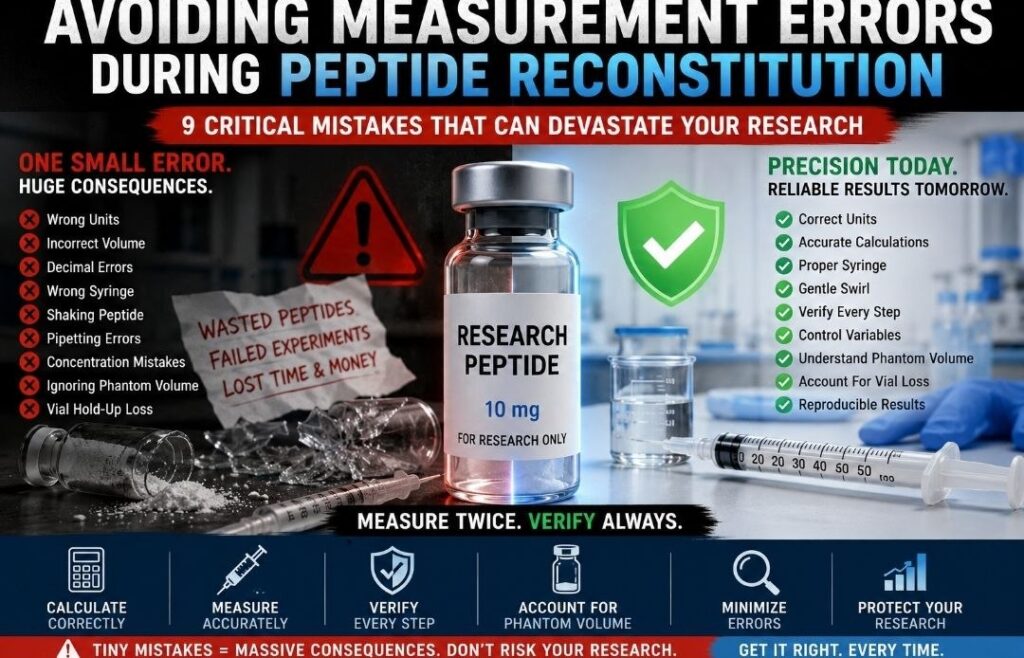
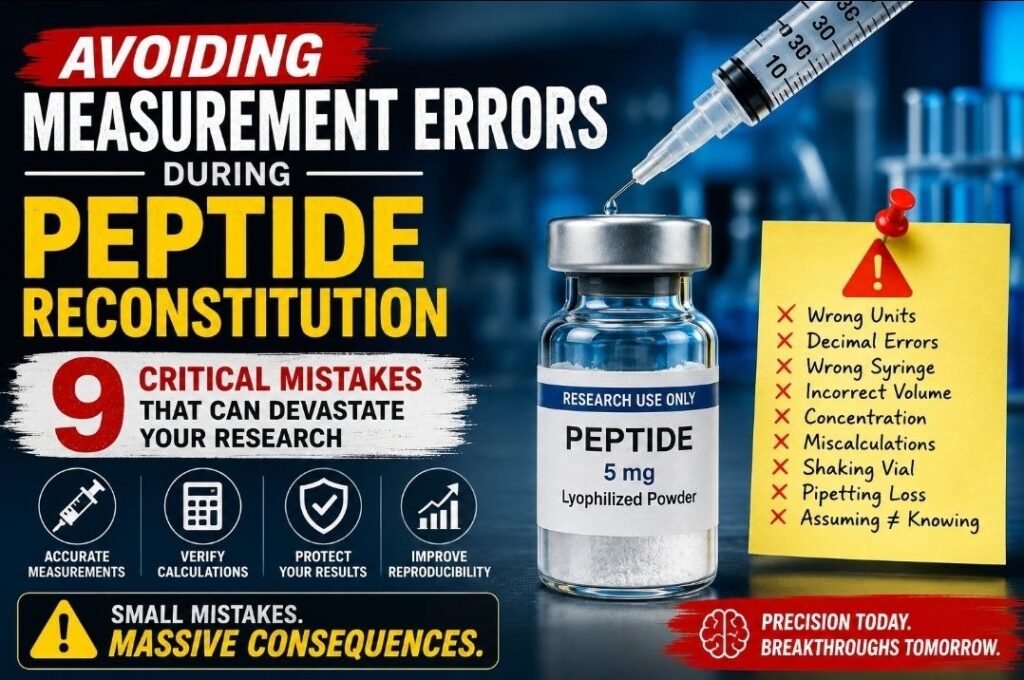
1. Confusing Syringe Units with Milligrams
This is the most common mistake I encounter.
Syringe units measure volume.
Milligrams measure peptide mass.
They are not interchangeable.
The actual dose depends entirely on the concentration of the reconstituted solution.
2. Mixing Up Milligrams and Micrograms
One milligram equals 1,000 micrograms.
A misplaced decimal point can create massive dosing errors.
Always verify:
• mg
• μg
• mL
• Units
before proceeding.
3. Using Incorrect BAC Water Volumes
Adding too much or too little bacteriostatic water changes concentration immediately.
This leads to inaccurate calculations and unreliable dosing.
Always record the exact volume added to each vial.
4. Ignoring Concentration Calculations
Many researchers focus only on vial size.
The concentration of the final solution determines the dose delivered.
Never draw a syringe before calculating concentration.
5. Assuming All Insulin Syringes Are Identical
Different syringes use different calibration systems.
Researchers frequently confuse:
• U-100 syringes
• U-40 syringes
This can create substantial measurement errors.
Always verify the syringe type before calculating doses.
6. Ignoring the Phantom Volume Effect
One of the least discussed causes of concentration error is the Phantom Volume Effect.
Most online guides assume that adding 2 mL of liquid creates exactly 2 mL of solution.
In reality, dissolved peptide and excipients occupy physical space.
A final volume of 2.05–2.10 mL is often possible.
Ignoring this effect can slightly alter concentration calculations.
7. Ignoring Vial Hold-Up Volume
Not every drop can be recovered from a vial.
Liquid remains attached to:
• Glass walls
• Rubber stoppers
• Needle hubs
• Syringe dead space
Researchers who assume 100% recovery often discover their final dose is missing volume.
8. Repeated Micro-Pipetting Errors
Every pipetting action introduces a small error margin.
When repeated daily, those small errors accumulate.
Professional laboratories often aliquot immediately after reconstitution to minimize repeated handling.
9. Shaking Instead of Swirling
Many peptides are delicate molecules.
Injecting diluent directly onto the peptide cake and aggressively shaking the vial may damage structural integrity.
Instead:
• Let the diluent run down the vial wall
• Allow gradual dissolution
• Gently swirl
Never shake.
My Personal Laboratory Lesson
Early in my career as a research analyst in a high-throughput biophysics laboratory, I learned one of the most expensive lessons of my professional life.
I was preparing a master stock solution from a newly synthesized signaling peptide.
The protocol required a 10 mg vial to be reconstituted with 2.5 mL of buffer.
Under deadline pressure, I mistakenly grabbed the wrong pipette.
The pipette looked nearly identical to the correct model.
Instead of adding the required 0.5 mL final volume, I added only 0.1 mL.
The concentration became significantly higher than intended.
The resulting receptor-binding assay appeared to show zero biological activity due to receptor saturation and a hook effect.
The consequences were severe:
• A custom peptide batch worth approximately $3,500 was lost.
• Three weeks of peptide synthesis time were wasted.
• A grant submission deadline was missed.
That experience taught me a rule I still follow today:
Never trust the color or position of a tool. Always read the label before use.
Case Study #1: The Volumetric Dilution Oversight
A graduate researcher repeatedly drew aliquots from a highly concentrated stock solution.
Because of peptide adsorption and cumulative pipetting errors, concentration drift occurred over a three-month study.
Result
• $4,000 in peptide material wasted
• 40 research animals lost
• One semester of unusable data
Case Study #2: The Microgram vs Milligram Metric Slip
A protocol required 50 μg.
A decimal-point error delivered 500 μg.
The subjects received a tenfold overdose.
Result
• Severe adverse reactions
• Study termination
• Funding review
• Nearly one year of delays
Case Study #3: The Reconstitution Turbulence Blunder
A researcher injected bacteriostatic water directly onto a delicate peptide cake and then vigorously shook the vial.
The peptide structure fragmented.
Result
• No biological activity
• Two weeks of preparation wasted
• $1,500 in peptide loss
The 3-Step Peptide System
Step 1: Determine Total Mass
Convert peptide mass into micrograms.
Example:
5 mg = 5,000 μg
Step 2: Determine Total Volume
Record exactly how much diluent is added.
Example:
2 mL = 200 units
Step 3: Calculate Concentration Per Unit
Calculate how much peptide exists in each syringe unit before drawing any dose.
This simple process dramatically reduces measurement errors.
The Read-Write-Verify Checklist
Before every reconstitution:
Read
Verify:
• Peptide name
• Peptide mass
• Diluent volume
Write
Document:
• Calculations
• Concentrations
• Target doses
Verify
Confirm:
• Units
• Syringe type
• Math
• Labels
This checklist has prevented countless mistakes over the years.
The Hidden Physics Most Researchers Ignore
Phantom Volume
The final solution volume is not always identical to the liquid added.
Peptide solids contribute measurable volume.
Vial Hold-Up Loss
Not all liquid can be recovered.
Expect small losses due to adhesion and dead space.
Gravimetric Verification
Elite laboratories often verify concentrations by weight rather than relying exclusively on volumetric measurements.
Because chemistry is governed by physics, actual recovered volume matters.
Essential Tools for Accurate Peptide Reconstitution
Recommended tools include:
• Insulin syringes
•Laboratory pipettes
• Graduated cylinders
• Analytical balances
• Digital peptide calculators
• Low-binding tubes
• Calibrated measuring equipment
For researchers seeking high-quality research peptides and educational resources, visit peptideaminonation.com for additional guides, calculators, and peptide information.
Frequently Asked Questions
What is the most common measurement error during peptide reconstitution?
Confusing syringe units with milligrams is the most common mistake.
Why do researchers confuse milligrams and micrograms?
Because both units are frequently used in peptide research. One milligram equals 1,000 micrograms.
What is the Phantom Volume Effect?
It is the increase in final solution volume caused by dissolved peptide solids and excipients occupying physical space.
Why should peptides be swirl instead of shaken?
Gentle swirling helps preserve peptide integrity and reduces the risk of structural damage.
Are all insulin syringes identical?
No. Different syringe types use different calibration systems and markings.
What is the Read-Write-Verify Checklist?
It is a three-step verification process designed to reduce human error during peptide preparation.
How can I improve dosing accuracy?
Use verified calculations, calibrated equipment, proper concentration measurements, and independent verification whenever possible.
Explore More Peptide Guides
Peptide reconstitution measurement errors
Peptide Reconstitution: The Science Behind Proper Mixing
Why Impurities Form During Peptide Synthesis: 7 Critical Mistakes Every Researcher Must Avoid
Conclusion
Avoiding Measurement Errors During Peptide Reconstitution is one of the most valuable skills any researcher can develop. Small mistakes during preparation can lead to inaccurate concentrations, inconsistent results, and unnecessary waste.
After helping more than 10,000 researchers since 2003, I have found that most peptide failures are not caused by poor peptide quality. Instead, they result from rushed preparation, incorrect assumptions, calculation mistakes, and inadequate verification. Avoiding Measurement Errors During Peptide Reconstitution begins with careful planning and attention to every step of the process.
Remember These Golden Rules
* Measure twice and verify again.
* Never confuse milligrams with micrograms.
* Understand concentration before dosing.
* Swirl, never shake.
* Aliquot early when possible.
* Respect Phantom Volume and Vial Hold-Up Volume.
* Follow the Read-Write-Verify Checklist every time.
Ultimately, Avoiding Measurement Errors During Peptide Reconstitution is about building consistent laboratory habits that improve accuracy and reproducibility. Every careful calculation and verification step contributes to more dependable research outcomes.
Whether you are new to peptide handling or an experienced researcher, Avoiding Measurement Errors During Peptide Reconstitution should remain a core part of your laboratory workflow. Precision today helps prevent costly errors tomorrow.
By making Avoiding Measurement Errors During Peptide Reconstitution a standard practice, researchers can produce more reliable, reproducible, and trustworthy results while maintaining the highest standards of scientific accuracy.
