Why Research Peptides Results Differ Between Laboratories

Researchers are often surprised when the same peptide receives different test results from different laboratories. Understanding Why Research Peptides Results Differ Between Laboratories is essential for interpreting Certificates of Analysis (COAs), evaluating suppliers, and making informed purchasing decisions.
As a peptide supplier, I have reviewed numerous laboratory reports involving peptides such as Retatrutide and Tirzepatide. Through these observations, I have found that laboratory differences rarely result from a single factor. Instead, multiple variables can influence analytical outcomes, creating confusion for peptide buyers and researchers.
This guide explains the most important reasons behind these discrepancies and shows how to evaluate laboratory results professionally.
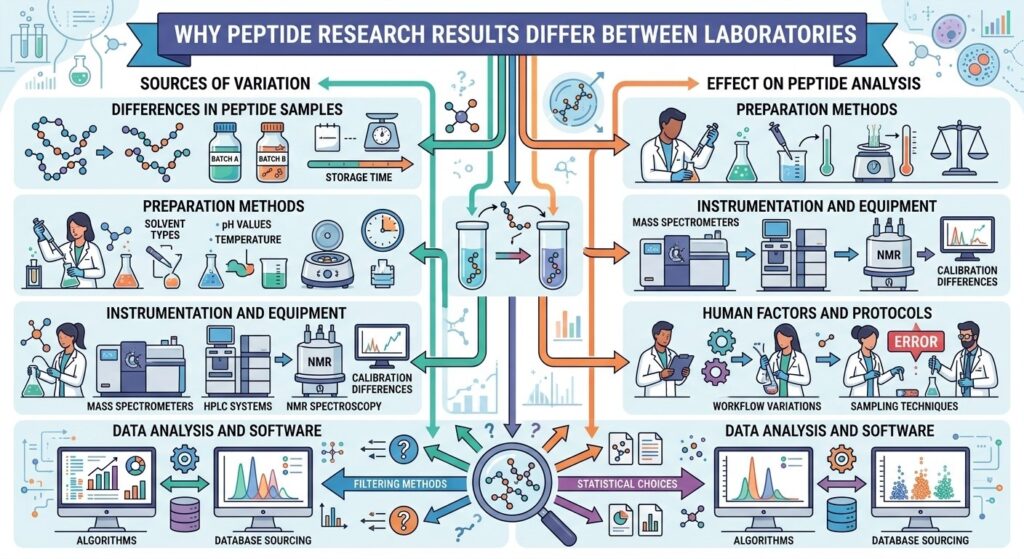
Table of Contents
1. What Causes Laboratory Differences?
2. Why Research Peptides Results Differ Between Laboratories: Testing Methods
3. Net Peptide Content vs. Gross Weight
4. Storage and Environmental Degradation
5. Reconstitution Buffer Effects
6. Analytical Equipment Calibration Differences
7. The Filter Loss Phenomenon
8. The HPLC Purity Trap
9. Regulatory and Accreditation Factors
10. How to Compare Laboratory Reports Correctly
11. Common Misconceptions About Peptide Testing
12. Final Thoughts
13. Frequently Asked Questions
What Causes Laboratory Differences?
Several factors can influence peptide testing outcomes.
These include:
•Purity differences
•Testing methodologies
•Storage conditions
•Synthesis quality
•Sample handling
•Instrument calibration
•Laboratory validation procedures
Even when two laboratories analyze samples from the same batch, the reported values may not be identical.
Why Research Peptides Results Differ Between Laboratories: Testing Methods
One major reason Why Research Peptides Results Differ Between Laboratories is that laboratories often use different analytical techniques.
Common methods include:
H3: Amino Acid Analysis
Amino acid analysis measures peptide composition by breaking the molecule into individual amino acids and quantifying them.
This method is highly accurate but can produce results that differ from other testing techniques.
H3: Peptide Mapping
Peptide mapping verifies molecular identity by analyzing peptide fragments.
Different laboratories may use varying protocols, software, or reference standards, resulting in slight variations.
H3: Endotoxin Testing
Endotoxin testing determines contamination levels.
Differences in equipment sensitivity and testing procedures can affect reported values.
Why Research Peptides Results Differ Between Laboratories: Net Peptide Content vs. Gross Weight
One of the most misunderstood aspects of peptide testing involves net peptide content and gross weight.
Many buyers assume that a vial labeled “10 mg” contains exactly 10 mg of active peptide.
In reality, laboratory measurements may include:
• Residual moisture
• Counterions
• Salts
• Excipients
• Manufacturing residues
One laboratory may calculate peptide content differently than another, creating apparent discrepancies.
This issue is especially important when comparing Retatrutide and Tirzepatide testing reports.
Why Research Peptides Results Differ Between Laboratories: Storage and Environmental Degradation
Peptides are sensitive molecules.
Improper storage can significantly affect analytical results.
Factors include:
• Temperature fluctuations
• Humidity exposure
• Oxidation
• UV light exposure
• Freeze-thaw cycles
A peptide tested immediately after production may produce different results than the same peptide tested months later.
This is one of the most overlooked explanations for conflicting laboratory reports.
Why Research Peptides Results Differ Between Laboratories: Reconstitution Buffer Effects
https://peptideaminonation.com/peptide-reconstitution-measurement-errors/
Before analysis, many peptides must be dissolved.
The chosen solvent can affect:
• Solubility
• Recovery rates
• Aggregation behavior
• Detection sensitivity
Different laboratories may use:
• Water
• Acetic acid solutions
• Buffered solutions
• Organic solvents
As a result, analytical outcomes may vary despite testing the same peptide.
Why Research Peptides Results Differ Between Laboratories: Analytical Equipment Calibration
Analytical instruments require regular calibration.
Even high-end equipment can produce slightly different measurements if calibration procedures differ.
Important variables include:
H3: HPLC Systems
Differences in:
• Columns
• Mobile phases
• Flow rates
• Detection wavelengths
can influence purity results.
H3: Mass Spectrometry Systems
Variations in instrument sensitivity and tuning may affect molecular identification and quantification.
Professional laboratories routinely validate their equipment, but small differences remain possible.
The Filter Loss Phenomenon (Quantification Error)
One of the most interesting real-world issues is what I call the Filter Loss Phenomenon.
During sample preparation, laboratories often filter solutions before analysis.
Some peptides can:
• Adsorb to filter materials
• Become trapped within filter membranes
• Experience reduced recovery
The result is a lower measured concentration than expected.
Researchers who are unaware of this issue may incorrectly assume a manufacturing defect exists.
The HPLC Purity Trap (Analytical Interpretation)
https://peptideaminonation.com/how-to-read-a-peptide-coa-10-critical-things-to-learn/
Another common source of confusion is the HPLC Purity Trap.
Many buyers believe that:
Higher purity automatically means higher potency.
This is not always true.
HPLC measures chromatographic purity, not biological activity.
Two peptide samples may both show:
• 99% HPLC purity
Yet still differ in:
• Stability
• Potency
• Degradation profile
•Manufacturing quality
Understanding this distinction is critical when interpreting COAs.
Regulatory and Accreditation Factors
Not all laboratories operate under the same quality standards.
Accreditation can influence reliability.
Important standards include:
H3: ISO Accreditation
ISO-accredited laboratories follow documented quality procedures and validation protocols.
H3: Good Laboratory Practice (GLP)
GLP standards help ensure consistency and traceability.
H3: Good Manufacturing Practice (GMP)
GMP environments reduce contamination risks and improve testing reliability.
Laboratories operating under these standards generally produce more reproducible results.
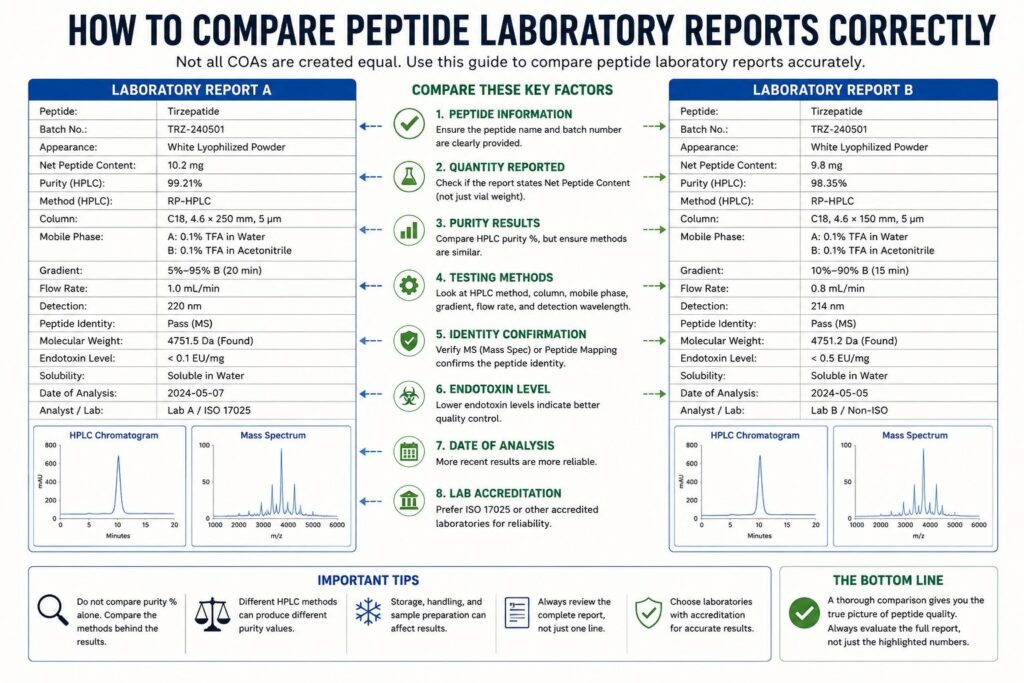
How to Compare Peptide Laboratory Reports Correctly
When reviewing COAs, focus on more than just purity percentages.
Examine:
• Testing methodology
• Sample preparation procedures
• Calibration records
• Batch numbers
• Endotoxin results
• Peptide mapping data
• Amino acid analysis reports
Comparing multiple data points provides a much clearer picture of peptide quality.
Common Misconception About Peptide Testing
H3: The Purity = Potency Fallacy
\Purity does not automatically equal biological effectiveness.
H3: The Universal COA Myth
Not all COAs are created equally.
Different laboratories may use different methodologies.
H3: The Weight vs. Molar Confusion
Mass alone does not always reflect active peptide content.
H3: The Freezer Eternity Assumption
Peptides can degrade even under cold storage conditions.
H3: The Solubility Is Absolute Myth
Solubility depends on formulation, concentration, and solvent selection.
Frequently Asked Questions
Why do two laboratories report different peptide purity values?
Different HPLC methods, columns, solvents, and calibration procedures can produce varying purity measurements.
Does higher peptide purity always mean higher potency?
No. Purity and potency are different measurements and should not be considered interchangeable.
Can peptide storage affect laboratory results?
Yes. Heat, humidity, oxidation, and freeze-thaw cycles can alter peptide integrity.
What is the most reliable peptide testing method?
No single method is sufficient. Combining HPLC, peptide mapping, amino acid analysis, and endotoxin testing provides a more complete assessment.
How can I verify a peptide supplier’s claims?
Request third-party laboratory reports, review testing methodologies, compare multiple COAs, and verify laboratory accreditation standards.
Final Thoughts
Understanding Why Research Peptides Results Differ Between Laboratories helps researchers avoid costly mistakes and interpret testing data accurately.
Laboratory differences often arise from testing methodologies, storage conditions, sample preparation techniques, calibration procedures, and analytical interpretation rather than outright product defects.
By evaluating COAs carefully and understanding the limitations of each testing method, peptide buyers and researchers can make more informed decisions and better assess product quality. I recommend peptideaminonation.com

Comment
How Laboratories Test Peptide Identity: 6 Powerful Methods That Protect You From Costly Mistakes
[…] https://peptideaminonation.com/why-research-peptides-results-differ-between-laboratories/ […]