Common Storage Mistakes That Reduce Peptide Quality

Common Storage Mistakes That Reduce Peptide Quality are responsible for countless cases of peptide degradation, inconsistent research outcomes, and unnecessary product loss. As a peptide supplier who has worked with thousands of peptide buyers and researchers, I have observed that most peptide quality issues are not caused by manufacturing defects. Instead, they result from improper handling and storage after the peptide arrives.
Many researchers assume that placing a peptide vial in a refrigerator or freezer is enough to preserve quality. Unfortunately, peptide integrity is far more complex. Peptides remain vulnerable to moisture, temperature fluctuations, oxidation, light exposure, and mechanical stress.
Understanding these risks is essential for maintaining purity, potency, and long-term stability.
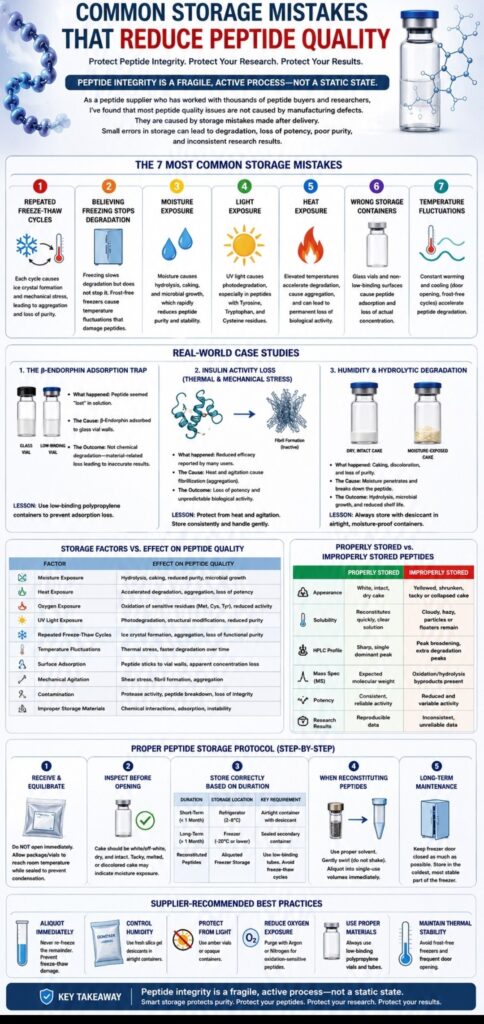
Table of Contents
1. Why Peptide Storage Matters
2. Common Storage Mistakes That Reduce Peptide Quality
3. The Freeze-Thaw Cycle Problem
4. The Freezing Equals Preservation Myth
5. Moisture Exposure and Hydrolysis
6. Light and Oxidation Damage
7. Heat Exposure and Thermal Degradation
8. Using the Wrong Storage Containers
9. Temperature Fluctuations and Frost-Free Freezers
10. Real-World Storage Failure Case Studies
11. Proper Peptide Storage Protocol
12.Storage Factors vs Effect Table
13. Properly stored vs. Improperly Stored Comparison
14. Best Practices From a Supplier’s Perspective
15. Conclusion
Why Peptide Storage Matters
Peptides are highly specialized molecules composed of amino acid chains arranged in precise sequences. Their biological activity depends entirely on maintaining their structural integrity.
Even minor environmental changes can initiate degradation pathways that alter purity, concentration, and performance.
The most common degradation mechanisms include:
• Hydrolysis
• Oxidation
• Aggregation
• Photodegradation
• Surface adsorption
• Mechanical stress
Once degradation begins, the process is often irreversible.
This is why understanding Common Storage Mistakes That Reduce Peptide Quality is critical for every peptide buyer and researcher.
Common Storage Mistakes That Reduce Peptide Quality
https://peptideaminonation.com/how-humidity-affects-lyophilized-peptides/
1. Repeated Freeze-Thaw Cycles
Repeated freeze-thaw cycles are among the most damaging storage practices affecting peptide stability.
Many users reconstitute an entire vial, remove a portion for use, and return the remaining solution to the freezer. While this may seem efficient, every freeze-thaw cycle introduces significant physical stress.
During freezing, ice crystals form throughout the solution. As the peptide thaws, these crystals can disrupt molecular structures and encourage aggregation.
Why This Happens
Each cycle creates:
• Ice crystal formation
• Mechanical shear stress
• Increased aggregation
• Reduced functional purity
Research consistently shows that repeated freeze-thaw exposure increases degradation products while reducing peptide stability.
Best Practice
Follow the Aliquot and Freeze Rule.
Immediately after reconstitution:
1. Calculate your required working volumes.
2. Divide the solution into single-use aliquots.
3. Store aliquots in low-binding polypropylene tubes.
4. Thaw only what you need.
This simple practice dramatically reduces peptide degradation.
2. The Dangerous Myth That Freezing Stops All Degradation
One of the biggest misconceptions in peptide storage is the belief that freezing automatically preserves peptides forever.
I frequently encounter customers who assume that once a peptide enters a freezer, degradation completely stops.
This assumption is incorrect.
The Frost-Free Freezer Problem
Most residential freezers are frost-free.
To prevent ice buildup, they periodically warm and cool during operation.
These temperature oscillations expose peptides to repeated micro-stress events that accelerate degradation.
check below some of Common Storage Mistakes That Reduce Peptide Quality
Industrial vs Household Storage
| Storage Environment | Typical Temperature | Stability Impact |
| Ultra-Low Laboratory Freezer | -80°C | Minimal degradation |
| Standard Laboratory Freezer | -20°C | Slow degradation continues |
| Household Freezer | -18°C to -20°C | Temperature fluctuations increase risk |
Key Takeaway
Freezing slows degradation.
It does not eliminate degradation.
Proper storage requires temperature stability in addition to low temperatures.
Moisture Exposure and Hydrolytic Degradation
Among all Common Storage Mistakes That Reduce Peptide Quality, moisture exposure is perhaps the most underestimated.
Lyophilized peptides may appear dry and stable, but they remain hygroscopic.
This means they actively absorb moisture from surrounding air.
When water enters the storage environment, hydrolysis begins.
What Is Hydrolysis?
Hydrolysis occurs when water molecules attack peptide bonds.
This gradually breaks down the molecular structure and creates degradation products.
In tropical and high-humidity environments, this process accelerates significantly.
Warning Signs
Improperly stored peptides may show:
• Caking
• Clumping
• Loss of cake structure
• Increased discoloration
• Reduced purity
Best Practice
Store peptides:
• In airtight containers
• With fresh silica gel desiccants
• Inside secondary moisture-proof packaging
• Away from humidity sources
Always allow cold vials to reach room temperature before opening to prevent condensation.
Real-World Case Study: Humidity and Hydrolysis
Pharmaceutical stability studies conducted under Zone IVb conditions (30°C and 75% relative humidity) have repeatedly demonstrated accelerated peptide degradation.
Water molecules penetrate the storage environment and attack peptide bonds.
The result is reduced purity, compromised structural integrity, and shortened shelf life.
For peptide users in tropical climates, humidity control is not optional.
It is essential.
Light Exposure and Photodegradation
Light exposure is one of the most overlooked Common Storage Mistakes That Reduce Peptide Quality.
Many peptide users focus on temperature while completely ignoring the effects of UV radiation. Certain amino acids are particularly vulnerable to light-induced damage.
These include:
• Tyrosine
• Tryptophan
•Phenylalanine
•Cysteine
When exposed to UV light, these residues absorb energy and undergo chemical modifications that can alter the peptide’s structure and activity.
How Photodegradation Occurs
Photodegradation occurs when ultraviolet light initiates chemical reactions within the peptide molecule.
Over time, this can result in:
• Reduced purity
• Structural modifications
• Lower biological activity
• Increased degradation products
Best Practices
To minimize photodegradation:
• Store peptides in amber vials.
• Use opaque storage containers.
• Keep peptides away from direct sunlight.
• Store vials in dark freezer compartments.
Even brief, repeated exposure to light can contribute to long-term degradation.
Heat Exposure and Thermal Degradation
https://peptideaminonation.com/why-impurities-form-during-peptide-synthesis/
Heat is one of the fastest ways to reduce peptide stability.
As temperature increases, molecular motion accelerates. This increased kinetic energy speeds up chemical reactions that break down peptide structures.
Why Heat Is Dangerous
Elevated temperatures can accelerate:
• Hydrolysis
• Oxidation
• Aggregation
• Deamidation
Even temporary exposure to excessive heat during shipping, storage, or handling can negatively impact peptide quality.
The Insulin Example
Insulin is one of the most well-studied examples of thermal degradation.
When exposed to heat or mechanical agitation, insulin molecules can aggregate and form fibrils.
These inactive aggregates reduce the peptide’s ability to perform its intended biological function.
This demonstrates why proper temperature management is critical for maintaining peptide integrity.
Using the Wrong Storage Containers
Container selection plays a larger role in peptide preservation than many users realize.
One of the most common Common Storage Mistakes That Reduce Peptide Quality is storing peptides in unsuitable containers.
The β-Endorphin Adsorption Case Study
Researchers studying β-Endorphin observed an apparent loss of peptide concentration during storage and analysis.
Initially, this loss was assumed to be chemical degradation.
However, further investigation revealed that the peptide was adsorbing to the walls of glass containers.
The peptide was not degrading.
It was simply sticking to the vial.
Why Adsorption Matters
Adsorption can cause:
• Apparent concentration loss
• Inaccurate measurements
• Misleading research results
• Reduced recovery rates
Best Practice
Use:
• Low-binding polypropylene tubes
° Low-protein-binding storage containers
• Specialized peptide storage vials
Avoid standard glass containers when storing hydrophobic peptides.
Temperature Fluctuations and Frost-Free Freezers
Many users believe a freezer provides a stable storage environment.
In reality, most household freezers experience continuous temperature fluctuations.
The Frost-Free Cycle Problem
Frost-free freezers periodically warm up to remove ice buildup.
These warming cycles expose peptides to repeated thermal stress.
Although the temperature changes may seem minor, they occur repeatedly over months of storage.
Why Fluctuations Matter
lTemperature fluctuations can:
• Promote aggregation
• Increase oxidation
• Accelerate degradation
• Reduce long-term stability
Best Practice
Create a thermal buffer by placing peptide containers inside:
• Insulated storage boxes
• Styrofoam containers
• Secondary sealed containers
This helps maintain a more consistent microenvironment.
Real-World Storage Failure Case Studies
check below some of the Common Storage Mistakes That Reduce Peptide Quality
Case Study 1: β-Endorphin Adsorption
Problem:
Researchers observed peptide loss during storage.
Cause:
The peptide adsorbed to glass vial surfaces.
Outcome:
Significant concentration loss and inaccurate measurements.
Lesson:
Storage material selection matters.
Case Study 2: Insulin Activity Loss
Problem:
Reduced therapeutic effectiveness after storage.
Cause:
Heat exposure and mechanical agitation promoted fibrillization.
Outcome:
Reduced potency and biological activity.
Lesson:
Temperature control is essential.
Case Study 3: Humidity-Induced Hydrolysis
Problem:
Accelerated degradation under tropical storage conditions.
Cause:
Water penetration and hydrolysis.
Outcome:
Reduced purity and compromised structural integrity.
Lesson:
Moisture is often the silent killer of peptide quality.
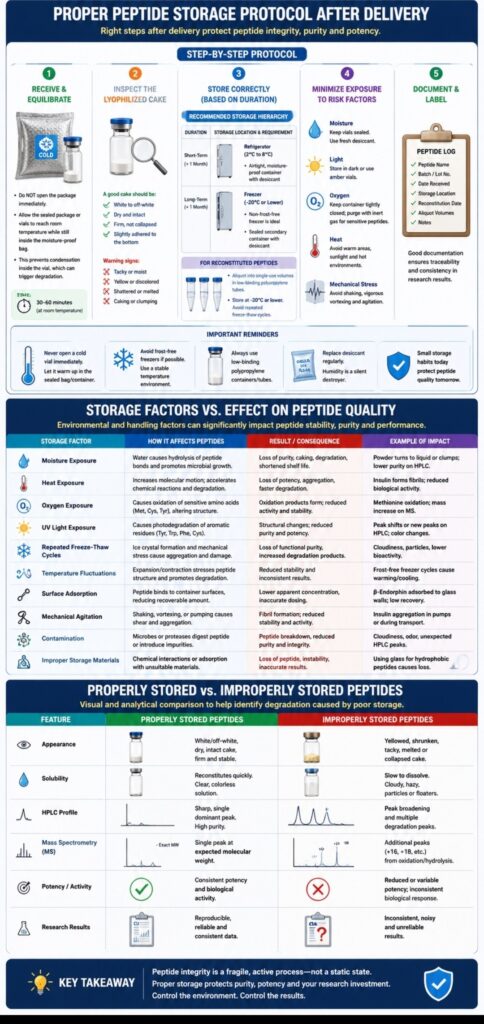
Proper Peptide Storage Protocol After Delivery
https://peptideaminonation.com/peptide-dosing-molar-concentration-mg-to-mm/
The first few minutes after receiving a peptide shipment can significantly affect long-term quality.
Step 1: Allow Temperature Equilibration
Do not immediately open a cold package.
Allow the package to reach room temperature while remaining sealed.
This prevents condensation from forming inside the vial.
Step 2: Inspect the Lyophilized Cake
A healthy peptide cake should appear:
• White or off-white
• Dry
• Structurally intact
Warning signs include:
• Tacky appearance
• Yellow discoloration
• Moisture presence
Collapsed cake structure
check below some of the Common Storage Mistakes That Reduce Peptide Quality
Step 3: Store Correctly
| Duration | Storage Location | Requirement |
| Less Than 1 Month | Refrigerator (2°C–8°C) | Airtight container with desiccant |
| More Than 1 Month | Freezer (-20°C or lower) | Secondary sealed container |
| Reconstituted Peptides | Aliquoted freezer storage | Avoid repeated freeze-thaw cycles |
Storage Factors vs. Effect on Peptide Quality
| Storage Factor | Effect on Peptide Quality |
| Moisture | Hydrolysis and purity loss |
| Heat | Accelerated degradation |
| Oxygen | Oxidation and molecular modification |
| UV Light | Photodegradation |
| Freeze-Thaw Cycle | Aggregation and instability |
| Temperature Fluctuation | Reduced long-term stability |
| Adsorption | Apparent concentration loss |
| Contamination | Structural degradation |
Properly Stored vs Improperly Stored Peptides
| Characteristics | Proper Stored | Improper Stored |
| Appearance | White, intact cake | Yellowed or collapsed cake |
| Solubility | Clear solution | Cloudy or hazy solution |
| HPLC Results | Sharp dominant peak | Multiple degradation peaks |
| Mass Spectrometry | Expected molecular weight | Oxidation and hydrolysis products |
| Potency | Consistent performance | Variable performance |
| Research results | Producible data | Inconsistent outcomes |
Best Practices From a Supplier’s Perspective
After working with thousands of peptide customers, several patterns consistently emerge.
The customers who experience the fewest quality issues follow a disciplined storage protocol.
The Non-Negotiable Rules
Aliquot Immediately
Never repeatedly freeze and thaw the same vial.
Control Humidity
Always use fresh silica gel desiccants.
Protect Against Light
Use amber containers whenever possible.
Reduce Oxygen Exposure
Consider inert gas purging for highly sensitive peptides.
Choose Proper Materials
Use low-binding polypropylene storage containers.
Create Thermal Stability
Avoid frequent freezer access and temperature fluctuations.
Following these practices can dramatically extend peptide shelf life and preserve purity.
Conclusion
Common Storage Mistakes That Reduce Peptide Quality are responsible for far more peptide failures than most users realize.
Throughout my experience as a peptide supplier serving thousands of buyers and researchers, I have found that storage practices often determine whether a peptide maintains its quality or slowly degrades before use.
Moisture, heat, oxidation, light exposure, adsorption, contamination, and repeated freeze-thaw cycles all contribute to peptide degradation.
The most important lesson is simple:
Peptide integrity is a fragile, active process—not a static state.
Proper storage is not about placing a vial in a freezer and forgetting about it.
It is about actively controlling the environmental factors that influence peptide stability.
By implementing proper storage protocols, choosing appropriate materials, minimizing moisture exposure, and avoiding repeated freeze-thaw cycles, researchers can maximize peptide quality, improve data reliability, and protect their investment. For more information and reliable products visit peptideaminonation.com
