Common Peptide Reconstitution Myths: 15 Dangerous Mistakes Every Researcher Should Avoid for Better Peptide Stability

Common Peptide Reconstitution Myths
Peptide reconstitution appears simple on the surface, but it is one of the most misunderstood steps in peptide research. Every year, researchers lose valuable samples because they follow advice copied from online forums, outdated protocols, or social media rather than peptide chemistry.
At PeptideAmino Nation, we’ve spent more than two decades supporting researchers with peptide handling, storage, sequence analysis, and laboratory best practices. Since 2003, we’ve helped over 10,000 researchers understand why successful experiments begin long before the first assay—it starts with proper peptide preparation.
Unfortunately, many failures blamed on “poor peptide quality” are actually caused by incorrect reconstitution techniques.
A peptide may arrive with excellent purity confirmed through HPLC analysis and supported by a Certificate of Analysis (COA), yet become unusable within minutes if reconstituted improperly.
Understanding Common Peptide Reconstitution Myths can help researchers:
• Preserve peptide integrity
• Improve experimental reproducibility
• Reduce unnecessary laboratory expenses
• Prevent peptide degradation
• Increase confidence in research results
In this comprehensive guide, we’ll separate laboratory facts from internet myths while explaining the science behind each recommendation.
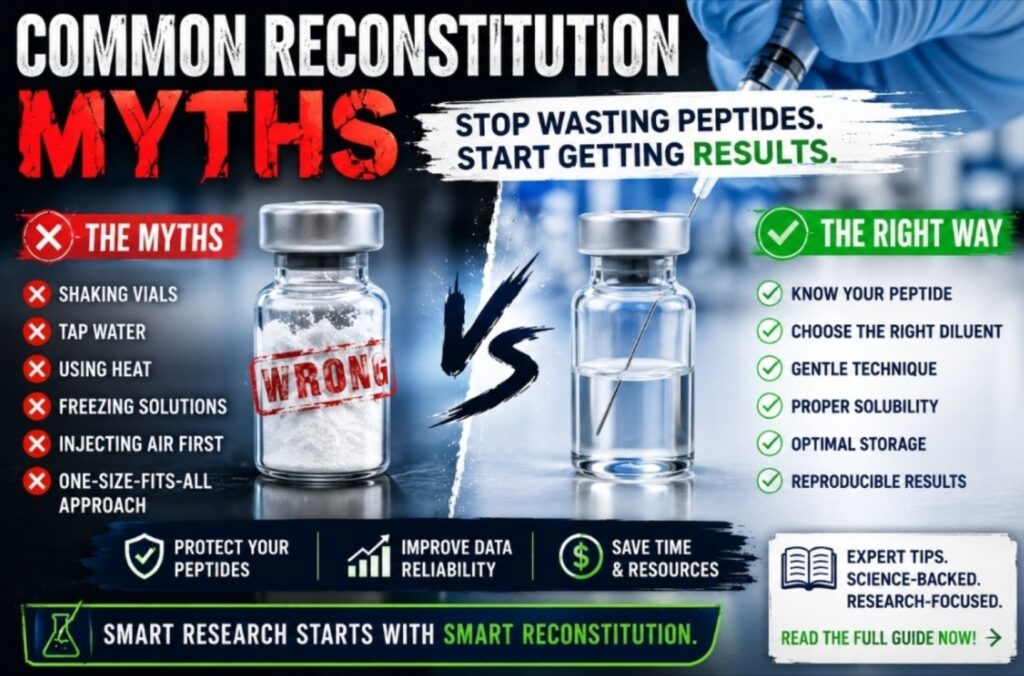
Table of Contents
1. What Are Common Peptide Reconstitution Myths?
2. Why Reconstitution Matters More Than Most Researchers Realize
3. Myth #1: Every Peptide Dissolves Perfectly in Water
4. Understanding Why Peptides Behave Differently
5. Hydrophilic vs Hydrophobic Peptides
6. Why Sequence Determines Solubility
7. Professional Laboratory Solvent Selection
8. Expert Insights from PeptideAmino Nation
What Are Common Peptide Reconstitution Myths?
https://pubmed.ncbi.nlm.nih.gov/
Common Peptide Reconstitution Myths are widespread misconceptions about how lyophilized peptides should be dissolved before laboratory research.
Many of these myths spread through bodybuilding forums, social media videos, copied protocols, and anecdotal advice rather than evidence-based peptide science.
Examples include:
• Every peptide dissolves in water.
• Shaking helps peptides dissolve faster.
• Hot water improves dissolution.
• Tap water is acceptable.
• Frozen reconstituted peptides last forever.
• Injecting air into every vial is always necessary.
Although these statements sound harmless, they ignore one important reality:
Every peptide possesses a unique amino acid sequence, molecular structure, charge distribution, and solubility profile.
Treating every peptide identically often produces inconsistent laboratory outcomes.
Why Reconstitution Matters More Than Most Researchers Realize
Researchers often focus heavily on peptide purity.
While purity certainly matters, improper handling after receiving the peptide frequently causes greater losses than manufacturing defects.
Imagine purchasing a peptide synthesized at over 99% purity.
If the researcher immediately:
• Uses the wrong solvent,
• Shakes the vial aggressively,
• Introduces excess heat,
• Stores it improperly,
that highly purified material may rapidly aggregate or degrade.
The result?
Poor assay performance.
Reduced biological activity.
Unexpected experimental variability.
Additional laboratory expenses.
Weeks of lost research.
Proper reconstitution protects the quality already achieved during synthesis.
Common Peptide Reconstitution Myths Myth #1: Every Peptide Dissolves Perfectly in Water
This is arguably the most expensive misconception in peptide research.
Many researchers assume peptides behave like table salt.
Add water.
Wait.
Everything dissolves.
Unfortunately, peptide chemistry is considerably more complex.
Why This Myth Exists
Many educational articles oversimplify peptide handling by recommending bacteriostatic water or sterile water without explaining that different peptide sequences possess completely different physicochemical properties.
Researchers naturally assume:
“If water works for one peptide, it should work for all.”
Unfortunately, that assumption has destroyed countless valuable peptide samples.
The Science Behind Peptide Solubility
A peptide is not simply a powder.
It is a carefully engineered chain of amino acids.
Each amino acid contributes unique chemical characteristics.
Some amino acids attract water.
Others strongly repel water.
Some carry positive electrical charges.
Others carry negative charges.
These differences determine how the peptide behaves when liquid first contacts the lyophilized cake.
Professional laboratories never assume every peptide shares identical solubility.
Instead, they evaluate:
• Amino acid sequence
• Hydrophobicity
• Molecular charge
• Isoelectric point (pI)
• Intended experimental buffer
• Storage conditions
These factors determine the optimal reconstitution strategy.
Hydrophilic vs. Hydrophobic Peptides
One of the biggest reasons Common Peptide Reconstitution Myths continue spreading is that many people never learn the difference between hydrophilic and hydrophobic peptides.
Hydrophilic Peptides
Hydrophilic peptides contain amino acids that readily interact with water.
These peptides generally dissolve relatively easily when appropriate aqueous solvents are used.
Examples often include peptides rich in:
• Serine
• Threonine
• Glutamate
• Aspartate
Even then, researchers should avoid assuming water alone is always the best choice.
Buffer composition and pH remain important considerations.
Hydrophobic Peptides
Hydrophobic peptides present much greater challenges.
These sequences contain amino acids that naturally avoid water.
Common hydrophobic amino acids include:
• Leucine
• Isoleucine
• Valine
• Phenylalanine
• Tryptophan
When pure water suddenly contacts these peptides, the molecules frequently cling to one another instead of dispersing.
Instead of dissolving, they begin forming aggregates.
This leads directly to one of the most frustrating laboratory problems.
The “Gummy Bear” Effect
Researchers often describe this phenomenon as:
• Sticky gel
• Cloudy suspension
• Rubbery pellet
• Gelatinous mass
Instead of becoming a clear solution, the peptide transforms into a thick clump at the bottom of the vial.
This occurs because hydrophobic regions attempt to avoid contact with water by sticking together.
Once extensive aggregation develops, recovering the peptide becomes extremely difficult.
In many cases, even introducing DMSO later cannot fully reverse the damage.
What started as a perfectly synthesized peptide becomes unusable—not because of poor manufacturing, but because the wrong reconstitution method was chosen.
This is one of the clearest examples of why understanding Common Peptide Reconstitution Myths can save both valuable research materials and significant laboratory costs.
Common Reconstitution Myths: The Truth Behind Laboratory Mistakes (Part 2)
Common Reconstitution Myths: Myth #2 — Shaking the Vial Helps Peptides Dissolve Faster
Among all Common Peptide Reconstitution Myths, few are as widespread as the belief that vigorously shaking a peptide vial speeds up dissolution.
Many researchers naturally assume that if sugar dissolves faster when stirred, peptides should behave the same way.
Unfortunately, peptides are far more delicate than simple crystalline compounds.
Why Researchers Believe This Myth
Many online videos demonstrate users shaking peptide vials immediately after adding the diluent. Others recommend vortexing the vial for several minutes until the powder disappears.
Although this may appear effective, it often creates problems that are invisible to the naked eye.
The peptide may look completely dissolved while its molecular structure has already been compromised.
Why Vigorous Shaking Can Damage Peptides
Peptides are chains of amino acids folded into specific conformations. Mechanical stress generated by aggressive shaking creates tiny air bubbles throughout the solution.
This introduces two major problems.
Air-Water Interfaces
Every bubble creates an air-water interface.
Many peptide molecules migrate toward these interfaces, where they begin unfolding.
As they unfold, they expose hydrophobic regions that normally remain protected.
These exposed regions rapidly stick together, forming aggregates.
The solution may appear normal initially, but laboratory performance often declines significantly.
Increased Oxidation
Vigorous shaking also introduces excess oxygen into the solution.
Certain amino acids are especially sensitive to oxidation, including:
• Methionine
• Cysteine
• Tryptophan
• Tyrosine
Oxidation alters peptide chemistry and may reduce biological activity long before researchers notice visible changes.
Foam Formation
Some peptide formulations produce foam after excessive shaking.
Foam dramatically increases the total air-water surface area, accelerating denaturation.
Professional laboratories avoid creating unnecessary foam whenever possible.
The Correct Technique
Instead of shaking:
Allow the diluent to flow gently down the inside wall of the vial.
Let the peptide hydrate naturally.
Slowly rotate or roll the vial between your palms.
If necessary, gently swirl in small circular motions.
Allow the solution to rest for several minutes before handling again.
Patience often produces better peptide recovery than force.
Common Peptide Reconstitution Myths: Myth #3 — Hot Water Makes Peptides Dissolve Better
Another dangerous entry among Common Peptide Reconstitution Myths is the belief that warming the diluent speeds dissolution without consequences.
Some researchers intentionally heat bacteriostatic water or sterile water before reconstitution.
Others place the peptide vial in warm water after adding the diluent.
Although heat can increase the solubility of many ordinary chemicals, peptides are biological molecules with far greater sensitivity.
Why Heat Can Become the Enemy
Temperature influences molecular motion.
As temperature rises, molecules move faster.
While this sometimes improves dissolution, excessive heat also accelerates unwanted chemical reactions.
These include:
• Hydrolysis
• Oxidation
• Deamidation
• Structural rearrangement
Once these reactions occur, they cannot simply be reversed by cooling the sample.
Heat Can Permanently Reduce Peptide Stability
Many researchers mistakenly assume:
“It dissolved faster, so everything must be fine.”
Unfortunately, faster dissolution does not always mean better preservation.
A peptide may become fully dissolved while simultaneously losing structural integrity.
This is why professional laboratories generally avoid unnecessary heating unless specific protocols require it.
Better Alternatives
If dissolution appears slow:
• Verify that the peptide is suitable for aqueous solvents.
• Review the amino acid sequence.
• Check the isoelectric point.
• Consider whether a small amount of DMSO or another compatible solvent should be used first.
• Allow additional time before assuming the peptide is insoluble.
Time is usually a safer solution than heat.
Common Peptide Reconstitution Myths: Myth #4 — Tap Water Is Good Enough
This misconception remains surprisingly common.
Because tap water is safe for drinking, some individuals assume it is acceptable for peptide research.
It is not.
Professional laboratories never use ordinary tap water for peptide reconstitution.
What’s Inside Tap Water?
Tap water composition varies between cities and countries.
It may contain:
• Calcium
• Magnesium
• Iron
• Copper
• Chlorine
• Fluoride
• Organic compounds
• Trace microorganisms
• Variable pH
Even extremely low concentrations of these substances may interfere with sensitive peptide preparations.
Trace Metals Can Accelerate Degradation
Certain metal ions catalyze oxidation reactions.
Sensitive amino acids become more susceptible to degradation when exposed to these contaminants.
The result may include:
• Lower peptide stability
• Reduced experimental reproducibility
• Unexpected assay variability
Researchers may incorrectly blame the peptide manufacturer when contamination actually originated from the water source.
Professional Recommendation
Instead of tap water, laboratories typically select an appropriate diluent based on the peptide’s characteristics.
Depending on the application, this may include:
• Sterile Water for Injection
• Bacteriostatic Water
• Buffered solutions
• Dilute acetic acid
• Appropriate laboratory-grade solvents
The correct choice depends on the peptide sequence—not internet advice.
Common Peptide Reconstitution Myths: Myth #5 — Injecting Air First Is Always Required
Another frequently misunderstood topic involves pressure equalization.
Many instructional videos teach researchers to inject air into every vial before withdrawing liquid.
While this practice is appropriate for many multidose diluent vials, it is not universally applicable.
Understanding Vacuum-Sealed Peptide Vials
Most lyophilized peptide vials leave the manufacturer under partial vacuum.
This vacuum helps preserve stability during storage and transportation.
Injecting excessive air too quickly can:
• Disturb the lyophilized cake.
• Increase oxygen exposure.
• Introduce unnecessary turbulence.
• Reduce sterility if poor technique is used.
Researchers should understand the purpose of the vacuum before attempting to equalize pressure.
The Correct Laboratory Approach
Professional laboratories typically:
1. Inspect the vial first.
2. Insert the needle carefully.
3. Allow the vacuum to gently draw in the diluent when appropriate.
4. Control the flow rather than forcing rapid injection.
5. Avoid blasting liquid directly onto the peptide cake.
This controlled approach minimizes mechanical stress while promoting even hydration.
Expert Insight from PeptideAmino Nation
After supporting researchers since 2003, one observation has remained remarkably consistent:
The majority of peptide handling problems are not caused by poor synthesis—they are caused by preventable handling errors.
Researchers often spend significant time comparing peptide purity percentages, yet overlook the importance of proper reconstitution.
A peptide verified by HPLC, supported by a Certificate of Analysis (COA), and manufactured to a high purity standard can still be compromised within minutes if incorrect techniques are used.
At PeptideAmino Nation, we encourage researchers to evaluate every peptide individually rather than relying on “one-size-fits-all” advice found online. Sequence characteristics, solubility, pH requirements, and storage conditions should always guide reconstitution decisions.
This scientific approach helps improve reproducibility, reduce wasted material, and maximize the value of every peptide used in research.
Common Peptide Reconstitution Myths: Advanced Laboratory Mistakes Researchers Should Never Ignore (Part 3)
Common Peptide Reconstitution Myths: Myth #6 — Once a Peptide Is Reconstituted, Freezing Always Extends Its Shelf Life
One of the most persistent Common Peptide Reconstitution Myths circulating on social media and online forums is the belief that freezing a peptide after reconstitution is always the best way to preserve it.
While freezing may be appropriate for some peptides under carefully validated laboratory conditions, it is not a universal recommendation.
In fact, repeatedly freezing and thawing certain peptide solutions can reduce stability and compromise research outcomes.
Why Freeze-Thaw Cycles Matter
When water freezes, it forms microscopic ice crystals.
As these crystals grow, they can place physical stress on peptide molecules.
Repeated freeze-thaw cycles may contribute to:
• Peptide aggregation
• Structural instability
• Reduced biological activity
• Concentration inconsistencies
• Lower experimental reproducibility
Even if the solution appears perfectly clear after thawing, microscopic changes may have already occurred.
This is why experienced laboratories avoid repeated freeze-thaw cycles whenever possible.
The Better Laboratory Practice
Instead of repeatedly freezing and thawing one vial:
• Prepare only the amount needed for immediate research.
• If long-term storage is necessary and validated for the specific peptide, divide the solution into smaller aliquots before freezing.
• Thaw each aliquot only once.
• Avoid refreezing thawed peptide solutions unless stability data specifically supports it.
Remember, storage recommendations vary depending on the peptide’s amino acid sequence and manufacturer guidance.
Common Peptide Reconstitution Myths: Myth #7 — All Peptides Can Be Reconstituted Using the Same Protocol
Perhaps the biggest misconception among beginners is believing there is a universal peptide reconstitution method.
There isn’t.
Every peptide possesses unique chemical characteristics.
These include:
• Amino acid composition
• Molecular weight
• Net charge
• Hydrophobicity
• Isoelectric point (pI)
• Intended laboratory application
Ignoring these differences often leads to failed dissolution, aggregation, or instability.
Why Peptide Sequence Matters
The amino acid sequence determines how a peptide interacts with water, buffers, acids, and organic solvents.
For example:
GLP-1 Peptides
Many GLP-1 receptor agonists require careful handling because certain analogues may exhibit reduced solubility under specific conditions.
Researchers should evaluate:
• Solvent compatibility
• Buffer composition
• Storage recommendations
• Temperature stability
Growth Hormone Peptides
Growth hormone-releasing peptides often dissolve readily under appropriate laboratory conditions but still require gentle handling.
Researchers should avoid:
• Excessive agitation
• Heat exposure
• Unnecessary freeze-thaw cycles
Maintaining sterility remains equally important.
Healing Peptides
Healing peptides such as tissue-repair research peptides may demonstrate different stability profiles depending on sequence modifications.
These peptides should always be reconstituted according to validated recommendations rather than assumptions.
Common Peptide Reconstitution Myths: Understanding the “Water-First” Disaster
Among all Common Peptide Reconstitution Myths, none has likely wasted more research material than assuming water should always be added first.
Professional peptide laboratories know that solvent selection depends entirely on peptide chemistry.
Adding water without understanding the sequence can immediately create irreversible problems.
The “Gummy Bear” Effect
Researchers frequently describe this phenomenon using terms like:
• Sticky gel
• Cloudy suspension
• Thick clumps
• Rubbery pellet
• Gelatinous mass
This occurs when hydrophobic peptide molecules rapidly bind to one another instead of interacting with water.
Rather than dissolving, they aggregate into an insoluble mass.
Unfortunately, once extensive aggregation occurs, complete recovery is often impossible.
The peptide may need to be discarded.
Invisible Precipitation
Sometimes the situation is even more deceptive.
The peptide appears completely dissolved.
The solution looks crystal clear.
Yet, over the next several hours, the peptide slowly precipitates or adsorbs onto the vial walls because the pH is close to its isoelectric point.
Researchers proceed with their experiments.
The biological response is weak or absent.
They conclude:
• The peptide was ineffective.
• The assay failed.
• The supplier delivered poor-quality material.
In reality, the peptide never remained fully dissolved.
Professional Laboratories Use a Solvent Hierarchy
Experienced laboratories rarely rely on guesswork.
Instead, they follow a systematic evaluation process.
Step 1 — Study the Peptide Sequence
Before selecting any solvent, researchers examine:
• Hydrophobic residues
• Charged amino acids
• Molecular properties
• Published stability information
Understanding sequence chemistry significantly improves reconstitution success.
Step 2 — Consider the Isoelectric Point (pI)
The isoelectric point represents the pH at which the peptide carries no net electrical charge.
Near this point, many peptides become less soluble.
Choosing a buffer close to the peptide’s pI may encourage precipitation.
Professional laboratories, therefore, evaluate pH carefully before selecting a diluent.
Step 3 — Select the Appropriate Solvent
Depending on the peptide, laboratories may use:
• Sterile Water
• Bacteriostatic Water
• Dilute acetic acid
• Ammonium hydroxide
• DMSO
• Acetonitrile
• Other validated laboratory solvents
The correct choice depends on scientific evidence—not internet trends.
Representative Laboratory Case Study
A Costly GLP-1 Research Setback
The following example represents a composite educational scenario based on recurring peptide technical support cases. It is intended to demonstrate common laboratory challenges while protecting customer confidentiality.
A research laboratory purchased an expensive custom GLP-1 receptor agonist analog for an experimental study.
Following advice from an online forum, the technician immediately added phosphate-buffered saline (PBS) directly to the lyophilized peptide.
Within seconds, the powder transformed into a thick, cloudy gel.
Believing the peptide simply required additional mixing, the technician vigorously vortexed the vial and warmed it in a water bath.
The aggregation became even worse.
The laboratory assumed the peptide batch was defective.
The Investigation
Instead of replacing the peptide immediately, the laboratory reviewed the amino acid sequence.
Analysis revealed:
• A relatively hydrophobic sequence.
• Several basic amino acid residues.
• An isoelectric point close to the pH of the chosen buffer.
The issue was not peptide quality.
The problem originated from solvent selection.
The Outcome
After reviewing peptide chemistry and selecting a more appropriate reconstitution strategy, the laboratory updated its standard operating procedures.
Future experiments demonstrated:
• Improved peptide solubility.
• Better assay reproducibility.
• Reduced sample waste.
• Lower operating costs.
• Greater confidence in research results.
This example illustrates why understanding Common Reconstitution Myths is just as important as purchasing high-quality peptides in the first place.
Expert Perspective from PeptideAmino Nation
At PeptideAmino Nation, we’ve learned that successful peptide research depends on far more than purity alone.
Researchers should evaluate every peptide based on its unique biochemical characteristics rather than assuming one protocol fits every molecule.
That is why we encourage researchers to:
• Review the Certificate of Analysis (COA).
• Understand peptide sequence properties.
• Select appropriate solvents.
• Handle every vial gently.
• Follow validated storage recommendations.
These simple practices can dramatically reduce costly mistakes and help produce more reliable, reproducible laboratory results.
If you’re unsure about the best reconstitution strategy for a specific research peptide, the educational resources available at PeptideAminoNation.com can help you make informed, science-based decisions before beginning your next experiment.
Common Peptide Reconstitution Myths: Hidden Mistakes, Expert Checklist & Best Practices (Part 4)
Common Peptide Reconstitution Myths: Myth #8 — Every Sterile Container Is Safe for Peptide Storage
Another frequently overlooked topic among Common Peptide Reconstitution Myths is the assumption that any sterile vial, syringe, or tube is suitable for peptide handling.
Sterility is essential, but it is only one part of the equation.
The material used to manufacture the container can significantly influence peptide recovery, especially when working with low-concentration or highly sensitive peptides.
The Science of Non-Specific Binding (NSB)
Many peptides naturally adsorb to container surfaces through a process known as Non-Specific Binding (NSB).
Instead of remaining dissolved in the solution, peptide molecules gradually attach themselves to the walls of the container.
This reduces the amount of peptide available for your experiment.
Researchers may unknowingly inject or analyze only a fraction of the intended concentration.
Glass Containers
Glass is an excellent storage material for many laboratory applications, but it contains negatively charged silanol groups on its surface.
Basic peptides carrying a positive charge may bind to these sites.
The result is reduced peptide recovery and inconsistent experimental dosing.
Plastic Containers
Standard polypropylene tubes can also create problems.
Highly hydrophobic peptides may adsorb to plastic surfaces, reducing the available concentration in solution.
For sensitive research applications, many laboratories choose low-retention (LoBind) tubes specifically designed to minimize peptide adsorption.
Common Peptide Reconstitution Myths: Myth #9 — Any Syringe Works the Same
Most disposable syringes are coated internally with a microscopic layer of silicone oil to allow the plunger to move smoothly.
While this improves usability, prolonged contact between peptide solutions and silicone-coated syringes may not always be ideal.
Why Silicone Matters
Certain peptides are attracted to the silicone oil-water interface.
Extended exposure may contribute to:
• Protein or peptide aggregation
• Reduced recovery
• Formation of microscopic particles
• Lower experimental consistency
Although this effect varies depending on the peptide, experienced laboratories avoid leaving reconstituted peptides inside syringes longer than necessary.
Whenever possible:
• Transfer the solution promptly.
• Prepare fresh doses when required.
• Minimize unnecessary storage inside syringes.
These simple habits help maintain peptide integrity throughout the experiment.
Common Peptide Reconstitution Myths: Myth #10 — Cold Peptides Should Be Reconstituted Immediately
Many researchers remove a peptide vial directly from the freezer and immediately add the diluent.
This shortcut may seem harmless, but it introduces unnecessary risks.
Condensation Can Become a Hidden Contaminant
A frozen vial exposed to room-temperature air quickly attracts moisture.
Tiny water droplets form on and around the vial.
If the vial is opened before reaching room temperature, condensation may enter the container.
Although the amount of moisture appears insignificant, it can:
• Alter the intended concentration
• Introduce contaminants
• Affect peptide stability before proper reconstitution begins
Professional laboratories generally allow lyophilized peptides to reach room temperature before opening the vial.
This simple step reduces condensation and promotes more controlled reconstitution.
Common Peptide Reconstitution Myths: Myth #11 — Air Exposure Doesn’t Matter
Another overlooked misconception is that oxygen has little effect on peptide stability.
For many peptides, this assumption is incorrect.
Several amino acids are particularly susceptible to oxidation.
Examples include:
• Methionine
• Cysteine
• Tryptophan
• Tyrosine
Repeatedly opening a vial, vigorous shaking, or leaving excessive air space above the solution may accelerate oxidative degradation over time.
Reducing Oxidation
Professional laboratories often minimize oxidation by:
• Opening vials only when necessary.
• Limiting repeated punctures.
• Storing peptides in appropriately sized containers.
• Protecting solutions from unnecessary air exposure.
• Following manufacturer storage recommendations.
These practices improve long-term stability and reproducibility.
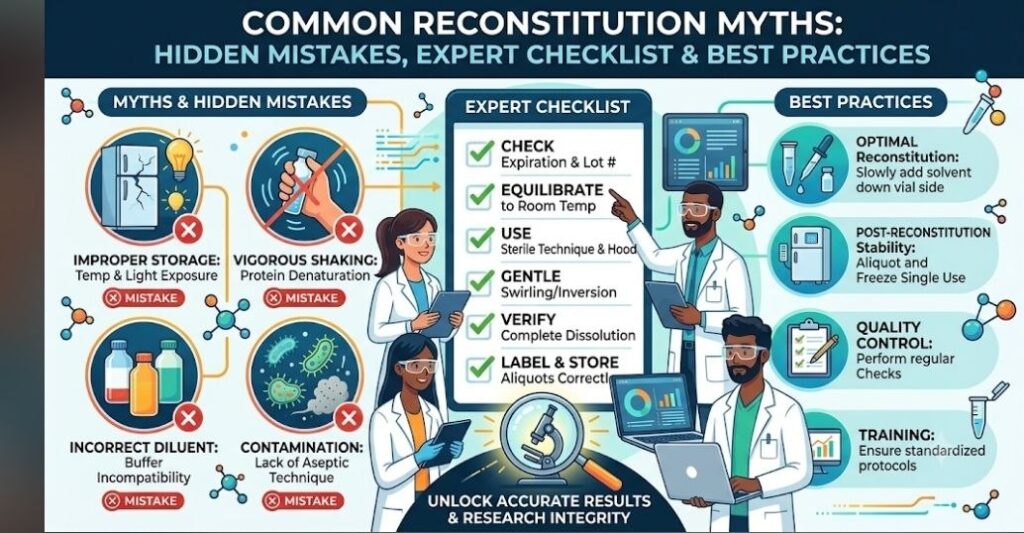
Before Reconstitution: A Professional Researcher’s Checklist
Every successful experiment begins before the first drop of diluent enters the vial.
Use this checklist to reduce avoidable mistakes.
✔ Inspect the Lyophilized Peptide
Check that the peptide cake appears intact and dry.
Avoid using vials showing signs of moisture, discoloration, or damaged seals.
✔ Verify the Certificate of Analysis (COA)
Review the COA before beginning.
Confirm:
• Batch number
• Purity
• Molecular weight
• Analytical testing results
• Storage recommendations
Never assume two peptide batches should be handled identically without verification.
✔ Allow the Vial to Reach Room Temperature
Removing condensation before opening the vial helps preserve sample integrity.
✔ Sanitize the Rubber Stopper
Clean the stopper with 70% isopropyl alcohol.
Allow it to air dry completely before inserting the needle.
Do not puncture a wet stopper.
✔ Double-Check Your Calculations
Before drawing any diluent, confirm:
• Peptide amount (mg)
• Desired concentration
• Final volume
• Required diluent volume
Small mathematical errors often lead to significant experimental inconsistencies.
During Reconstitution: Best Laboratory Practices
Following a consistent technique improves reproducibility.
Add the Diluent Slowly
Allow the liquid to flow gently down the inside wall of the vial.
Avoid directing a strong stream onto the lyophilized peptide.
Let the Peptide Hydrate Naturally
Some peptides require several minutes to hydrate fully.
Patience often prevents unnecessary agitation.
Roll—Don’t Shake
Gently roll the vial between your hands or swirl slowly.
Avoid:
• Shaking
• Vortexing
• Rapid inversion
• Excessive mixing
Inspect the final solution
A properly reconstituted peptide solution should typically appear clear and free from visible particles unless otherwise specified by the manufacturer.
Cloudiness, floating material, or gel formation may indicate incomplete dissolution or incompatibility with the selected solvent.
After Reconstitution: Protecting Peptide Stability
Correct storage is just as important as proper reconstitution.
Researchers should:
• Label every vial immediately.
• Record the reconstitution date.
• Note the final concentration.
• Follow recommended storage temperatures.
• Protect light-sensitive peptides from prolonged light exposure.
• Avoid repeated freeze-thaw cycles unless supported by stability data.
Maintaining accurate records also improves laboratory reproducibility and simplifies troubleshooting.
Why Evidence Always Beats Internet Advice
The internet contains thousands of discussions about peptide handling.
Some recommendations are excellent.
Others are based entirely on anecdotal experience.
When evaluating advice, prioritize information supported by:
• Peptide chemistry
• Stability studies
• Manufacturer recommendations
• Scientific literature
• HPLC analytical testing
• Experienced peptide suppliers
At PeptideAmino Nation, our educational approach is built on these principles because reliable research begins with reliable information.
Every peptide is unique.
Understanding its chemistry before reconstitution helps reduce waste, improve reproducibility, and protect valuable research investments.
The more researchers understand the science behind Common Peptide Reconstitution Myths, the more confident they become in producing accurate and repeatable laboratory results.
Common Peptide Reconstitution Myths: Frequently Asked Questions, Final Expert Advice & Conclusion (Part 5)
Frequently Asked Questions About Common Peptide Reconstitution Myths
1. What is the biggest misconception about peptide reconstitution?
The biggest misconception behind Common Peptide Reconstitution Myths is that every peptide can be reconstituted using exactly the same method.
In reality, peptide solubility depends on several factors, including:
• Amino acid sequence
• Hydrophobicity
• Molecular charge
• Isoelectric point (pI)
• Intended research application
• Storage conditions
Treating every peptide identically often leads to aggregation, precipitation, or reduced stability.
2. Should researchers always use bacteriostatic water?
No.
One of the most common Common Peptide Reconstitution Myths is that bacteriostatic water is automatically the correct choice for every peptide.
While bacteriostatic water is widely used in research, some peptides dissolve more effectively in other laboratory-grade solvents or buffers depending on their chemical properties.
Always consult the manufacturer’s recommendations, peptide-specific documentation, and available stability data before selecting a diluent.
3. Is shaking a peptide vial really harmful?
Aggressive shaking can introduce unnecessary mechanical stress, increase oxygen exposure, and encourage aggregation in some peptides.
Professional laboratories generally recommend gently rolling or swirling the vial instead of shaking it vigorously.
4. Why won’t my peptide dissolve?
Incomplete dissolution may occur because of:
• Incorrect solvent selection
• Hydrophobic amino acid content
• Reconstitution near the peptide’s isoelectric point
• Insufficient hydration time
• Improper storage before reconstitution
Rather than forcing dissolution with excessive heat or vigorous shaking, evaluate the peptide’s chemical characteristics first.
5. Is cloudy solution always a sign of poor peptide quality?
Not necessarily.
Cloudiness may indicate:
• Aggregation
• Incomplete dissolution
• Inappropriate solvent
• Precipitation
• Buffer incompatibility
The appearance of cloudiness alone does not automatically mean the peptide was poorly manufactured.
6. Why should researchers verify the Certificate of Analysis (COA)?
The Certificate of Analysis provides valuable information, including:
• Batch identification
• Purity
• Molecular weight
• Analytical testing results
• Quality control verification
Reviewing the COA before reconstitution helps researchers confirm they are working with the correct material and understand any product-specific handling recommendations.
7. Why do peptides require different reconstitution methods?
Each peptide has a unique amino acid sequence.
That sequence determines:
• Solubility
• Stability
• Charge
• Hydrophobicity
• Buffer compatibility
This is why one protocol cannot be applied universally.
Understanding peptide chemistry is the foundation of successful laboratory research.
Expert Tips from PeptideAmino Nation
After supporting researchers since 2003, one lesson has remained remarkably consistent:
Most peptide failures are preventable.
The overwhelming majority of technical support questions are not related to peptide synthesis—they are related to handling.
Researchers who achieve consistent, reproducible results typically follow a systematic workflow:
• Review the peptide’s Certificate of Analysis (COA).
• Understand its solubility profile.
• Select an appropriate diluent.
• Calculate concentrations carefully.
• Use gentle reconstitution techniques.
• Store the peptide under recommended conditions.
• Record every step for future reproducibility.
These simple habits reduce costly mistakes and improve long-term research quality.
Why Researchers Trust PeptideAmino Nation
At PeptideAmino Nation, we believe supplying high-quality research peptides is only part of our responsibility.
Researchers also deserve clear, evidence-based educational resources that help them avoid common laboratory mistakes.
That is why we continually publish practical guides covering topics such as:
• Peptide reconstitution
• Storage best practices
• Peptide stability
• Certificate of Analysis (COA) interpretation
• HPLC chromatogram understanding
• Research calculations
• Laboratory handling techniques
• Peptide purity and quality control
Whether you are new to peptide research or an experienced laboratory professional, our goal is to help you make informed decisions backed by peptide chemistry rather than internet myths.
Explore additional educational resources, product documentation, and research peptides at PeptideAminoNation.com.
Final Thoughts on Common Reconstitution Myths
Understanding Common Peptide Reconstitution Myths is one of the most effective ways to protect valuable research materials and improve experimental reproducibility.
Many of the misconceptions discussed in this guide—such as shaking the vial, using tap water, applying heat, freezing every reconstituted peptide, or assuming water is always the correct solvent—continue to circulate because they are simple, memorable, and widely repeated. Unfortunately, simplicity does not guarantee scientific accuracy.
Successful peptide research begins with respecting the unique chemistry of every molecule. Factors such as amino acid sequence, hydrophobicity, molecular charge, pH, solvent compatibility, and storage conditions all influence how a peptide behaves during and after reconstitution.
Rather than relying on generic online advice, researchers should follow evidence-based laboratory practices, review product-specific documentation, verify Certificates of Analysis, and consult reliable technical guidance whenever uncertainty exists.
A few extra minutes spent selecting the correct solvent, allowing proper hydration, or verifying calculations can save weeks of experimental work and prevent the unnecessary loss of valuable peptide samples.
At PeptideAmino Nation, our mission extends beyond providing premium research peptides. Since 2003, we’ve been committed to educating researchers, promoting best laboratory practices, and helping laboratories avoid costly errors through science-driven guidance.
By replacing Common Reconstitution Myths with sound biochemical principles, researchers can improve peptide stability, increase reproducibility, reduce waste, and generate more reliable experimental results.
Key Takeaways
• Every peptide has unique chemical properties that influence reconstitution.
• Water is not the correct solvent for every peptide.
• Avoid vigorous shaking and unnecessary heat.
• Never use tap water for peptide reconstitution.
• Allow frozen lyophilized peptides to reach room temperature before opening.
• Verify the Certificate of Analysis (COA) before beginning.
• Choose solvents based on peptide chemistry—not internet trends.
• Minimize freeze-thaw cycles whenever possible.
• Store peptides according to validated recommendations.
• Understanding Common Reconstitution Myths leads to better peptide stability, improved reproducibility, and more reliable research outcomes.
Continue Expanding Your Peptide Knowledge
Successful peptide research goes beyond proper reconstitution. Explore our expert guides to learn how peptide chemistry, storage conditions, and laboratory best practices can improve research accuracy, protect sample integrity, and maximize reproducibility.
Recommended Articles:
• Understanding Peptide Reconstitution Calculations
• Why Researchers Use Bacteriostatic Water Instead of Sterile Water
• Understanding Peptide Oxidation and How to Prevent It
• How Peptide Length Influences Stability
• The Role of pH in Peptide Solubility
• Understanding Hydrophobic vs. Hydrophilic Peptides
• Common Calculation Errors in Peptide Research
• Light Exposure vs. Peptide Stability
• Buffer Solutions in Peptide Research
• Understanding Peptide Purity on Certificates of Analysis (COA)
