Why Researchers Use Bacteriostatic Water: 9 Proven Reasons Every Laboratory Should Know

you’ve ever wondered why researchers use bacteriostatic water, you’re not alone. It is one of the most frequently asked questions we receive from academic laboratories, biotech companies, pharmaceutical researchers, contract research organizations (CROs), and experienced independent researchers.
Having supported peptide researchers since 2003, we’ve noticed that many online articles explain what bacteriostatic water is but rarely explain why researchers use bacteriostatic water in real laboratory settings or how improper handling can compromise valuable research.
In this comprehensive guide, we’ll explain why researchers use bacteriostatic water, dispel common myths, share real laboratory experiences, and help you avoid expensive mistakes that could ruin peptide research.
Whether you’re working with Semaglutide, Tirzepatide, Retatrutide, BPC-157, TB-500, GHK-Cu, MOTS-c, HGH, or other research peptides, understanding why researchers use bacteriostatic water is essential for obtaining reliable research results.
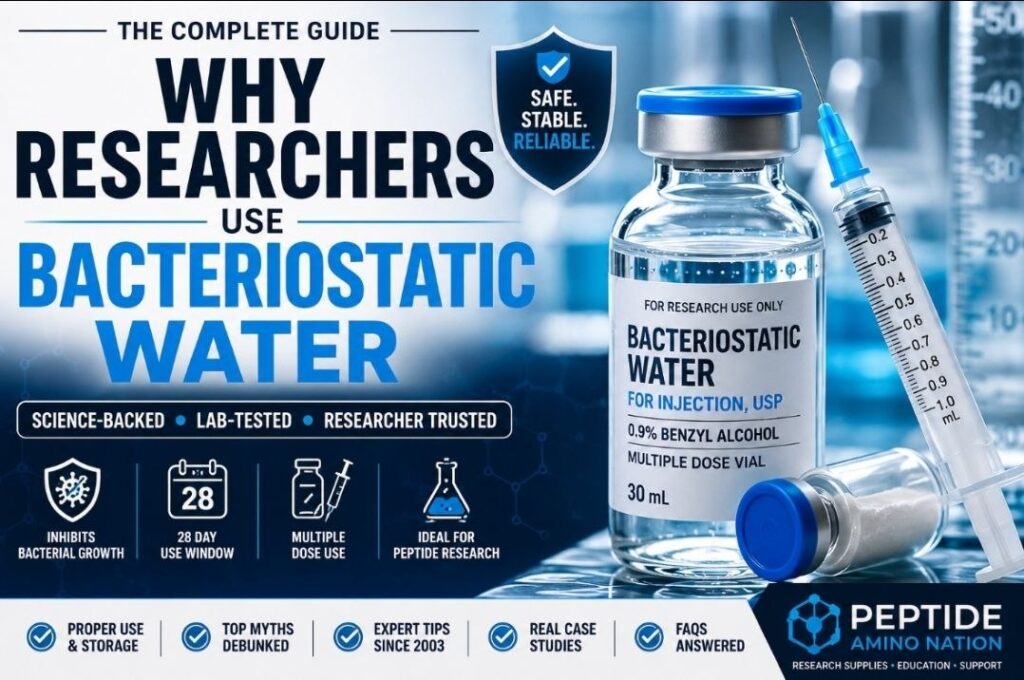
Table of Contents
1. What Is Bacteriostatic Water?
2. Why Researchers Use Bacteriostatic Water
3. Why Bacteriostatic Water Is Different from Sterile Water
4. Which Researchers Commonly Use Bacteriostatic Water?
5. The Science Behind Bacteriostatic Water
6. 9 Reasons Researchers Choose Bacteriostatic Water
7. Common Research Peptides Reconstituted with BAC Water
8. Common Mistakes Researchers Make
9. Expert Case Studies from Our Experience Since 2003
10. Frequently Asked Questions
11. Final Thoughts
What Is Bacteriostatic Water?
https://pubmed.ncbi.nlm.nih.gov/
Why researchers use bacteriostatic water begins with understanding what it actually is.
Bacteriostatic Water for Injection (BWFI) is sterile water containing 0.9% benzyl alcohol, which acts as a bacteriostatic preservative. Rather than killing bacteria, benzyl alcohol slows or prevents bacterial multiplication after repeated punctures of a multi-dose vial.
This makes bacteriostatic water one of the preferred diluents for laboratory peptide reconstitution when repeated withdrawals are required.
Unlike ordinary sterile water, bacteriostatic water is specifically designed for multiple withdrawals under proper laboratory practices.
Why Researchers Use Bacteriostatic Water
The answer isn’t simply “because it contains benzyl alcohol.”
Researchers use bacteriostatic water because it helps support:
• Multi-dose peptide preparation
• Reduced bacterial growth
• Consistent peptide reconstitution
• Laboratory convenience
• Better workflow efficiency
• Reliable research protocols
For laboratories handling expensive peptides, replacing an entire vial because of contamination can cost hundreds or even thousands of dollars.
Understanding why researchers use bacteriostatic water helps researchers protect both their samples and research investment.
The Science Behind Why Researchers Use Bacteriostatic Water
To truly understand why researchers use bacteriostatic water, it’s important to understand the science behind it.
Bacteriostatic water contains sterile water for injection combined with 0.9% benzyl alcohol. This preservative creates an environment that inhibits bacterial growth after the vial has been punctured multiple times.
Notice the wording carefully.
The preservative does not sterilize contaminated equipment.
It does not destroy bacteria already introduced into the vial.
Instead, it helps prevent bacteria from multiplying rapidly, making bacteriostatic water suitable for properly handled multi-dose applications in laboratory settings.
This is one of the biggest reasons why researchers use bacteriostatic water instead of standard sterile water for many peptide reconstitution protocols.
9 Proven Reasons Why Researchers Use Bacteriostatic Water
1. Why Researchers Use Bacteriostatic Water for Multi-Dose Convenience
One of the biggest reasons why researchers use bacteriostatic water is that laboratories rarely need only a single withdrawal from a peptide vial.
Many peptide studies require repeated sampling over several days or weeks.
Because bacteriostatic water contains benzyl alcohol, it provides an added layer of protection against bacterial multiplication between withdrawals when aseptic techniques are followed.
This makes laboratory workflows much more practical than repeatedly opening new sterile water vials.
2. Why Researchers Use Bacteriostatic Water to Reduce Contamination Risks
Every time a needle punctures a vial stopper, microscopic contaminants can potentially enter.
Although no preservative can replace proper sterile technique, bacteriostatic water helps slow bacterial replication should minimal contamination occur.
Researchers still need to:
• Use new sterile needles and syringes
• Clean vial stoppers with alcohol before every puncture
• Avoid touching sterile equipment
• Discard compromised vials immediately
Good laboratory practice always comes first.
3. Why Researchers Use Bacteriostatic Water for Expensive Research Peptides
Modern research peptides can be extremely valuable.
Many laboratories routinely work with compounds such as:
• Tirzepatide
• Semaglutide
• Retatrutide
• BPC-157
• TB-500
• GHK-Cu
• CJC-1295
• Ipamorelin
• MOTS-c
Replacing contaminated peptide preparations can significantly increase research costs.
Understanding why researchers use bacteriostatic water helps laboratories protect these valuable research materials while maintaining proper laboratory standards.
4. Why Researchers Use Bacteriostatic Water for Better Laboratory Efficiency
Researchers appreciate consistency.
Instead of opening a brand-new sterile water vial for every withdrawal, properly handled bacteriostatic water allows laboratories to maintain smoother workflows throughout ongoing projects.
This reduces unnecessary interruptions while helping laboratories follow standardized reconstitution procedures.
5. Why Researchers Use Bacteriostatic Water for Accurate Peptide Reconstitution
Successful peptide research starts with proper reconstitution.
Since 2003, one of the most common support requests we’ve received involves incorrect mixing techniques—not defective peptides.
Proper reconstitution includes:
• Allowing the bacteriostatic water to flow gently down the inside wall of the vial
• Avoid direct pressure on the lyophilized peptide cake
• Gently swirling the vial
• Never shaking vigorously
These simple practices help preserve delicate peptide structures and improve consistency across experiments.
Expert Insight from Over Two Decades of Supporting Researchers
After supporting peptide researchers since 2003, one lesson stands out above all others:
Most peptide failures are not caused by poor peptide quality.
Instead, they result from preventable handling mistakes.
Some of the most common include:
• Confusing bacteriostatic water with sterile water
• Using contaminated syringes
• Reusing needles
• Improper storage
• Incorrect dilution calculations
• Aggressively shaking peptide vials
• Continuing to use bacteriostatic water long after the recommended usage period
These avoidable errors can compromise months of research and lead to unnecessary expenses.
That is why, at Peptide Amino Nation, we don’t simply supply laboratory products. We also provide educational resources, reconstitution protocols, technical support, quality documentation, and practical guidance to help researchers achieve consistent and reliable results.
If you’re looking for trusted peptide research supplies or need expert assistance with peptide reconstitution, visit peptideaminonation.com to explore our resources and connect with our knowledgeable support team.
Debunking the Biggest Myths About Why Researchers Use Bacteriostatic Water
After supporting peptide researchers since 2003, we’ve noticed that many misconceptions about why researchers use bacteriostatic water originate from fitness forums, DIY blogs, and social media rather than reputable scientific sources
Believing these myths can lead to contaminated samples, degraded peptides, failed experiments, and unnecessary costs.
Let’s separate facts from fiction.
Myth #1: Bacteriostatic Water Kills Bacteria and Sterilizes Contaminated Needles
This is one of the most dangerous misconceptions.
Many articles describe bacteriostatic water as “antibacterial” or “sanitizing,” leading researchers to believe it can eliminate contamination after a dirty needle enters the vial.
The Truth
The word bacteriostatic literally means to stop bacterial growth, not to kill bacteria.
The 0.9% benzyl alcohol helps inhibit bacterial replication. It does not sterilize contaminated equipment or purify a contaminated vial.
If bacteria enter the vial through poor aseptic technique, the preservative can not undo that contamination.
Key takeaway: Always use a new sterile needle and syringe for every puncture. Proper sterile technique is far more important than relying on the preservative.
Myth #2: Bacteriostatic Water Can Be Injected by Itself
Another common misconception is that bacteriostatic water can be used like saline for hydration or flushing.
The Truth
Bacteriostatic water is not a substitute for normal saline.
Because it contains virtually no dissolved salts, it is hypotonic. Injecting large amounts of pure bacteriostatic water without an appropriate solute can disrupt osmotic balance and damage cells.
Researchers should use bacteriostatic water only according to established research or clinical protocols for the compounds being reconstituted.
Myth #3: Refrigeration Makes Bacteriostatic Water Last Forever
This myth appears repeatedly on online forums.
Some users believe a refrigerated vial remains safe indefinitely.
The Truth
Even under proper storage conditions, a punctured vial should not be used indefinitely.
The commonly accepted guidance is to discard a multi-dose vial 28 days after the first puncture, as the preservative’s effectiveness decreases over time and repeated punctures increase contamination risk.
Refrigeration may slow certain processes, but it does not stop chemical degradation or eliminate contamination risks.
A good laboratory habit is to write the date of first puncture directly on the vial.
Myth #4: Homemade Bacteriostatic Water Is Just as Good
Some online guides recommend making bacteriostatic water at home.
The Truth
Medical-grade bacteriostatic water is manufactured under carefully controlled conditions.
It requires:
• Pharmaceutical-grade ingredients
• Precisely measured 0.9% benzyl alcohol
• Sterile manufacturing processes
• Quality testing
• Proper pH control
• Microbial quality assurance
Attempting to make bacteriostatic water outside of controlled manufacturing environments can introduce contamination and inconsistent preservative concentrations, making it unsuitable for reliable research.
Why Researchers Use Bacteriostatic Water Instead of Sterile Water
This is one of the questions our support team receives most often.
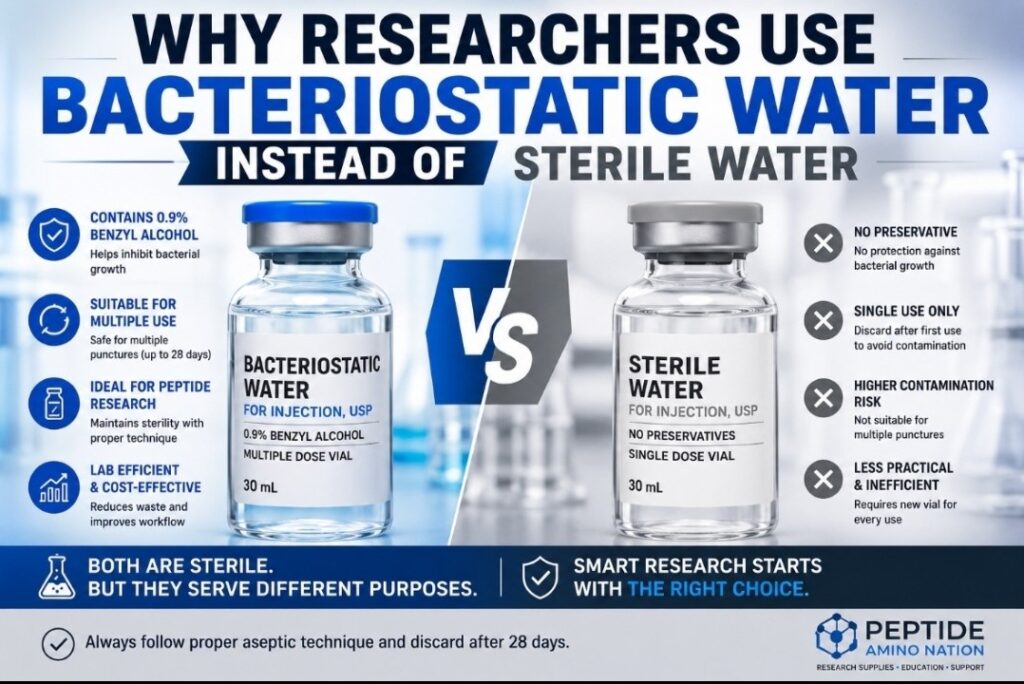
Although both products begin as sterile water, they serve different purposes.
| Feature | Bacteriostatic Water | Sterile Water For Injection |
| Contains preservative | yes (0.9% benzyl alcohol | No |
| Intended for multiple withdrawal | Yes when handled properly | Generally single-use |
| Helps inhibit bacterial growth | Yes | No |
| Suitable for repeating vial punctures | Yes | Not typically |
Choosing the correct diluent depends on the manufacturer’s instructions for the specific peptide or medication being used.
Understanding this distinction is one of the key reasons why researchers use bacteriostatic water for many peptide reconstitution workflows.
Common Mistakes Researchers Make
Over more than two decades of supporting peptide researchers, we’ve observed that most problems stem from handling errors rather than product quality.
The most common mistakes include:
Confusing Sterile Water with Bacteriostatic Water
These products are not interchangeable in every situation. Using the wrong diluent can affect storage practices and multi-dose handling.
Reusing Needles
Every puncture should be performed with a new sterile needle and syringe.
Reusing needles greatly increases the chance of introducing contaminants into the vial.
Improper Storage
Store unopened bacteriostatic water according to the manufacturer’s recommendations.
Protect it from excessive heat, direct sunlight, and freezing.
Incorrect Reconstitution Technique
One mistake we regularly help researchers correct is injecting the diluent directly onto the peptide powder under high pressure.
Instead:
• Allow the bacteriostatic water to run slowly down the inside wall of the vial.
• Let the powder dissolve naturally.
• Gently swirl the vial.
• Never shake vigorously, especially with delicate peptides.
Incorrect Dilution Calculations
Adding too much or too little bacteriostatic water changes the final concentration of the peptide and can complicate accurate dosing within a research protocol.
Always calculate the desired final concentration before beginning reconstitution.
Real-World Case Studies: Why Researchers Use Bacteriostatic Water Correctly
Since 2003, we’ve had the privilege of supporting academic researchers, biotechnology companies, pharmaceutical scientists, universities, contract research organizations (CROs), and experienced independent researchers.
While we never disclose customer identities, the following anonymized case studies reflect common situations our technical support team has encountered over the years. These examples highlight why researchers use bacteriostatic water correctly and how proper handling can prevent costly setbacks.
Case Study #1: A Simple Mixing Mistake Nearly Ruined an Expensive MOTS-c Experiment
The Challenge
A laboratory researcher was reconstituting MOTS-c, a delicate mitochondrial peptide.
When the lyophilized powder didn’t dissolve immediately, the researcher vigorously shook the vial for about 30 seconds.
The solution quickly became cloudy and foamy.
Believing the peptide was defective, the researcher contacted our technical support team.
Our Recommendation
We explained that the peptide itself wasn’t necessarily the problem.
Delicate peptides can be damaged by aggressive shaking, which introduces excessive shear stress and air bubbles that may denature or aggregate the peptide.
Instead, we recommended:
• Slowly inject bacteriostatic water down the inside wall of the vial.
• Avoid direct pressure on the peptide cake.
• Allowing the powder to dissolve naturally.
• Gently swirling the vial instead of shaking it.
The Outcome
The researcher followed the revised protocol with a replacement vial.
The peptide dissolved into a clear solution without visible aggregation, allowing the research project to continue successfully.
Lesson: Proper reconstitution technique is just as important as using high-quality bacteriostatic water.
Case Study #2: The “Three-Month Refrigerator Myth”
The Challenge
An independent researcher conducting a long-term study had been using the same punctured vial of bacteriostatic water for approximately 75 days.
The vial had remained refrigerated the entire time.
The researcher believed refrigeration made continued use acceptable.
Our Recommendation
We explained that refrigeration does not eliminate contamination risks or stop preservative degradation.
Although benzyl alcohol helps inhibit bacterial growth, repeated punctures increase contamination opportunities, and the commonly accepted recommendation is to discard the vial 28 days after first puncture.
We advised the researcher to:
• Discard the existing vial.
• Label every newly opened vial with the puncture date.
• Replace it after 28 days.
The Outcome
The laboratory implemented a simple date-labeling procedure for all multi-dose vials.
This small workflow improvement reduced contamination concerns and helped standardize laboratory practices.
Lesson: Good laboratory documentation is one of the easiest ways to improve research reliability.
Case Study #3: When the Problem Wasn’t the Peptide
The Challenge
A researcher reported significant localized irritation during a peptide research protocol.
Initially, they suspected contaminated bacteriostatic water.
Our Investigation
After reviewing their protocol, we discovered the peptide had been diluted into an unusually large volume of bacteriostatic water.
The issue wasn’t contamination.
Instead, the dilution strategy required adjustment to better align with the research protocol and intended concentration.
The Outcome
After correcting the dilution calculations, the researcher reported improved consistency throughout the study.
Lesson: Accurate calculations are just as important as selecting the correct diluent.
The Most Common Peptides Reconstituted with Bacteriostatic Water
Understanding why researchers use bacteriostatic water also means understanding which peptides commonly require it.
Some of the most frequently reconstituted research peptides include:
Metabolic Research Peptides
• Tirzepatide
• Semaglutide
• Retatrutide
These peptides are widely studied in metabolic and obesity research and require careful concentration calculations during reconstitution.
Tissue Repair Peptides
• BPC-157
• TB-500
These peptides are commonly investigated in regenerative and tissue repair research and generally dissolve readily when proper reconstitution techniques are followed.
Growth Hormone Secretagogues
• CJC-1295
• CJC-1295 DAC
• Ipamorelin
• Sermorelin
Researchers frequently use bacteriostatic water when preparing these peptides for laboratory investigations involving growth hormone pathways.
Aesthetic and Cellular Research Peptides
• GHK-Cu
• Melanotan II
These peptides are commonly studied in skin, pigmentation, and regenerative biology research.
Peptides That Require Extra Care During Reconstitution
Not every peptide behaves the same way.
Some require particularly careful handling.
GHK-Cu
Because of its copper component, GHK-Cu may cause localized irritation if highly concentrated.
Researchers often reduce concentration by using appropriate dilution strategies based on their protocols.
MOTS-c and Humanin
These fragile mitochondrial peptides should never be shaken aggressively.
Instead:
Add bacteriostatic water slowly.
Let the peptide dissolve naturally.
Gently swirl the vial.
Proper handling helps preserve peptide integrity.
Human Growth Hormone (HGH)
Once reconstituted, HGH becomes much more sensitive to temperature.
It should be stored according to the manufacturer’s recommendations, typically under refrigerated conditions after reconstitution, to help preserve stability.
Hydrophobic Research Peptides
Certain custom peptides naturally resist dissolving in water.
These specialized compounds may require alternative laboratory solvents before dilution with bacteriostatic water, following validated research protocols.
Why Researchers Trust Peptide Amino Nation
At Peptide Amino Nation, we understand that supplying products is only part of supporting successful research.
Since 2003, we’ve helped researchers by providing:
• Premium-quality laboratory supplies
• Detailed peptide reconstitution protocols
• Technical support from experienced professionals
• Product documentation
• Reliable packaging and shipping
• Educational resources designed specifically for peptide researchers
Whether you’re working in a university laboratory, biotech company, pharmaceutical research facility, CRO, or conducting advanced independent research, our goal is to help you work with greater confidence and consistency.
Visit PeptideAminoNation.com to explore our selection of bacteriostatic water, peptide research products, educational guides, and expert technical support.
Frequently Asked Questions About Why Researchers Use Bacteriostatic Water
Below are the questions our technical support team has answered most frequently since 2003. If you’ve ever wondered why researchers use bacteriostatic water, these answers address many of the concerns we hear from laboratories and research professionals.
Why do researchers use bacteriostatic water instead of sterile water?
The primary reason why researchers use bacteriostatic water is that it contains 0.9% benzyl alcohol, which helps inhibit bacterial growth after repeated vial punctures.
Standard Sterile Water for Injection contains no preservative and is generally intended for single-use applications. For many multi-dose peptide reconstitution workflows, bacteriostatic water offers added convenience when proper aseptic techniques are followed.
How long can bacteriostatic water be used after opening?
The widely accepted recommendation is to discard bacteriostatic water 28 days after the first puncture.
Even if the solution remains clear and has been stored correctly, repeated punctures increase contamination risk, and the preservative gradually loses effectiveness over time.
A simple best practice is to write the opening date directly on the vial.
Does refrigeration make bacteriostatic water last longer?
No.
Proper storage is important, but refrigeration does not make bacteriostatic water last indefinitely.
Many researchers refrigerate reconstituted peptides because the peptide itself requires cold storage, not because bacteriostatic water needs refrigeration.
Always follow the manufacturer’s storage recommendations for both the bacteriostatic water and the specific peptide being used.
Can bacteriostatic water be used for every peptide?
Not always.
Although why researchers use bacteriostatic wat s closely tied to peptide research, every peptide has its own manufacturer instructions and stability profile.
Some peptides require special handling, while certain specialized compounds may require alternative solvents before dilution.
Always review the recommended reconstitution protocol for your specific research peptide.
Can bacteriostatic water kill bacteria?
No.
This is one of the biggest misconceptions online.
Bacteriostatic water does not kill bacteria.
Its preservative helps inhibit bacterial growth, but it can not sterilize contaminated equipment or rescue a vial that has been exposed to poor aseptic technique.
Always use new sterile needles and syringes for every puncture.
What is the biggest mistake researchers make?
From our experience supporting peptide researchers since 2003, the most common mistakes include:
• Confusing bacteriostatic water with sterile water
• Reusing needles
• Improper storage
• Incorrect dilution calculations
• Shaking delicate peptides during reconstitution
• Continuing to use bacteriostatic water well beyond the recommended usage period
Fortunately, each of these mistakes can be avoided by following established laboratory procedures.
Read Related Topics Below to Boost Your Knowledge on Peptide
Why Peptide Reconstitution Is More Complex Than Most Guides Suggest
Peptide Formulation Challenges: A Complete Guide for Researchers and Peptide Suppliers
Peptide Reconstitution: The Science Behind Proper Mixing
Why Impurities Form During Peptide Synthesis: 7 Critical Mistakes Every Researcher Must Avoid
Final Thoughts: Why Researchers Use Bacteriostatic Water
Understanding why researchers use bacteriostatic water goes far beyond knowing that it contains benzyl alcohol.
Researchers choose bacteriostatic water because it supports safe and efficient multi-dose peptide reconstitution when used with proper aseptic technique. It helps streamline laboratory workflows, protects valuable research materials, and contributes to more consistent handling practices.
However, even the highest-quality bacteriostatic water cannot compensate for poor laboratory habits. Proper storage, accurate calculations, sterile technique, careful peptide handling, and adherence to recommended protocols remain essential for successful research outcomes.
After supporting peptide researchers since 2003, we’ve learned that the difference between a successful experiment and a failed one often comes down to attention to detail. Small practices—such as labeling the date of first puncture, using a fresh sterile needle every time, and gently reconstituting fragile peptides—can make a significant difference in research quality.
If you’re looking for high-quality bacteriostatic water, premium research peptides, detailed reconstitution guides, technical documentation, and experienced customer support, visit PeptideAminoNation.com.
Our mission is not only to supply trusted research products but also to provide the educational resources and technical guidance researchers need to work with confidence.
Why Choose Peptide Amino Nation?
When you partner with Peptide Amino Nation, you benefit from:
• Over 20 years of peptide industry experience supporting researchers since 2003
• High-quality laboratory products backed by rigorous quality standards
• Comprehensive peptide reconstitution protocols
• Expert technical support
• Product documentation and quality information
• Secure packaging and reliable shipping
• Educational content designed to help researchers avoid costly mistakes
Whether you’re part of an academic institution, biotech company, pharmaceutical laboratory, contract research organization, or an experienced independent researcher, we’re committed to supporting your research with dependable products and expert guidance.
Visit peptideaminonation.com today to explore our complete range of research supplies and educational resources.
Related Question and Answers
Q: Why do researchers use bacteriostatic water?
A: Researchers use bacteriostatic water because it contains 0.9% benzyl alcohol, which helps inhibit bacterial growth after repeated vial punctures, making it suitable for many multi-dose peptide reconstitution protocols when proper sterile techniques are followed.
Q: Is bacteriostatic water the same as sterile water?
A: No. Bacteriostatic water contains a preservative (0.9% benzyl alcohol), while sterile water contains no preservative and is generally intended for single-use applications.
Q: How long does bacteriostatic water last after opening?
A: The commonly accepted recommendation is to discard bacteriostatic water 28 days after the first puncture to reduce contamination risks.
Q: Can bacteriostatic water kill bacteria?
A: No. Bacteriostatic water does not kill bacteria. It helps inhibit bacterial growth but cannot sterilize contaminated equipment or solutions.
Q: Which peptides are commonly reconstituted with bacteriostatic water?
A: Common examples include Tirzepatide, Semaglutide, Retatrutide, BPC-157, TB-500, GHK-Cu, CJC-1295, Ipamorelin, Sermorelin, MOTS-c, and many other research peptides, depending on the manufacturer’s recommended reconstitution protocol.
