Amino Acid Sequence and Peptide Stability: 15 Powerful Secrets Every Researcher Must Know to Prevent Costly Peptide Degradation

Amino Acid Sequence and Peptide Stability
When researchers think about peptide stability, most immediately focus on storage temperature, purity, or shipping conditions. While these factors certainly matter, they are not the true starting point of peptide stability.
Amino Acid Sequence and Peptide Stability begin at the molecular level. Every amino acid incorporated into a peptide influences how that peptide behaves during synthesis, purification, lyophilization, reconstitution, storage, and laboratory experimentation. A single amino acid substitution can dramatically improve—or completely destroy—the stability of an otherwise well-designed peptide.
After supplying research peptides to laboratories worldwide since 2003, one lesson has remained remarkably consistent:
Most peptide failures are not caused by poor manufacturing—they are caused by researchers underestimating the chemistry hidden within the amino acid sequence itself.
Many researchers assume that if a peptide arrives with excellent HPLC purity and a verified molecular weight, it will remain stable throughout their experiments. Unfortunately, that assumption often leads to expensive setbacks, inconsistent data, and unnecessary repeat purchases.
We’ve seen researchers blame synthesis quality when the real culprit was:
• An Asn-Gly sequence undergoing rapid deamidation.
• A Methionine residue slowly oxidizing after repeated exposure to air.
• A hydrophobic peptide aggregating because it was dissolved in the wrong solvent.
• Incorrect concentration calculations caused by misunderstanding Net Peptide Content (NPC).
• Multiple freeze-thaw cycles that accelerated degradation of an otherwise high-quality peptide.
These situations occur every day in research laboratories—not because researchers lack expertise, but because peptide chemistry is far more sequence-dependent than many realize.
This comprehensive guide explains how Amino Acid Sequence and Peptide Stability are directly connected, which amino acids present the greatest risks, why some peptides degrade significantly faster than others, and how experienced researchers can dramatically extend peptide stability through proper handling and sequence-aware laboratory practices.
Whether you’re working with BPC-157, TB-500, CJC-1295, Ipamorelin, Semaglutide, Tirzepatide, Kisspeptin, Hexarelin, Follistatin, or any custom research peptide, understanding the relationship between amino acid sequence and stability will help you generate more reproducible data while protecting valuable research materials.
If you’re sourcing research peptides, it’s equally important to choose a supplier that provides transparent quality documentation, including HPLC chromatograms, mass spectrometry verification, and clear storage recommendations. At PeptideAminoNation.com, we emphasize both product quality and researcher education so laboratories can make informed decisions before beginning their experiments.
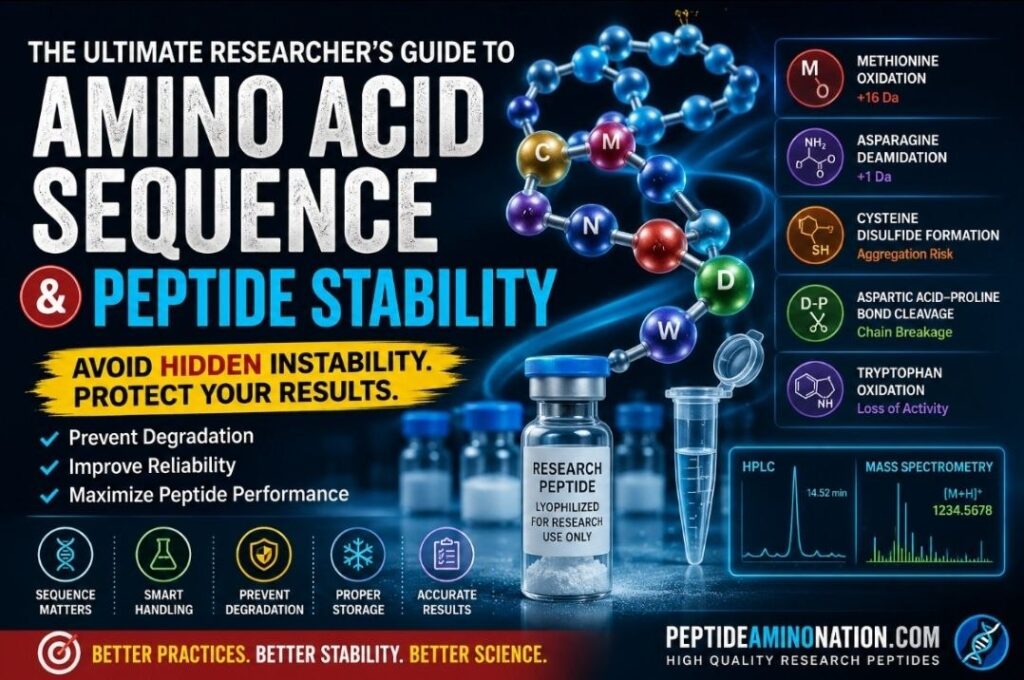
Table of Contents
1. What Is Amino Acid Sequence and Peptide Stability?
2. Why the Primary Sequence Determines Peptide Stability
3. How Individual Amino Acids Influence Chemical Stability
4. The Hidden Chemical Weak Links Every Researcher Should Recognize
5. Why Structural Stability Does Not Always Mean Chemical Stability
6. Real Laboratory Case Studies from Years of Supporting Researchers
7. Common Research Mistakes That Accelerate Peptide Degradation
8. How Different Countries Approach Peptide Handling
9. Best Practices for Peptide Storage and Reconstitution
10.Understanding COAs: Purity vs. Net Peptide Content
11. Myths About Amino Acid Sequence and Peptide Stability
12. Frequently Asked Questions
13. Final Thoughts
What Is Amino Acid Sequence and Peptide Stability?
https://pubmed.ncbi.nlm.nih.gov/
Amino Acid Sequence and Peptide Stability describe the relationship between a peptide’s primary amino acid arrangement and its ability to maintain its chemical identity, structural integrity, and biological function over time.
Every peptide is constructed from amino acids linked together through peptide bonds. While two peptides may have similar molecular weights or even similar biological targets, small differences in their amino acid sequences can produce dramatically different stability profiles.
For example, one sequence may remain stable for months under proper storage conditions, while another with only a single amino acid change may begin degrading within days.
Why?
Because each amino acid contributes unique chemical properties that influence how the peptide interacts with:
•Oxygen
• Moisture
• Light
• Temperature
• Buffer systems
• pH
• Metal ions
• Organic solvents
• Mechanical stress during laboratory handling
These interactions determine whether a peptide remains intact or begins to undergo reactions such as oxidation, hydrolysis, deamidation, disulfide scrambling, aggregation, or fragmentation
Unlike proteins, many synthetic peptides lack extensive tertiary structures that naturally protect vulnerable amino acid residues. As a result, the primary sequence often has an even greater influence on stability than many researchers expect.
Understanding this concept allows researchers to move beyond simply asking, “How should I store my peptide?” and instead begin asking the more important question:
“What is my peptide’s amino acid sequence trying to tell me about its chemical vulnerabilities?”
This sequence-first mindset is one of the most effective ways to improve experimental reproducibility, reduce peptide loss, and avoid costly laboratory errors.
Why Amino Acid Sequence and Peptide Stability Matter More Than Most Researchers Realize
After assisting more than 10,000 researchers since 2003, one recurring pattern stands out.
Researchers rarely lose valuable peptides because the peptide was poorly synthesized.
Instead, they lose them because the amino acid sequence itself predicts vulnerabilities that were never considered during storage, reconstitution, or experimental design.
One of the most common misconceptions is believing that a well-folded peptide is automatically a chemically stable peptide.
This is simply not true.
A peptide may adopt an excellent three-dimensional structure while simultaneously containing chemically fragile regions that slowly degrade under perfectly normal laboratory conditions.
For example:
• An Asn-Gly motif can undergo rapid deamidation.
• An Asp-Pro sequence may experience spontaneous peptide bond cleavage.
• Methionine residues readily oxidize in the presence of oxygen and light.
• Cysteine residues can form unintended disulfide bonds.
• Highly hydrophobic sequences frequently aggregate if dissolved improperly.
These chemical changes often occur long before researchers notice obvious visual signs of degradation.
In many cases, the peptide still appears as a clear solution, yet its biological activity has already declined significantly.
This explains why understanding Amino Acid Sequence and Peptide Stability is not merely an academic exercise—it is essential for preserving peptide integrity, ensuring reproducible results, and maximizing the value of every research project.
How Amino Acid Sequence and Peptide Stability Are Controlled by Individual Amino Acids
Understanding Amino Acid Sequence and Peptide Stability starts with recognizing that not all amino acids behave the same way. Every residue contributes its own chemical properties, and these properties determine how a peptide responds to oxygen, moisture, pH changes, temperature, light, and mechanical handling.
One unstable amino acid positioned in the wrong location can become the weakest link in an otherwise well-designed peptide.
This is why experienced peptide researchers examine the primary sequence before deciding how to dissolve, store, or transport a peptide. The sequence often predicts degradation pathways long before laboratory testing reveals them.
After supporting researchers since 2003, we’ve consistently found that laboratories achieving the most reproducible results don’t simply follow generic storage recommendations—they adapt their handling protocol to the peptide’s amino acid composition.
The Amino Acids That Most Frequently Influence Peptide Stability
The table below summarizes the amino acids that deserve the closest attention during peptide research.
| Amino Acid | Common Stability Risk | Typical Cause | Recommended Practice |
| Methionine (Met) | Oxidation | Oxygen, light, repeated air exposure | Store in single-use aliquots, protect from light, minimize air exposure |
| Cysteine (Cys) | Disulfide bond cleavage | Oxidation and improper storage | Keep dry, avoid repeated freeze-thaw cycles, limit oxygen exposure |
| Asparagine (Asn) | Deamidation | Neutral to alkaline pH moisture | Store cold, use slightly acidic buffers when appropriate |
| Aspartic Acid (Asp) | Peptide bond | Acidic environment Asp-Pro motifs | Monitor buffer selection and storage conditions |
| Tryptophan (Trp) | photo-oxidation | UV and laboratory lighting | Store in amber containers or protect from light |
| Glutamine (Gln) | cyclization and degradation | Extended storage under unfavorable condition | Minimize long-term exposure to moisture and heat |
Each of these amino acids behaves differently, yet all can dramatically influence Amino Acid Sequence and Peptide Stability if their vulnerabilities are ignored.
Methionine: One Oxygen Atom Can Change Everything
Among all amino acids, Methionine is one of the most oxidation-sensitive.
Its sulfur-containing side chain readily reacts with oxygen, converting Methionine into Methionine sulfoxide.
While this chemical change appears small, it can significantly alter:
•Receptor binding
•Biological activity
•Solubility
•Hydrophobicity
• Experimental reproducibility
In one research project we reviewed, a peptide performed exceptionally well immediately after preparation but gradually lost activity after several days of repeated use.
The synthesis quality was never the problem.
Analytical testing showed a +16 Da mass increase, confirming Methionine oxidation rather than manufacturing failure.
The researcher had unintentionally exposed the stock solution to fresh oxygen each time the vial was opened.
The lesson was simple:
Repeated handling can sometimes be more damaging than long-term storage itself.
Best Practices for Methionine-Containing Peptides
If your sequence contains Methionine:
• Prepare only the amount needed.
• Divide into single-use aliquots immediately.
• Keep samples protected from light.
,• Reduce unnecessary exposure to oxygen.
• Return aliquots to appropriate storage promptly after use.
Small procedural changes like these often preserve peptide activity for significantly longer periods.
Cysteine: A Valuable Amino Acid with Unique Challenges
Cysteine plays an essential role in many biologically active peptides because it forms disulfide bonds that stabilize three-dimensional structure.
However, these same bonds can become problematic if oxidation occurs under uncontrolled conditions.
Instead of forming the intended disulfide bridge, peptides may undergo:
• Incorrect disulfide pairing
• Molecular aggregation
• Structural rearrangement
• Reduced biological activity
For peptides containing multiple Cysteine residues, careful handling becomes especially important.
Researchers should avoid excessive agitation, prolonged oxygen exposure, and repeated freeze-thaw cycles that encourage unwanted oxidation.
Asparagine: The Hidden Source of Deamidation
If there is one amino acid that quietly causes more unexpected laboratory problems than most researchers realize, it is Asparagine (Asn).
Asparagine is particularly vulnerable when positioned beside Glycine.
The Asn-Gly motif is widely recognized as one of the fastest deamidating sequences in peptide chemistry.
Over time, Asparagine converts into Aspartate and Isoaspartate through hydrolysis.
Although the peptide may still appear intact visually, its biological function may have already changed significantly.
Researchers often misinterpret this loss of activity as poor synthesis quality when the actual cause is predictable sequence chemistry.
Why Asn-Gly Sequences Require Special Attention
An Asn-Gly sequence creates enough molecular flexibility for the peptide backbone to attack itself chemically.
This reaction accelerates when exposed to:
• Neutral or alkaline pH
• Moisture
• Elevated temperatures
• Extended storage in solution
Whenever possible, researchers should:
• Store sensitive peptides in lyophilized form.
• Prepare fresh aliquots when needed.
• Avoid prolonged storage at room temperature.
• Select buffers that minimize deamidation.
Understanding these precautions can greatly improve Amino Acid Sequence and Peptide Stability during long-term projects.
Aspartic Acid: When Peptide Bonds Break Themselves
Unlike many degradation pathways that occur gradually, peptides containing Asp-Pro sequences may undergo spontaneous peptide bond cleavage.
This reaction is especially important because it can completely fragment the peptide.
Researchers sometimes notice a sudden loss of biological activity without obvious changes in solution appearance.
Only detailed analytical techniques such as RP-HPLC and LC-MS reveal that the peptide has split into smaller fragments.
For this reason, Asp-Pro motifs deserve careful consideration during both peptide design and storage planning.
Tryptophan and Glutamine: Often overlooked but still important
Although Methionine and Asparagine receive much of the attention, Tryptophan and Glutamine also influence Amino Acid Sequence and Peptide Stability.
Tryptophan
Tryptophan is highly sensitive to ultraviolet light and oxidative conditions.
Extended exposure to laboratory lighting may gradually alter the residue, affecting peptide activity and analytical results.
Researchers working with Tryptophan-containing peptides should minimize unnecessary light exposure whenever practical.
Glutamine
Glutamine may undergo cyclization and other degradation reactions during prolonged storage under unfavorable conditions.
While generally less reactive than Asparagine, it still deserves attention when designing long-term storage strategies.
Amino Acid Sequence Is More Important Than Peptide Length
A widespread misconception is that shorter peptides are automatically more stable than longer peptides.
Our experience supporting researchers has shown that this assumption is often incorrect.
A short peptide containing:
• Methionine
• Asparagine-Glycine
• Multiple Cysteines
may degrade much faster than a considerably longer peptide lacking chemically vulnerable residues.
In reality, the sequence matters far more than the number of amino acids.
A carefully designed 30-amino-acid peptide can remain remarkably stable, while an 8-amino-acid peptide with multiple reactive residues may require extremely careful handling.
This is why experienced peptide suppliers evaluate sequence chemistry rather than relying solely on peptide length when recommending storage and reconstitution protocols.
Practical Takeaway
Before opening a peptide vial, ask yourself four questions:
1. Does the sequence contain Methionine that may oxidize?
2. Are there Cysteine residues that require careful oxidation control?
3. Is there an Asn-Gly or Asp-Pro motif that could degrade during storage?
4. Is the peptide highly hydrophobic, requiring a sequence-specific reconstitution strategy?
Answering these questions before your experiment begins can save weeks of troubleshooting, preserve valuable peptide material, and improve the reproducibility of your research.
Real-World Case Studies: How Amino Acid Sequence and Peptide Stability Affect Research Outcomes
One of the biggest advantages of working with researchers for more than two decades is seeing the same problems appear repeatedly. In our experience supporting laboratories since 2003, peptide failures are rarely random. They almost always trace back to either a vulnerable amino acid sequence or handling practices that ignored those vulnerabilities.
The following anonymized case studies demonstrate how understanding Amino Acid Sequence and Peptide Stability can prevent costly mistakes and improve experimental reproducibility.
Case Study 1: An Asn-Gly Sequence Caused a Dramatic Loss of Binding Activity
Background
A research laboratory ordered a 14-amino-acid synthetic peptide designed to mimic a viral surface loop for antibody-binding studies.
The sequence contained an Asparagine-Glycine (Asn-Gly) motif located within a critical functional region.
Initially, the peptide performed exactly as expected.
However, after approximately two weeks, the ELISA results became inconsistent, and binding activity dropped by more than 80%.
The research team suspected poor synthesis quality and requested a replacement batch.
Unfortunately, the second batch produced the same disappointing outcome.
Investigation
Instead of assuming a manufacturing problem, the laboratory compared the fresh peptide with the stored stock solution.
Analysis using Reverse-Phase High-Performance Liquid Chromatography (RP-HPLC) showed that the stored sample had developed an additional chromatographic peak.
Subsequent Liquid Chromatography-Mass Spectrometry (LC-MS) analysis revealed a +1 Dalton (+1 Da) mass increase.
This small change confirmed Asparagine deamidation, a well-known degradation pathway for Asn-Gly motifs.
The peptide had not been poorly manufactured.
Its amino acid sequence simply contained one of the most chemically vulnerable motifs in peptide chemistry.
Solution
The researcher adopted two improvements:
• Prepared stock solutions using a mildly acidic buffer (approximately pH 5.5–6.0).
• Stored single-use aliquots at −80°C instead of repeatedly using the same stock.
For future work, the non-essential Glycine residue was replaced with Alanine during sequence optimization, greatly reducing the risk of deamidation.
Outcome
Following these changes, peptide stability improved dramatically.
The optimized sequence maintained consistent biological activity throughout long-term experiments, eliminating unnecessary delays and repeat purchases.
Case Study 2: Hydrophobicity Was Mistaken for Peptide Degradation
Not every cloudy peptide solution indicates degradation.
Sometimes, the problem is simply poor solubilization.
Background
A laboratory received a 22-amino-acid hydrophobic peptide rich in:
• Leucine
• Isoleucine
• Valine
• Phenylalanine
• Tryptophan
The researcher attempted to dissolve the peptide directly into cell culture medium.
Within minutes, the solution became cloudy.
Believing the peptide simply needed additional mixing, the researcher vortexed the sample aggressively for several minutes before placing it into a heated sonication bath.
Instead of improving solubility, visible white aggregates appeared.
The peptide completely lost biological activity.
Investigation
The sequence was evaluated using hydrophobicity calculations.
Its GRAVY (Grand Average of Hydropathy) score confirmed that the peptide possessed an extremely hydrophobic core.
The peptide had never truly dissolved.
Instead, vigorous vortexing created thousands of microscopic air bubbles.
Hydrophobic peptide molecules migrated to these air-water interfaces, assembled into stable aggregates, and formed irreversible precipitates.
The peptide looked degraded.
In reality, it had simply been handled incorrectly.
Solution
The laboratory adopted a sequence-specific reconstitution protocol.
The peptide was first dissolved in a small volume of sterile DMSO until completely clear.
Only then was it slowly diluted into aqueous medium with gentle swirling instead of vortexing.
Outcome
The peptide remained fully soluble.
Cell culture experiments became highly reproducible, and the laboratory no longer lost valuable peptide through irreversible aggregation.
Case Study 3: Methionine Oxidation Silently Destroyed Biological Activity
Some degradation reactions occur without any obvious visual warning.
Methionine oxidation is one of the best examples.
Background
A research group used a 9-amino-acid immunological peptide containing a central Methionine residue.
The peptide was prepared in water and kept on the laboratory bench throughout an intensive week of experiments.
Each day, the same vial was opened repeatedly to prepare additional assays.
By the fifth day, T-cell activation had almost completely disappeared.
The solution remained perfectly clear.
Nothing appeared unusual.
Investigation
Comparison of the working solution with a freshly prepared control revealed a new chromatographic peak during RP-HPLC analysis.
Mass spectrometry demonstrated a +16 Da increase, confirming oxidation of Methionine to Methionine sulfoxide.
The peptide’s molecular identity had changed enough to reduce its biological recognition dramatically.
Repeated exposure to oxygen and laboratory lighting had slowly damaged the sequence.
Solution
The laboratory immediately changed its handling procedures.
Researchers began to:
• Prepare small, single-use aliquots.
• Minimize repeated opening of stock solutions.
• Protect peptides from light using amber tubes or aluminum foil.
• Store aliquots appropriately between experiments.
Outcome
Peptide activity remained consistent throughout the entire experimental schedule.
The apparent “instability” disappeared once the handling protocol matched the chemical characteristics of the sequence.
The Four Most Common Mistakes Researchers Make
After helping more than 10,000 researchers source and handle peptides since 2003, the same avoidable mistakes continue to appear.
Understanding Amino Acid Sequence and Peptide Stability means recognizing these pitfalls before they compromise your research.
Mistake 1: Assuming Structural Stability Means Chemical Stability
One of the most common misconceptions is believing that a peptide with a stable three-dimensional structure is automatically chemically stable.
This assumption is dangerous.
A peptide may fold correctly while still containing highly reactive amino acid motifs such as:
• Asn-Gly
• Asp-Pro
• Methionine
• Cysteine
These weak points may slowly degrade despite excellent overall structural integrity.
Always evaluate the primary sequence—not just the folded structure.
Mistake 2: Ignoring Net Peptide Content (NPC)
Many researchers mistakenly assume that:
1 mg of lyophilized powder equals 1 mg of peptide.
In reality, lyophilized material also contains:
• Counterions
• Residual moisture
• Manufacturing salts
The Net Peptide Content (NPC) reported on the Certificate of Analysis represents the actual peptide available for research.
Ignoring NPC frequently results in stock solutions that are 20–30% less concentrated than intended.
This simple calculation error can affect every downstream experiment.
Mistake 3: Using One Reconstitution Method for Every Peptide
No universal solvent works for every peptide.
Different amino acid sequences require different approaches.
For example:
• Highly hydrophobic peptides often benefit from initial dissolution in DMSO before dilution.
• Basic peptides may dissolve better in mildly acidic solutions.
• Acidic peptides may require carefully adjusted alkaline conditions before dilution.
The sequence—not habit—should determine the solvent.
Mistake 4: Vortexing Delicate Peptides
When peptides dissolve slowly, many researchers instinctively vortex harder.
Unfortunately, aggressive mixing often makes the problem worse.
Excessive vortexing may:
• Introduce oxygen.
• Increase oxidation.
• Promote aggregation.
• Generate heat.
• Create damaging air-water interfaces.
Gentle swirling or slow inversion is usually the safer approach for sensitive sequences.
What We Have Learned from Researchers Around the World
Working with laboratories in the United States, Germany, the United Kingdom, and Australia has shown that excellent peptide handling is not determined by geography—it is determined by good laboratory practice.
However, some regional habits offer valuable lessons.
| County | Strength | Common Challenges | Practical Lesson |
| United States | High-throughput automation and efficient aliquoting | Repeat freeze-thaw cycle due to large master stock | Prepare single-use aliquots immediately after reconstitution |
| Germany | Excellent SOP compliance and moisture control | Rigid adherence to standard protocol | Adapt handling procedure to the peptide sequence rather than relying on one protocol |
| United Kingdom | Strong practice of storing peptides in lyophilized form | Shared free space can introduce temperature fluctuations | Keep sensitive peptide dry until they are needed for experiment |
| Australia | Careful quality checks after long distance shipping | High ambient humidity in some regions | Allow sealed vials to reach room temperature before opening to prevent moisture condensation |
These examples are not absolute rules, but they highlight practical habits that can improve Amino Acid Sequence and Peptide Stability regardless of where research is performed.
The most successful laboratories share one common principle:
They let the amino acid sequence dictate the handling strategy—not convenience or routine.
Best Practices for Amino Acid Sequence and Peptide Stability
Understanding Amino Acid Sequence and Peptide Stability is only half of the equation. The other half is applying that knowledge every time a peptide arrives in your laboratory.
Over the past two decades, we’ve found that researchers who consistently achieve reproducible results follow one simple principle:
Never use a generic peptide handling protocol. Always let the amino acid sequence determine how the peptide should be stored, reconstituted, and used.
This sequence-first approach minimizes degradation, reduces wasted material, and improves experimental consistency.
Step 1: Allow the Peptide to Reach Room Temperature Before Opening
One of the simplest yet most overlooked practices is allowing a frozen peptide vial to warm to room temperature before breaking the seal.
Ideally, leave the sealed vial inside its protective packaging or a desiccator for approximately 30 minutes.
Why does this matter
Lyophilized peptides are highly hygroscopic, meaning they readily absorb moisture from the surrounding air.
If a cold vial is opened immediately after removal from the freezer:
• Moisture condenses on the peptide.
• Hydrolysis reactions can begin.
• Sensitive residues such as Asparagine may start deamidating.
• Long-term stability may decrease before the experiment even begins.
Many researchers unknowingly shorten peptide shelf life within seconds of opening the vial.
Step 2: Check the Certificate of Analysis Before Performing Any Calculations
One of the biggest causes of inaccurate peptide concentrations is misunderstanding the Certificate of Analysis (COA).
Never assume:
1 mg of powder = 1 mg of peptide
Instead, verify the Net Peptide Content (NPC) listed on the COA.
Example
Suppose your vial contains:
• Gross Weight: 10 mg
• Peptide Content: 76%
Your actual peptide amount is:
10 mg × 0.76 = 7.6 mg of peptide
Preparing solutions using the gross weight instead of the peptide content results in incorrect concentrations and poor experimental reproducibility.
Purity vs Net. Peptide Content
Many first time researchers confuse tis two measurement.
| COA Parameter | What It Means | Why It Matters |
| HPLC Purity | Percentage of peptide molecules that are the desired sequence | Confirms synthesis quality |
| Net Peptide Content | Percentage of the powder that is actual peptide | Used for accurate concentration calculations |
| Molecular Weight | Confirms peptide identity | Verifies correct synthesis |
| Mass Spectrometry | Confirms expected molecular mass | Helps identify degradation or synthesis errors |
| Retention Time | Chromatographic behavior under specific test conditions | Useful for QC but varies between HPLC systems |
Understanding these values is essential for maintaining Amino Acid Sequence and Peptide Stability throughout your research.
Step 3: Choose the Correct Solvent Based on the Amino Acid Sequence
One of the fastest ways to damage a peptide is using an unsuitable solvent.
Different amino acid compositions require different reconstitution strategies.
Hydrophobic Peptides
Sequences rich in:
• Leucine
• Valine
• Isoleucine
• Phenylalanine
• Tryptophan
often dissolve poorly in water.
A practical approach is:
1. Dissolve the peptide in a minimal volume of sterile DMSO or DMF.
2. Once fully dissolved, slowly dilute with the desired aqueous buffer.
This method significantly reduces aggregation.
Basic Peptides
Peptides containing large numbers of:
• Lysine
• Arginine
• Histidine
Often dissolve better in slightly acidic solutions, such as dilute acetic acid, before final dilution.
Acidic Peptides
Peptides enriched with:
• Aspartic acid
• Glutamic acid
May require a small amount of dilute ammonium hydroxide before dilution into the final buffer.
The correct solvent depends on the amino acid sequence—not on laboratory habit.
Step 4: Never Vortex a Sensitive Peptide Unless Necessary
Aggressive vortexing is another common reason researchers experience poor peptide performance.
Excessive mixing can:
• Introduce oxygen.
• Generate heat.
• Increase air-water interfaces.
• Promote aggregation.
• Accelerate oxidation.
Instead:
• Gently swirl the vial.
• Slowly invert the tube.
• Use brief, low-energy sonication only if appropriate for the peptide.
A little patience often preserves far more peptide than aggressive mixing.
Step 5: Aliquot Immediately After Reconstitution
Repeated freeze-thaw cycles remain one of the most preventable causes of peptide degradation.
Rather than storing one large stock solution:
• Divide it into single-use aliquots.
• Label each aliquot clearly.
• Freeze immediately after preparation.
This prevents repeated exposure to:
• Oxygen
• Moisture
• Temperature fluctuations
• Light
Aliquoting is especially important for peptides containing Methionine, Cysteine, or Asparagine.
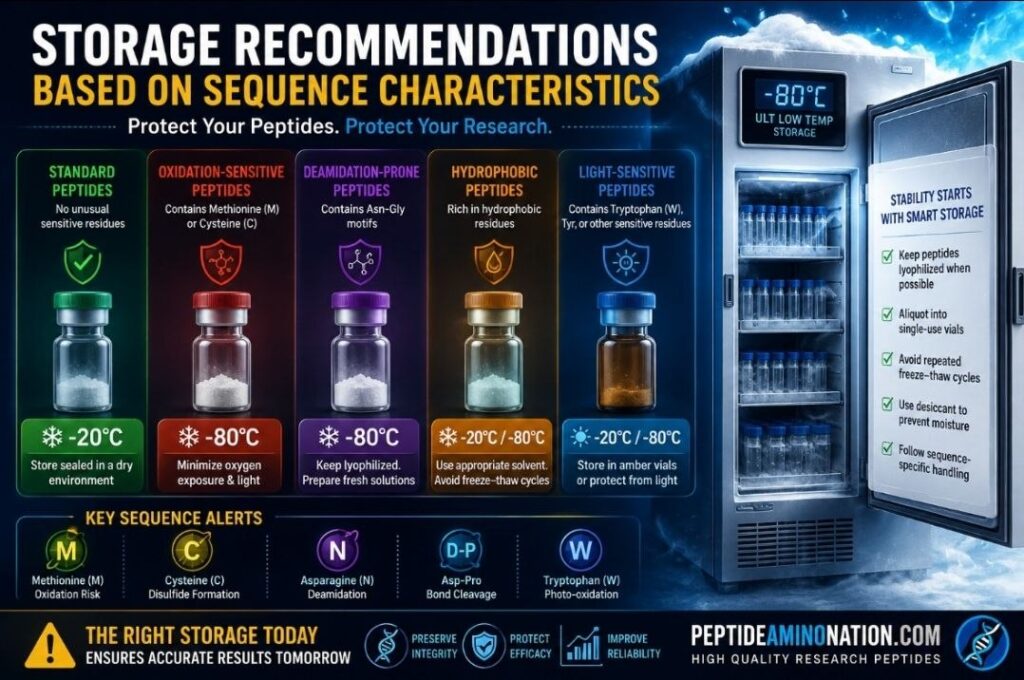
Storage Recommendations Based on Sequence Characteristics
| Sequence Feature | Recommended Storage |
| Standard lyophilized peptides | Store sealed at -20°C in a dry environment |
| Oxidation-sensitive peptides (Methionine, Cysteine) | Store at -80°C when possible and minimize oxygen exposure |
| Deamidation-prone peptides (Asn-Gly motifs) | Keep lyophilized until needed and prepare fresh solutions |
| Hydrophobic peptides | Protect from repeated warming and cooling; use sequence-appropriate solvents |
| Light-sensitive peptides (Tryptophan-containing) | Store in amber vials or protect from light |
Remember, these are general best practices. Always review the supplier’s recommendations and consider the specific sequence and intended research application.
Common Myths About Amino Acid Sequence and Peptide Stability
Many researchers unknowingly follow outdated assumptions.
Let’s separate fact from fiction.
Myth 1: Shorter peptides are always more stable.
Reality
Length alone does not determine stability.
A short peptide containing an Asn-Gly motif or a reactive Methionine residue may degrade faster than a much longer peptide without chemically vulnerable residues.
Myth 2: A peptide with 99% purity cannot degrade.
Reality
Purity reflects the quality of the peptide at the time of analysis.
After shipment, storage, and repeated laboratory handling, degradation can still occur if proper procedures are not followed.
Myth 3: Every peptide should be stored the same way.
Reality
Different amino acid sequences require different handling strategies.
Storage recommendations should always be guided by sequence chemistry rather than convenience.
Myth 4: A cloudy solution always means the peptide has degraded.
Reality
Cloudiness often indicates poor solubility or aggregation—not chemical degradation.
Many hydrophobic peptides become perfectly usable once dissolved using an appropriate solvent system.
Expert Recommendations from PeptideAmino Nation
At PeptideAminoNation.com, our goal extends beyond supplying research peptides.
We believe researchers achieve the best results when they understand the chemistry behind every peptide they use.
Based on years of supporting laboratories, we recommend the following best practices:
• Review the amino acid sequence before opening the vial.
• Read the Certificate of Analysis carefully, especially the Net Peptide Content.
• Select a solvent that matches the sequence’s chemical properties.
• Avoid unnecessary vortexing and repeated freeze-thaw cycles.
• Store peptides according to their sequence-specific stability requirements.
• Keep peptides lyophilized whenever practical until they are needed for research.
By combining high-quality analytical documentation—including HPLC chromatograms and mass spectrometry verification—with proper handling techniques, researchers can significantly improve peptide stability and experimental reproducibility.
Following these practices not only protects valuable research materials but also helps ensure that the results generated today remain reliable tomorrow.
Frequently Asked Questions About Amino Acid Sequence and Peptide Stability
Below are answers to some of the most common questions researchers ask after purchasing synthetic peptides. These FAQs are based on years of experience supporting research laboratories and are designed to help improve experimental accuracy and peptide longevity.
What is Amino Acid Sequence and Peptide Stability?
Amino Acid Sequence and Peptide Stability describe how the order of amino acids within a peptide influences its resistance to chemical degradation, oxidation, hydrolysis, aggregation, and structural changes. Certain amino acid combinations are naturally more stable than others, making sequence analysis an essential step before storage or reconstitution.
Why does the amino acid sequence affect peptide stability?
Each amino acid has unique chemical properties. Some residues are highly resistant to environmental conditions, while others react readily with oxygen, moisture, light, or changes in pH.
For example:
• Methionine is prone to oxidation.
Asparagine can undergo deamidation.
• Cysteine may form unwanted disulfide bonds.
• Tryptophan is sensitive to light-induced oxidation.
These reactions directly influence Amino Acid Sequence and Peptide Stability.
Which amino acids are most likely to reduce peptide stability?
Researchers should pay particular attention to:
• Methionine (oxidation)
• Cysteine (disulfide bond formation)
• Asparagine (deamidation)
• Aspartic acid (Asp-Pro bond cleavage)
• Tryptophan (photo-oxidation)
• Glutamine (cyclization under certain conditions)
Understanding these residues allows researchers to develop handling procedures that minimize degradation.
Does high HPLC purity guarantee long-term peptide stability?
No.
High HPLC purity confirms that the peptide met quality specifications at the time of analysis. However, improper storage, repeated freeze-thaw cycles, unsuitable solvents, oxygen exposure, or incorrect pH can still cause degradation after the peptide reaches the laboratory
What is the difference between peptide purity and Net Peptide Content?
These two values measure different characteristics.
Purity refers to the percentage of peptide molecules that match the desired sequence.
Net Peptide Content (NPC) indicates how much of the total powder weight is actual peptide after accounting for counterions and residual moisture.
For accurate concentration calculations, researchers should always use the Net Peptide Content listed on the Certificate of Analysis.
How should hydrophobic peptides be reconstituted?
Highly hydrophobic peptides often dissolve poorly in water.
A common approach is to dissolve the peptide in a small volume of sterile DMSO or DMF first, then slowly dilute with the desired aqueous buffer while gently mixing.
Always review the sequence and supplier recommendations before selecting a solvent.
Is it better to store peptides as powders or solutions?
In most cases, lyophilized peptides remain more stable than peptides stored in solution.
Keeping peptides dry reduces exposure to hydrolysis, oxidation, and microbial contamination.
When practical, prepare only the amount required for immediate experiments and leave the remaining peptide in its lyophilized form.
Can repeated freeze-thaw cycles damage peptides?
Yes.
Repeated freezing and thawing expose peptides to moisture, oxygen, and temperature fluctuations, all of which may accelerate degradation.
Preparing single-use aliquots is one of the simplest ways to preserve Amino Acid Sequence and Peptide Stability.
Why does my peptide look like a clear film instead of a white powder?
This is usually normal.
Depending on the peptide sequence, salt form, and lyophilization process, peptides may appear as:
• White powder
• Fluffy cake
• Thin transparent film
• Glass-like residue
Appearance alone does not indicate degradation. The Certificate of Analysis provides a more reliable assessment of quality.
Where can researchers purchase high-quality research peptides?
Researchers should choose suppliers that provide transparent analytical documentation, including:
• RP-HPLC chromatograms
• Mass spectrometry verification
• Certificate of Analysis (COA)
• Storage recommendations
• Batch-specific quality information
At PeptideAminoNation.com, we are committed to supporting researchers with carefully documented research peptides and educational resources that promote proper peptide handling and reproducible laboratory results.
Final Thoughts on Amino Acid Sequence and Peptide Stability
Understanding Amino Acid Sequence and Peptide Stability is one of the most valuable skills a researcher can develop.
While temperature, shipping conditions, and laboratory handling all influence peptide quality, the amino acid sequence remains the foundation of peptide stability. It determines how a peptide responds to oxidation, moisture, pH, light, solvents, and storage conditions.
Throughout this guide, we’ve explored why seemingly minor sequence differences can lead to significant changes in peptide performance. We’ve examined real-world case studies, discussed common laboratory mistakes, clarified how to interpret Certificates of Analysis, and outlined practical handling strategies that help protect valuable research materials.
Perhaps the most important lesson is this:
A peptide should never be treated as a generic laboratory reagent. Its amino acid sequence should guide every decision—from solvent selection and reconstitution to storage and experimental design.
By adopting a sequence-first approach, researchers can:
• Improve experimental reproducibility.
• Reduce peptide degradation.
• Minimize unnecessary repeat purchases.
• Extend peptide shelf life.
• Increase confidence in research findings.
Whether you are working with BPC-157, TB-500, CJC-1295, Ipamorelin, Semaglutide, Tirzepatide, Hexarelin, Kisspeptin, Follistatin, or a custom peptide, understanding the relationship between sequence chemistry and stability can make a measurable difference in the success of your research.
If you’re looking for research peptides supported by comprehensive quality documentation—including RP-HPLC analysis, mass spectrometry verification, batch-specific Certificates of Analysis, and practical storage guidance—visit PeptideAminoNation.com. Our mission is not only to supply high-quality research peptides but also to equip researchers with the knowledge needed to handle them correctly and achieve consistent, reliable results.
Read Recommended Related Topics To Boost Your Knowledge on Peptide
How to Calculate Peptide Molarity: 10 Powerful Steps for Accurate Research Success
Why Researchers Use Bacteriostatic Water: 9 Proven Reasons Every Laboratory Should Know
How Peptide Length Influences Stability: 9 Powerful Scientific Insights Every Researcher Should Know
Understanding Peptide Oxidation: 15 Powerful Ways to Prevent Costly Peptide Degradation
Can Different Peptides Be Reconstituted the Same Way? 9 Powerful Facts Every Researcher Must Know
Light Exposure vs Peptide Stability: 9 Powerful Truths to Prevent Costly Research Failures
