Common Calculation Errors in Peptide Research: 12 Critical Mistakes Every Scientist Must Avoid for Accurate Results

Common Calculation Errors in Peptide Research: Why Tiny Mistakes Can Destroy Months of Laboratory Work
Peptide research depends on one critical principle: accurate calculations. Even the highest-purity research peptide cannot produce reliable data if it is prepared, diluted, or calculated incorrectly.
Whether you’re reconstituting a lyophilized peptide, preparing serial dilutions, adjusting for Net Peptide Content (NPC), or converting concentrations from milligrams per milliliter (mg/mL) to micromolar (µM), every calculation influences the reliability of your experimental results.
Unfortunately, Common Calculation Errors in Peptide Research remain one of the leading causes of failed assays, inconsistent biological activity, poor reproducibility, and unnecessary laboratory expenses.
As an experienced supplier of research-grade peptides, we’ve worked with academic laboratories, biotechnology companies, and pharmaceutical researchers worldwide. One pattern appears repeatedly: most experimental failures are not caused by poor peptide quality—they originate from avoidable calculation errors made before the experiment even begins.
In this comprehensive guide, you’ll discover the most common peptide calculation mistakes, learn how to prevent them, and explore real laboratory case studies demonstrating how seemingly minor mathematical errors can invalidate weeks of research.
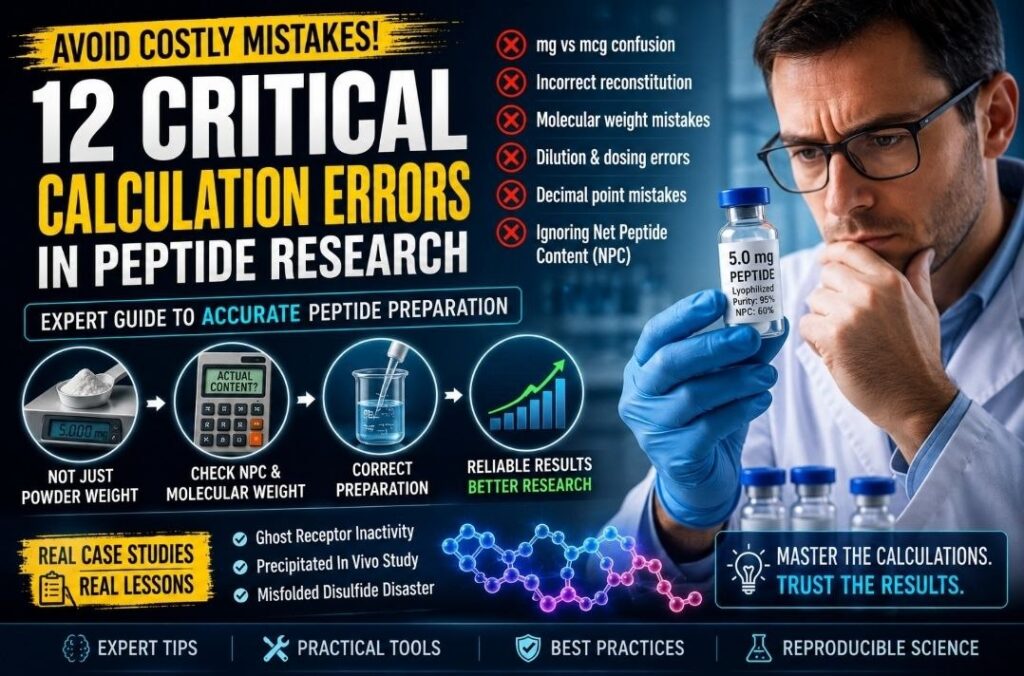
Table of Contents
1. Why Accurate Peptide Calculations Matter
2. Understanding Common Calculation Errors in Peptide Research
3. Error #1: Confusing Gross Weight with Net Peptide Content (NPC)
4. Error #2: Assuming Purity Equals Net Peptide Content
5. Error #3: Mixing Up mg and mcg Units
6. Error #4: Incorrect Peptide Reconstitution
7. Error #5: Molecular Weight Calculation Errors
8. Error #6: Incorrect Dilution Calculations
9. Error #7: Miscalculating Molar Concentrations
10. Error #8: Ignoring Extinction Coefficient Calculations
11. Real Laboratory Case Studies
12. Best Practices for Accurate Peptide Calculations
13. Recommended Calculation Tools
14. Frequently Asked Questions
15. Final Thoughts
Why Accurate Peptide Calculations Matter
https://pubmed.ncbi.nlm.nih.gov/
Every peptide experiment begins long before the first sample reaches an instrument. It begins with mathematics.
A single misplaced decimal point or an incorrect concentration calculation can completely alter:
• Receptor binding studies
•Cell culture experiments
• Animal studies
• Pharmacokinetic investigations
• Stability studies
• HPLC analytical results
• LC-MS verification
• Biological activity assays
Even when using peptides manufactured to exceptional purity standards, inaccurate preparation can produce misleading conclusions that waste valuable time, reagents, and funding.
Researchers often blame peptide synthesis when experiments fail. In reality, the underlying problem frequently originates from incorrect calculations during stock preparation or dilution.
This is why understanding Common Calculation Errors in Peptide Research is essential for anyone working with synthetic peptides.
Understanding Common Calculation Errors in Peptide Research
Peptide calculations involve far more than dividing mass by volume.
Researchers must account for several variables simultaneously, including:
• Net Peptide Content (NPC)
• HPLC purity
• Counterions (TFA, acetate, HCl)
• Residual moisture
• Molecular weight
• Stock concentration
• Working concentration
• Molarity
• Solubility limitations
• Extinction coefficients
• Serial dilution accuracy
Ignoring even one of these variables can introduce substantial experimental error.
Fortunately, these mistakes are entirely preventable with the correct preparation workflow.
Common Calculation Errors in Peptide Research – Error #1: Confusing Gross Weight with Net Peptide Content (NPC)
This is by far the most common mistake observed in peptide laboratories.
Many researchers assume that a vial labeled 5 mg contains exactly 5 mg of pure peptide.
It rarely does.
Synthetic peptides typically contain additional components such as:
• Residual water
• Trifluoroacetate (TFA)
• Acetate salts
• Hydrochloride salts
• Trace residual solvents
These components contribute to the vial’s total weight but are not part of the peptide itself.
For example:
• Gross vial weight = 5.0 mg
• Net Peptide Content (NPC) = 62%
Actual peptide present:
5.0 mg × 0.62 = 3.1 mg
If the researcher ignores NPC and prepares solutions based on 5 mg instead of 3.1 mg, every subsequent concentration calculation becomes inaccurate.
Expert Tip
Always review the Certificate of Analysis (CoA) before calculating stock concentrations.
Never calculate concentrations using gross powder weight alone.
Common Calculation Errors in Peptide Research – Error #2: Assuming HPLC Purity Equals Net Peptide Content
Another widespread misconception is believing:
95% HPLC purity means the powder contains 95% peptide.
This is incorrect.
HPLC purity measures the percentage of chromatographic peaks representing the desired peptide relative to impurities.
Net Peptide Content measures the actual amount of peptide present after accounting for:
• Water
• Counterions
• Residual salts
• Solvents
Example:
A peptide may report:
• HPLC Purity = 98.6%
• Net Peptide Content = 74.2%
Although chromatographically pure, nearly one-quarter of the powder consists of non-peptide material.
This distinction is critical when preparing accurate stock solutions.
Why These Two Errors Cause the Most Experimental Failures
From our experience supplying research peptides, these first two calculation mistakes account for a significant proportion of customer troubleshooting requests.
Researchers often spend days optimizing experimental protocols when the real issue lies in an incorrect starting concentration.
The solution is straightforward:
• Review the Certificate of Analysis before opening the vial.
• Confirm the Net Peptide Content (NPC).
• Verify HPLC purity separately.
• Base calculations on the actual peptide content—not the total powder weight.
Following these steps from the outset can save weeks of troubleshooting and substantially improve experimental reproducibility.
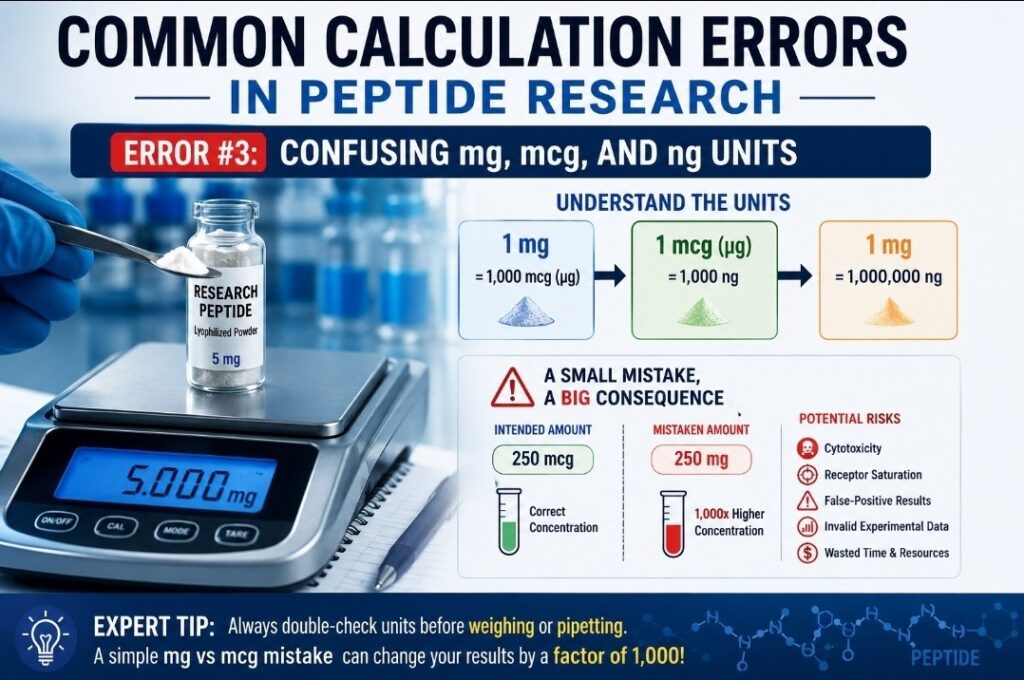
Common Calculation Errors in Peptide Research – Error #3: Confusing mg, mcg, and ng Units
One of the most dangerous Common Calculation Errors in Peptide Research is confusing units of mass. A simple mistake when converting milligrams (mg), micrograms (mcg or µg), and nanograms (ng) can change the intended peptide concentration by a factor of 1,000 or even 1,000,000.
Understanding the Unit Conversions
| Unit | Equivalent |
| 1 mg | 1,000 mcg (µg) |
| 1 mg | 1,000 ng |
| 1 mg | 1,000,000 ng |
For example, if a protocol requires 250 mcg of peptide but a researcher mistakenly weighs 250 mg, the experiment receives 1,000 times the intended amount.
Such errors can lead to:
• Cytotoxicity in cell cultures
• Receptor saturation
• False-positive biological responses
• Animal welfare concerns
• Complete loss of experimental validity
Expert Tip
Always write units clearly and avoid abbreviations that can be misread. Before preparing a stock solution, verify every calculation independently or have another researcher review it.
Common Calculation Errors in Peptide Research – Error #4: Incorrect Peptide Reconstitution
Reconstitution is much more than adding water to a lyophilized peptide. The solvent, volume, peptide sequence, and target concentration all influence the final stock solution.
Many researchers select a solvent based on convenience rather than peptide chemistry.
Common mistakes include:
• Using sterile water when a buffer is more appropriate
• Dissolve hydrophobic peptides directly in aqueous buffers
• Adding the entire solvent volume at once
• Ignoring manufacturer recommendations
• Preparing unnecessarily concentrated stock solutions
Example
Suppose you receive:
• Net peptide mass = 2.5 mg
• Desired stock concentration = 5 mg/mL
The required solvent volume is:
Volume = Mass ÷ Concentration
2.5 mg ÷ 5 mg/mL = 0.5 mL
Adding 1 mL instead would reduce the stock concentration by half, affecting every subsequent dilution.
Best Practice
Before reconstitution:
• Review peptide solubility characteristics.
• Calculate the required solvent volume.
• Label the stock concentration immediately after preparation.
• Mix gently to avoid foaming or peptide degradation.
Common Calculation Errors in Peptide Research – Error #5: Incorrect Molecular Weight Calculations
Many researchers assume they can calculate peptide molecular weight simply by adding together the molecular weights of individual amino acids.
This approach is incorrect.
During peptide synthesis, every peptide bond forms through a condensation reaction that releases one molecule of water (18.015 Da).
Ignoring this loss results in an overestimated molecular weight.
Correct Principle
The molecular weight of a peptide equals:
Sum of amino acid residue masses + terminal groups
—not the sum of free amino acid molecular weights.
Why It Matters
Incorrect molecular weights affect:
• Molar concentration calculations
• Stoichiometric reactions
• Binding affinity studies
• LC-MS confirmation
• Pharmacokinetic modeling
Professional Recommendation
Instead of calculating manually, verify molecular weights using:
• Manufacturer Certificates of Analysis (CoA)
• Validated peptide calculation software
• Trusted web-based peptide molecular weight calculators
Always cross-check values before beginning experiments.
Common Calculation Errors in Peptide Research – Error #6: Dilution Errors
Even when the stock solution is prepared correctly, improper dilution techniques can compromise the final working concentration.
Common dilution mistakes include:
• Pipetting inaccurate volumes
• Forgetting dilution factors
• Mislabeling dilution tubes
• Skipping intermediate dilutions
• Incorrect serial dilution calculations
The Dilution Equation
The standard equation is:
C₁V₁ = C₂V₂
Where:
• C₁ = Initial concentration
• V₁ = Volume removed
• C₂ = Desired concentration
• V₂ = Final volume
Example
Stock concentration:
5 mg/mL
Desired concentration:
0.5 mg/mL
Final volume:
10 mL
Required stock volume:
V₁ = (0.5 × 10) ÷ 5
V₁ = 1 mL
Add:
• 1 mL stock solution
• 9 mL diluent
This produces the desired concentration accurately.
H3: The “10× Rule” for Serial Dilutions
Experienced laboratories often avoid very large single-step dilutions.
Instead, they use the 10× Rule, where each dilution decreases concentration by a factor of ten.
Advantages include:
• Improved pipetting accuracy
• Reduced cumulative error
• Better reproducibility
• Easier troubleshooting
Example:
10 mg/mL → 1 mg/mL → 0.1 mg/mL → 0.01 mg/mL
This approach is especially useful when preparing standards for ELISA, receptor-binding assays, and dose-response experiments.
Common Calculation Errors in Peptide Research – Error #7: Incorrect Mass-to-Molar Concentration Conversions
Many biological protocols require peptide concentrations in micromolar (µM) rather than mg/mL.
Unfortunately, researchers sometimes ignore molecular weight or Net Peptide Content, producing incorrect molar concentrations.
Example
Suppose:
• Net peptide mass = 2 mg
• Molecular Weight = 2,000 Da
• Final volume = 1 mL
First convert mass into grams:
2 mg = 0.002 g
Then calculate moles:
Moles = Mass ÷ Molecular Weight
0.002 ÷ 2,000 = 1 × 10⁻⁶ mol
Since the final volume is 1 mL (0.001 L):
Concentration = 1 mmol/L
= 1 mM
Ignoring molecular weight would produce completely inaccurate values.
Common Calculation Errors in Peptide Research – Error #8: Ignoring Beer–Lambert Extinction Coefficient Calculations
Many laboratories assume that weighing a peptide accurately guarantees the correct concentration.
In reality, verification is equally important.
One of the most reliable methods is Beer–Lambert spectrophotometry.
The Beer–Lambert equation is:
A = εcl
Where:
• A = Absorbance
• ε = Extinction coefficient
• c = Concentration
• l = Path length
For peptides containing aromatic amino acids such as tryptophan or tyrosine, absorbance at 280 nm provides a convenient way to verify concentration.
For peptides lacking these residues, measurements at 205 nm often provide a more accurate estimate because peptide bonds strongly absorb ultraviolet light at this wavelength.
Verifying concentration after reconstitution helps identify:
• Pipetting errors
• Incomplete dissolution
• Concentration drift
• Preparation mistakes before costly experiments begin
Professional Workflow for Accurate Peptide Calculations
Based on years of supporting peptide researchers, we recommend following the same standardized workflow before every experiment.
Step 1: Review the Certificate of Analysis (CoA)
Confirm:
• Net Peptide Content (NPC)
• HPLC purity
• Molecular weight
• Counterion type
• Batch information
Step 2: Calculate Using Net Peptide Content
Never base calculations on gross powder weight.
Always determine the actual peptide mass before preparing stock solutions.
Step 3: Select the Appropriate Solvent
Consider:
• Amino acid composition
• Hydrophobicity
• Experimental application
• Storage stability
If necessary, begin with a minimal amount of an appropriate organic solvent before gradual dilution into the final aqueous buffer.
Step 4: Verify Every Calculation
Before adding solvent:
• Double-check formulas.
• Review unit conversions.
• Confirm molecular weight.
• Verify dilution factors.
A second review by another researcher can prevent costly mistakes.
Step 5: Label Everything Clearly
Every tube should include:
• Peptide name
• Batch number
• Concentration
• Solvent
• Preparation date
• Researcher’s initials
Clear labeling minimizes confusion and improves traceability.
Expert Insight
At Peptide Amino Nation, we’ve found that the most successful laboratories are not necessarily those with the most advanced equipment—they’re the ones that follow consistent calculation and quality-control procedures. Using reliable calculations, verifying concentrations, and reviewing the Certificate of Analysis before every experiment dramatically improves reproducibility and helps avoid many of the Common Calculation Errors in Peptide Research.
Real Laboratory Case Studies on Common Calculation Errors in Peptide Research
Understanding theory is essential, but nothing demonstrates the importance of accurate peptide calculations better than real laboratory experiences.
Over the years, while supplying research-grade peptides and supporting laboratories worldwide, we’ve helped researchers troubleshoot experiments that initially appeared to have failed because of poor peptide quality or flawed study design. In many cases, the true cause was one of the Common Calculation Errors in Peptide Research.
The following case studies have been anonymized to protect customer confidentiality while preserving the technical lessons that every peptide researcher should understand.
Case Study #1 – The “Ghost” Receptor Inactivity
The Challenge
A biotechnology startup ordered a custom 22-amino-acid synthetic peptide for receptor-binding studies.
The peptide had been carefully designed using computational modeling and was expected to demonstrate strong affinity toward a specific cell-surface receptor.
The research team prepared its stock solution by weighing the entire contents of a 5.0 mg lyophilized peptide vial and calculating the concentration based solely on the gross vial weight.
Their assumption was straightforward:
5 mg on the label equals 5 mg of peptide.
Unfortunately, that assumption proved costly.
The Unexpected Results
During several weeks of in vitro receptor-binding assays, the peptide displayed virtually no measurable biological activity.
Even after increasing the concentration to nearly ten times the predicted EC₅₀, receptor activation remained minimal.
The scientists questioned:
• Their peptide design
• Their receptor model
• Their assay conditions
• Their biological hypothesis
The peptide itself became the prime suspect.
How the Problem Was Discovered
Before abandoning the project, the laboratory decided to send a sample of the prepared stock solution to an independent analytical laboratory for Amino Acid Analysis (AAA).
The results were surprising.
The measured peptide concentration was approximately 40% lower than expected.
The laboratory had unknowingly ignored one critical value listed on the manufacturer’s Certificate of Analysis (CoA):
Net Peptide Content (NPC): 58%
Although the vial contained 5 mg of powder, only 58% represented the actual peptide sequence.
The remaining mass consisted of:
• Trifluoroacetate (TFA) counterions
• Residual moisture
• Trace salts from purification
The Consequences
Because every stock solution had been prepared using the incorrect starting mass:
• Every dilution calculation became inaccurate.
• All receptor-binding assays were significantly under-dosed.
• Biological activity appeared much weaker than reality.
• Three weeks of laboratory work became unusable.
• Thousands of dollars in reagents, cell cultures, and personnel time were lost.
A promising peptide candidate nearly failed—not because of poor design, but because of one of the most common Common Calculation Errors in Peptide Research.
How We Helped Solve the Problem
After reviewing the analytical data, we guided the research team through a revised preparation workflow.
Instead of using gross powder weight, we calculated the required mass based on the Net Peptide Content (NPC) shown on the CoA.
Formula
Required Gross Mass = Target Net Mass ÷ NPC
For future experiments, we also recommended verifying stock concentrations using far-UV spectrophotometry at 205 nm, since the peptide lacked aromatic amino acids such as tryptophan and tyrosine.
This additional verification step provided confidence that every prepared stock solution matched the intended concentration before biological testing began.
Key Lesson
Gross powder weight is not the same as peptide weight.
Before preparing any stock solution:
• Review the Certificate of Analysis.
• Confirm the Net Peptide Content.
• Base all calculations on the actual peptide mass—not the total powder weight.
This single habit can eliminate one of the most damaging Common Calculation Errors in Peptide Research.
Case Study #2 – The Precipitated In Vivo Study
The Challenge
An academic research laboratory was preparing a highly hydrophobic peptide for an in vivo mouse pharmacology study.
The peptide sequence contained a high proportion of non-polar amino acids, including:
• Leucine (Leu)
• Isoleucine (Ile)
• Phenylalanine (Phe)
The researcher assumed the peptide would dissolve normally and attempted to prepare a concentrated stock solution directly in sterile phosphate-buffered saline (PBS).
Initially, the solution appeared slightly cloudy.
After brief vortexing, the team proceeded with the study.
Early Warning Signs
During the injection phase, researchers noticed several unusual problems:
• Syringe needles clogged repeatedly.
• Injection resistance varied between animals.
• The solution became increasingly turbid over time.
Despite these warning signs, the experiment continued.
Within 48 hours, the first pharmacokinetic data revealed highly inconsistent peptide concentrations across the treatment group.
Several animals also developed localized irritation at the injection site.
What Actually Happened?
The peptide had never completely dissolved.
Instead, the hydrophobic molecules formed microscopic aggregates and partially precipitated from solution.
Rather than receiving a homogeneous peptide solution, the animals were injected with microscopic peptide suspensions.
As a result:
• Drug release became unpredictable.
• Bioavailability varied significantly.
• Tissue irritation increased.
• Pharmacokinetic data became unreliable
The Cost
The first cohort of 15 laboratory mice could not be included in the final analysis.
The research team lost:
• Several weeks of experimental work
• Valuable laboratory animals
• Research funding
• Significant staff time
All because peptide solubility had not been evaluated before reconstitution.
Our Investigation
After reviewing the peptide sequence, we calculated its hydrophobicity profile and confirmed that direct dissolution in PBS was inappropriate.
We recommended a revised preparation strategy.
Step 1
First dissolve the peptide in a minimal volume of sterile Dimethyl Sulfoxide (DMSO) while keeping the final DMSO concentration below approximately 5% of the finished solution.
Step 2
Gradually dilute the peptide with the aqueous buffer while continuously stirring.
Step 3
Add a small amount of sterile Tween-20 (0.1%) to improve solution stability and reduce aggregation.
The Outcome
The revised preparation protocol produced:
• A clear solution
• Stable peptide concentration
• Consistent injections
• Reliable pharmacokinetic data
• Successful completion of the study
Key Lesson
Sequence determines solubility.
Hydrophobic peptides should never be treated the same as hydrophilic peptides.
Before reconstitution:
• Analyze the amino acid sequence.
• Understand peptide hydrophobicity.
• Choose the appropriate solvent system.
• Confirm complete dissolution before proceeding.
Doing so can prevent one of the most overlooked Common Calculation Errors in Peptide Research—assuming that every peptide behaves similarly in solution.
Expert Analysis: Why These Case Studies Matter
Although these laboratories worked in different research fields, both incidents shared a common theme:
The experiments did not fail because of poor peptide quality—they failed because the initial calculations and preparation methods were incorrect.
In both cases, the laboratories:
• Used high-quality synthetic peptides.
• Followed established biological protocols.
• Invested substantial time and resources.
Yet, a simple oversight during stock preparation compromised the entire workflow.
This highlights an important principle:
Successful peptide research depends as much on accurate calculations and proper preparation as it does on peptide purity.
By incorporating standardized calculation procedures, reviewing the Certificate of Analysis, selecting suitable solvents, and verifying stock concentrations, researchers can significantly improve reproducibility while reducing unnecessary costs.
As an educational resource and supplier of research-grade peptides, Peptide Amino Nation encourages laboratories to make careful calculation review a routine part of every experiment. Access to reliable preparation guides, quality-control information, and technical support can help researchers avoid many of the Common Calculation Errors in Peptide Research before they affect valuable data.
Real Laboratory Case Studies on Common Calculation Errors in Peptide Research – Case Study #3: The Misfolded Disulfide Disaster
Disulfide-containing peptides present a unique challenge in peptide research. Unlike linear peptides, these molecules must fold into a precise three-dimensional structure to achieve their intended biological activity.
One laboratory learned this lesson the hard way.
The Customer’s Challenge
A structural biology laboratory was investigating a cyclic peptide toxin that required two specific disulfide bonds to achieve its native conformation.
To reduce synthesis costs, the researchers ordered the linear peptide and decided to perform the oxidative folding process themselves.
Their oxidation protocol appeared simple:
• Dissolve the peptide.
• Expose it to air oxidation.
• Allow disulfide bonds to form naturally.
To maximize productivity, they prepared the peptide at a relatively high concentration of 2.0 mg/mL.
On paper, everything looked correct.
In reality, the peptide concentration itself became the problem.
The Discovery
Following oxidation, the researchers analyzed the sample using High-Performance Liquid Chromatography (HPLC).
Instead of observing a single, sharp chromatographic peak representing the correctly folded peptide, they obtained:
• Multiple overlapping peaks
• Broad peak smearing
• Significant heterogeneity
The sample clearly contained numerous peptide species rather than one correctly folded molecule.
What Went Wrong?
At 2.0 mg/mL, peptide molecules were packed closely together.
Rather than forming intramolecular disulfide bonds (folding back onto themselves), neighboring peptide molecules reacted with one another.
The result was:
• Intermolecular disulfide bonding
• Peptide dimers
• Larger peptide polymers
• Misfolded structures
• Aggregated products
Instead of producing the desired cyclic peptide, the oxidation reaction generated what researchers often describe as “polymer soup.”
The Consequences
The incorrectly folded batch could not be used for:
• Structural biology studies
• Receptor-binding experiments
• Biological activity assays
• Nuclear Magnetic Resonance (NMR) analysis
• Stability studies
The laboratory lost:
• One week of optimization work
• Valuable peptide material
• Analytical resources
• Experimental time
How We Solved the Problem
After reviewing their protocol, we recommended applying high-dilution oxidative folding principles.
The revised workflow included:
Step 1: Lower Peptide Concentration
Reduce peptide concentration from:
2.0 mg/mL
to approximately
0.1 mg/mL
This dramatically favors intramolecular folding over intermolecular polymerization.
Step 2: Introduce a Controlled Redox Buffer
Instead of relying on uncontrolled air oxidation, we recommended a redox system containing:
• Reduced glutathione (GSH)
• Oxidized glutathione (GSSG)
This reversible oxidation environment allows incorrect disulfide bonds to break and reform until the peptide reaches its most stable native structure.
Step 3: Monitor Folding Progress
Rather than assuming oxidation is complete, monitor folding using:
• HPLC
• LC-MS
• Mass spectrometry
• Analytical purity testing
Only proceed once the correctly folded peptide predominates.
Lesson Learned
Oxidative folding is a controlled chemical process—not a race.
High peptide concentrations increase intermolecular reactions, dramatically reducing folding efficiency.
Patience, dilution, and analytical verification consistently produce superior results.
Common Myths Behind Common Calculation Errors in Peptide Research
Many calculation mistakes originate from misconceptions that have circulated through laboratories for years.
Let’s separate scientific fact from fiction.
Myth #1 — “A 5 mg vial contains exactly 5 mg of peptide.”
Reality
The vial contains gross powder weight, not pure peptide.
That powder may include:
• Residual water
• Counterions
• Salts
• Residual solvents
Always check the Net Peptide Content (NPC) listed on the Certificate of Analysis.
Myth #2 — “95% HPLC purity means 95% of the powder is peptide.”
Reality
HPLC purity measures chromatographic purity.
It does not measure actual peptide content by weight.
A peptide may report:
• HPLC Purity = 98%
while simultaneously having:
• Net Peptide Content = 73%
These values describe two completely different characteristics.
Myth #3 — “Any peptide concentration can be verified at 280 nm.”
Reality
Not every peptide absorbs ultraviolet light equally.
Only peptides containing aromatic amino acids such as:
• Tryptophan
• Tyrosine
• Phenylalanine (to a lesser extent)
produce meaningful absorbance at 280 nm.
Many synthetic peptides should instead be quantified using 205 nm spectroscopy.
Myth #4 — “Adding amino acid molecular weights together gives the peptide molecular weight.”
Reality
Peptide bond formation removes one water molecule during every condensation reaction.
Ignoring this produces incorrect molecular weights and inaccurate molar concentration calculations.
Always verify molecular weight using:
• Manufacturer documentation
• Professional peptide software
• Trusted online peptide calculators
Myth #5 — “Adding more solvent improves calculation accuracy.”
Reality
Excess solvent simply lowers concentration.
Accuracy depends on:
• Correct calculations
• Precise measurements
• Proper mixing
• Complete dissolution
More solvent does not compensate for poor preparation.
Professional Tools That Help Prevent Common Calculation Errors in Peptide Research
Experienced laboratories rarely rely solely on manual calculations.
Instead, they combine validated formulas with trusted digital tools.
Some of the most useful resources include:
Web-Based Peptide Calculators
• Molecular weight calculators
• Molar concentration converters
• Extinction coefficient calculators
• Net peptide content calculators
• Reconstitution volume calculators
Spreadsheet Templates
Many laboratories maintain standardized spreadsheets for calculating:
• Stock concentrations
• Working solutions
• Serial dilutions
• Aliquot preparation
• Freeze-thaw inventories
Using standardized templates reduces transcription errors and improves consistency.
Laboratory Information Management Systems (LIMS)
Modern laboratories increasingly integrate peptide calculations into Laboratory Information Management Systems to:
• Track batches
• Store Certificates of Analysis
• Record preparation history
• Improve traceability
• Minimize manual calculation errors
The 205 nm Spectrophotometric Verification Method
For peptides lacking aromatic residues, concentration verification using 205 nm UV absorbance provides an additional quality-control checkpoint.
Rather than assuming calculations are correct, verify them experimentally whenever possible.
Professional Quality-Control Checklist Before Every Peptide Experiment
Before preparing any peptide solution, experienced laboratories routinely work through the following checklist.
✔ Review the Certificate of Analysis (CoA).
✔ Confirm Net Peptide Content (NPC).
✔ Verify HPLC purity.
✔ Confirm peptide molecular weight.
✔ Review amino acid sequence.
✔ Assess peptide hydrophobicity.
✔ Select the correct solvent.
✔ Calculate stock concentration.
✔ Double-check dilution calculations.
✔ Verify molar concentration.
✔ Prepare aliquots to minimize freeze-thaw cycles.
✔ Label every tube clearly.
✔ Verify concentration using spectroscopy when appropriate.
✔ Record every calculation in laboratory documentation.
This simple checklist can eliminate many of the Common Calculation Errors in Peptide Research before they affect experimental results.
Best Practices Used by Experienced Peptide Researchers
After supporting laboratories across academic, biotechnology, and pharmaceutical research, we’ve observed that the most successful researchers share several consistent habits.
They:
• Never calculate using gross powder weight alone.
• Always consult the Certificate of Analysis before reconstitution.
• Verify every concentration independently.
• Maintained standardized calculation worksheets.
• Document every preparation step.
• Use aliquots instead of repeated freeze-thaw cycles.
• Validate concentrations before beginning expensive experiments.
• Train laboratory staff on calculation fundamentals rather than relying solely on software.
These practices improve data quality, reduce experimental variability, and enhance reproducibility across studies.
As a supplier of research-grade peptides, Peptide Amino Nation is committed to supporting researchers beyond peptide supply. Through educational guides, technical resources, and quality-control information available at peptideaminonation.com, laboratories can strengthen their preparation workflows and minimize preventable errors that compromise valuable research.
Frequently Asked Questions About Common Calculation Errors in Peptide Research
The following questions address some of the most common concerns researchers have when preparing and calculating peptide solutions. These answers are optimized to target Google’s People Also Ask (PAA) results while providing practical guidance for laboratory professionals.
What are the most common calculation errors in peptide research?
The most Common Calculation Errors in Peptide Research include:
• Confusing gross powder weight with Net Peptide Content (NPC)
• Assuming HPLC purity equals peptide content
• Mixing up mg, mcg (µg), and ng units
• Incorrect peptide reconstitution
• Molecular weight calculation mistakes
• Incorrect dilution calculations
• Errors when converting mg/mL to molar concentration
• Ignoring extinction coefficient verification
• Mislabeling stock solutions
• Decimal point mistakes
These seemingly small errors can significantly affect peptide concentration, experimental reproducibility, and biological activity.
Why is Net Peptide Content (NPC) more important than gross vial weight?
Gross vial weight represents the total mass of everything inside the vial, including:
• The target peptide
• Counterions (such as TFA or acetate)
• Residual moisture
• Trace salts
Net Peptide Content (NPC) represents the actual amount of peptide available for research.
Calculating concentrations from gross weight instead of NPC leads to under-concentrated stock solutions and inaccurate experimental results.
Does HPLC purity determine peptide concentration?
No.
HPLC purity measures chromatographic purity, indicating how much of the chromatographic signal belongs to the desired peptide.
It does not indicate how much of the powder is peptide by weight.
For accurate stock preparation, researchers should always use Net Peptide Content (NPC) together with molecular weight and gross mass.
How can I avoid calculation errors during peptide reconstitution?
A reliable workflow includes:
• Reviewing the Certificate of Analysis (CoA)
• Confirming Net Peptide Content (NPC)
• Verifying molecular weight
• Choosing the correct solvent based on peptide properties
• Calculating the required solvent volume before reconstitution
• Double-checking every calculation
• Clearly, labeling all prepared solutions
Following a standardized protocol greatly improves reproducibility and minimizes errors.
Why is molecular weight important in peptide calculations?
Molecular weight is essential for converting between mass concentration (mg/mL) and molar concentration (µM or mM).
Using an incorrect molecular weight results in inaccurate dosing, flawed receptor-binding studies, and unreliable pharmacological data.
Researchers should always verify molecular weight using the manufacturer’s Certificate of Analysis or a trusted peptide calculator.
What is the best way to verify peptide concentration after reconstitution?
The most reliable verification methods include:
• UV spectrophotometry at 280 nm for peptides containing aromatic amino acids (such as tryptophan or tyrosine)
• 205 nm UV spectrophotometry for peptides lacking aromatic residues
• Amino Acid Analysis (AAA)
• Quantitative HPLC
• LC-MS when appropriate
Verification confirms that the prepared stock solution matches the intended concentration before valuable experiments begin.
Key Takeaways
Every successful peptide experiment starts with accurate preparation—not just high-quality materials.
Throughout this guide, we’ve explored the Common Calculation Errors in Peptide Research that most frequently compromise laboratory results. From incorrect unit conversions and improper reconstitution to misunderstandings about Net Peptide Content (NPC), these mistakes are preventable with the right knowledge and a disciplined workflow.
The three laboratory case studies demonstrated how seemingly minor calculation errors can lead to:
• Weeks of lost research
• Invalid biological data
• Wasted reagents
• Increased project costs
• Delayed scientific progress
The encouraging news is that careful planning, verified calculations, and consistent quality-control practices can dramatically improve reproducibility and confidence in experimental outcomes.
The One Rule Every Peptide Researcher Should Remember
If there is one principle to remember from this entire guide, it is this:
Never treat the powder weight as the peptide weight.
The white powder inside a peptide vial is not composed solely of your target peptide. It may also contain counterions, residual moisture, and other components introduced during synthesis and purification.
Before calculating concentrations or adding solvent, always review the Certificate of Analysis (CoA) and determine the Net Peptide Content (NPC).
Making this a routine habit can eliminate one of the most significant and widespread Common Calculation Errors in Peptide Research, helping transform inconsistent experiments into reliable, reproducible scientific data.
Read Related Content Below To Boost Your Knowledge on Peptide
Understanding Peptide Hydrophobicity: 9 Powerful Insights That Prevent Costly Research Failures.
The Role of pH in Peptide Solubility
Understanding Syringe Units for Peptide Research Calculations
How Laboratories Test Peptide Identity: 6 Powerful Methods That Protect You From Costly Mistakes.
Why Different Peptides Have Different Shelf Lives
Continue Building Better Peptide Research with Peptide Amino Nation
Accurate calculations are only one part of successful peptide research. The quality of your starting materials, technical documentation, and preparation guidance also play a crucial role in achieving reliable results.
At Peptide Amino Nation, we are committed to supporting researchers with more than just high-quality research peptides. We provide educational resources, technical insights, and practical guidance to help laboratories improve experimental accuracy and reproducibility.
Whether you’re preparing your first peptide stock solution or optimizing advanced analytical workflows, visit peptideaminonation.com to explore:
• Research-grade peptide products
• Educational blog articles
• Peptide reconstitution guides
• Quality-control best practices
• Technical resources for peptide researchers
Our goal is to help researchers make informed decisions, avoid preventable errors, and generate dependable scientific results.
Final Thoughts
Precision is the foundation of peptide research. While advanced instruments and sophisticated analytical methods are important, they cannot compensate for errors made during the earliest stages of preparation.
By understanding and avoiding the Common Calculation Errors in Peptide Research, researchers can improve data quality, reduce experimental variability, and make better use of valuable time and resources.
Remember:
Good science begins with good calculations. Great science begins with verified calculations.
