Can Different Peptides Be Reconstituted the Same Way? 9 Powerful Facts Every Researcher Must Know

If you’ve ever asked “Can Different Peptides Be Reconstituted the Same Way?”, the short answer is no.
One of the most expensive mistakes researchers make is assuming that every lyophilized peptide behaves identically once a solvent is added. While many laboratory protocols appear similar at first glance, every peptide possesses unique chemical characteristics that determine how it should be dissolved, handled, stored, and used.
At PeptideAminoNation, we have extensive experience sourcing high-purity research peptides and supporting biotechnology companies, research laboratories, and scientists with reliable educational resources. One recurring observation from laboratory support requests is that unsuccessful experiments are often traced back—not to peptide purity—but to incorrect reconstitution procedures.
Understanding why different peptides require different approaches can save researchers significant time, reduce unnecessary waste, and improve experimental reproducibility.
This guide explains the science behind peptide reconstitution, common mistakes to avoid, and the laboratory best practices that experienced researchers rely on every day.
[7/4/2026 6:26 AM] Bobak 🌄: Final Thoughts
So, Can Different Peptides Be Reconstituted the Same Way?
The answer is a clear no.
Successful peptide reconstitution requires understanding the unique chemistry of each molecule rather than relying on generalized protocols. Factors such as amino acid composition, net charge, hydrophobicity, structural complexity, solvent compatibility, and storage conditions all influence how a peptide should be handled.
Researchers who take the time to evaluate each peptide individually are more likely to achieve consistent dissolution, preserve molecular integrity, and improve the reproducibility of their experiments.
As a research peptide supplier with extensive experience sourcing high-purity peptides and supporting research laboratories, PeptideAminoNation encourages every researcher to combine high-quality materials with evidence-based laboratory practices. Doing so not only protects valuable peptide resources but also strengthens the reliability of scientific outcomes.
Thank you for reading this comprehensive guide. We hope it serves as a trusted resource for biotechnology professionals, researchers, and peptide users seeking a deeper understanding of peptide reconstitution and best laboratory practices.
Table of Contents
1. Can Different Peptides Be Reconstituted the Same Way?
2. Why There Is No Universal Peptide Reconstitution Method
3. Understanding What Determines Peptide Solubility
4. The Science Behind Successful Peptide Reconstitution
5. Common Factors That Influence Reconstitution Success
6. Laboratory Case Study: When the Wrong Solvent Ruined an Experiment
7. How to Choose the Correct Reconstitution Strategy
8. Common Mistakes Researchers Should Avoid
9. Best Practices After Reconstitution
10. Frequently Asked Questions
11. Final Thoughts
What Does Peptide Reconstitution Mean?
https://pubmed.ncbi.nlm.nih.gov/
Before answering Can Different Peptides Be Reconstituted the Same Way, it’s important to understand what peptide reconstitution actually involves.
Most research peptides are supplied as lyophilized (freeze-dried) powders. Lyophilization removes water while preserving structural stability during shipping and long-term storage.
Reconstitution is the process of carefully adding an appropriate solvent to convert the dry peptide into a solution suitable for laboratory research.
Although this process sounds straightforward, successful reconstitution depends on choosing the correct:
• Solvent
• pH environment
• Concentration
• Mixing technique
• Storage conditions
Selecting the wrong solvent—or even using the correct solvent incorrectly—can permanently damage sensitive peptide molecules before an experiment even begins.
Why There Is No Universal Peptide Reconstitution Method
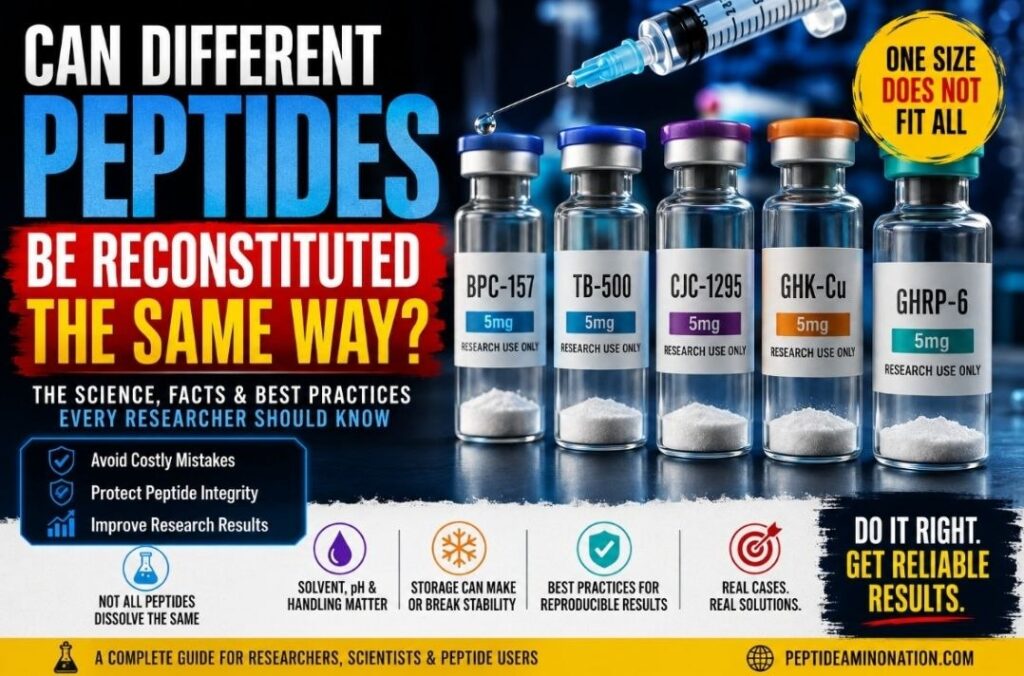
The question “Can Different Peptides Be Reconstituted the Same Way?” continues to appear across research forums and scientific communities because many assume all peptides dissolve similarly.
Scientifically, that assumption is incorrect.
Every peptide has its own chemical personality.
Its behavior depends on several molecular characteristics, including:
• Amino acid sequence
• Molecular length
• Net electrical charge
• Hydrophobicity
• Structural complexity
• Oxidation sensitivity
These characteristics determine how a peptide interacts with different solvents.
Using one universal protocol for every peptide would inevitably cause some peptides to:
• Aggregate
• Precipitate
• Form gels
• Oxidize
• Lose biological activity
- Become unsuitable for research
For this reason, experienced laboratories evaluate each peptide individually rather than relying on generic reconstitution instructions.
The Science Behind Peptide Solubility
Understanding peptide chemistry helps explain why different peptides cannot be reconstituted the same way.
1. Amino Acid Composition
Every peptide is built from amino acids.
The sequence and proportion of these amino acids determine how the peptide behaves once solvent is introduced.
Some amino acids attract water.
Others actively repel it.
Certain amino acids become unstable when exposed to oxygen or alkaline environments.
Even changing one amino acid within a sequence can significantly alter its solubility.
This explains why two peptides of similar size may require completely different reconstitution procedures.
2. Net Electrical Charge
The overall electrical charge of a peptide strongly influences which solvent works best.
Generally speaking, peptides fall into three categories:
| Peptide Type | Typical Behavior |
| Basic peptides | Often dissolve better in neutral or slightly acidic enviroment |
| Acidic peptides | Frequently require slightly basic conditions |
| Neutral peptides | May dissolve readily in sterile water or buffered solutions |
If the surrounding pH approaches the peptide’s isoelectric point, solubility decreases dramatically.
Instead of forming a clear solution, researchers may observe:
• Cloudiness
• Visible particles
• Clumping
• Precipitation
These are chemical incompatibility issues—not mixing problems.
3. Hydrophobicity
Hydrophobic peptides present one of the biggest challenges in peptide research.
Unlike hydrophilic molecules, hydrophobic peptides naturally avoid water.
Adding sterile water directly may cause immediate aggregation.
Instead of dissolving, the peptide may:
• Form a cloudy suspension
• Stick to the vial walls
• Produce gelatinous clumps
• Become nearly impossible to recover
Experienced laboratories often begin with a minimal amount of an appropriate organic solvent before gradually introducing aqueous buffers.
This step minimizes aggregation and promotes complete dissolution.
4. Peptide Length and Structural Complexity
Longer peptides generally require more careful handling.
As molecular size increases, structural stability becomes increasingly dependent on maintaining proper folding.
Examples include research peptides such as:
• Tirzepatide
• Retatrutide
• Tesamorelin
• Certain cyclic peptides
These molecules are often far more sensitive to:
• Mechanical stress
• Temperature fluctuations
• Rapid solvent introduction
Consequently, careful handling becomes just as important as solvent selection.
Why Manufacturer Guidance Matters
One of the most overlooked resources in peptide research is the Certificate of Analysis (CoA).
Researchers sometimes assume every batch behaves identically.
In reality, manufacturing observations often reveal subtle differences in:
• Solubility
• Purity
• Moisture content
• Recommended solvents
• Storage requirements
At PeptideAminoNation, we always encourage researchers to review available product documentation before beginning reconstitution.
Manufacturer guidance should always take priority over generic advice found on forums or social media.
Following validated recommendations helps protect valuable research materials while improving experimental consistency.
Laboratory Insight: Chemistry Always Wins
One lesson repeatedly observed while supporting research laboratories is this:
Most reconstitution failures are chemistry problems—not mixing problems.
When a peptide refuses to dissolve, many researchers instinctively shake the vial harder.
Unfortunately, vigorous mixing rarely fixes chemical incompatibility.
Instead, it often accelerates peptide degradation.
Successful peptide reconstitution begins with understanding the molecule itself.
Once the correct solvent environment is selected, many peptides dissolve smoothly with only gentle swirling.
This simple principle has helped numerous laboratories avoid unnecessary product loss and repeat experiments with greater confidence.
Key Takeaways
• There is no universal peptide reconstitution method.
• Every peptide possesses unique chemical properties that influence solubility.
• Amino acid composition, net charge, hydrophobicity, and molecular structure all determine the correct reconstitution strategy.
• Manufacturer guidance and Certificates of Analysis should always be consulted before selecting a solvent.
• Most failed reconstitutions result from choosing an incompatible solvent—not from inadequate mixing.
Can Different Peptides Be Reconstituted the Same Way? Choosing the Right Solvent for Every Peptide
Selecting the correct solvent is one of the most critical decisions in peptide research. If you’re still wondering Can Different Peptides Be Reconstituted the Same Way, this section provides a deeper scientific explanation of why solvent selection directly affects peptide stability, solubility, and research outcomes.
Many researchers assume that adding sterile water or bacteriostatic water is sufficient for every peptide. While that approach may work for some compounds, it can lead to precipitation, aggregation, or degradation in others. Understanding how different solvents interact with different peptide chemistries is essential for obtaining reliable and reproducible experimental results.
Why Solvent Selection Matters
A peptide’s ability to dissolve depends on its molecular properties—not on the convenience of a particular solvent.
The right solvent should:
• Maintain peptide stability.
• Promote complete dissolution.
• Preserve the peptide’s molecular structure.
• Minimize aggregation.
• Support downstream laboratory applications.
The wrong solvent can result in:
• Cloudy solutions
• Insoluble particles
• Gel formation
• Oxidation
• Reduced experimental reproducibility
• Permanent loss of peptide activity
This is why experienced laboratories evaluate the peptide before selecting a solvent instead of relying on a universal protocol.
Can Different Peptides Be Reconstituted the Same Way? Understanding Common Solvents
Below are the most frequently used solvents in peptide research and when they may be appropriate.
Sterile Water
Sterile water is one of the most commonly used reconstitution solvents.
It contains no preservatives and is suitable for many peptides that readily dissolve in aqueous environments.
Advantages
• High purity
• Minimal chemical interference
• Compatible with many laboratory applications
• Ideal for immediate use in many research protocols
Limitations
Sterile water is not universally suitable.
Highly hydrophobic peptides or peptides with challenging charge characteristics may not dissolve completely in sterile water alone.
Bacteriostatic Water
Bacteriostatic water contains a small amount of benzyl alcohol to inhibit bacterial growth.
It is frequently chosen when a peptide solution will be used multiple times over a short storage period.
Advantages
• Reduces microbial contamination
• Convenient for multi-use laboratory preparations
• Can extend usability under appropriate storage conditions
Limitations
Contrary to popular belief, bacteriostatic water is not the correct choice for every peptide.
Certain sensitive peptides may respond poorly to benzyl alcohol, and some research protocols specifically require preservative-free solvents.
Always consult the manufacturer’s recommendations before use.
Phosphate Buffered Saline (PBS)
PBS is commonly used in biological and cell culture research because it maintains a relatively stable pH.
Advantages
• Physiological pH
• Useful for many biological assays
• Compatible with numerous laboratory applications
Limitations
Not every peptide remains soluble in PBS.
Some peptides may aggregate or precipitate in buffered saline due to ionic interactions.
Dilute Acetic Acid
Certain positively charged (basic) peptides dissolve more efficiently in mildly acidic environments.
A very dilute acetic acid solution may improve solubility when neutral water proves ineffective.
Because only a small adjustment in pH is often required, laboratories typically use carefully controlled concentrations rather than highly acidic solutions.
Dilute Ammonium Hydroxide
Some negatively charged (acidic) peptides require a slightly basic environment to dissolve properly.
In these situations, laboratories may use a very dilute ammonium hydroxide solution before gradually diluting the peptide with an aqueous buffer.
This strategy helps prevent precipitation caused by unfavorable pH conditions.
DMSO (Dimethyl Sulfoxide)
DMSO is widely used for peptides that exhibit significant hydrophobicity.
Rather than adding water directly, researchers often dissolve the peptide in a minimal amount of DMSO before slowly introducing the final aqueous solution.
Advantages
• Excellent for highly hydrophobic peptides
• Helps prevent aggregation
• Facilitates complete dissolution
Important Consideration
Only a small volume is typically needed.
After the peptide has fully dissolved, the solution is generally diluted according to the experimental protocol.
A Simple Comparison of Common Reconstitution Solvents
| Solvent | Best Suited For | Important Consideration |
| Sterile Water | Many water-soluble peptides | Best for peptides with good equeous solubility |
| Bacteriostatic Water | Multi-use preparation | Contains preservative; not appropriate for every peptide |
| PBS | Cell culture application | May reduce solubility for certain peptides |
| Dilute Acetate Acid | Some basic peptides | Used to improve dissolution in acidic condition |
| Dilute Ammonium Hydroxide | Some acidic peptides | Used to increase pH for difficult peptides |
| DMSO | Hydrophobic peptides | Often used first before gradual equeous dilution |
How Experienced Laboratories Choose a Reconstitution Method
Rather than guessing, experienced research laboratories follow a logical evaluation process.
Step 1: Review the Certificate of Analysis (CoA)
The first document researchers should examine is the Certificate of Analysis.
The CoA often includes valuable information regarding:
• Recommended solvent
• Solubility observations
• Storage conditions
• Batch-specific characteristics
Ignoring this information can result in unnecessary trial and error.
Step 2: Evaluate the Peptide’s Chemical Properties
If manufacturer guidance is unavailable, researchers examine characteristics such as:
• Net electrical charge
• Hydrophobicity
• Amino acid sequence
• Molecular length
• Structural complexity
These properties help determine which solvent is most likely to produce a stable solution.
Step 3: Test on a Small Scale
Professional laboratories rarely risk an entire vial when working with unfamiliar peptides.
Instead, they evaluate the selected solvent using a small aliquot before proceeding with full reconstitution.
This approach minimizes waste while confirming solvent compatibility.
Step 4: Observe the Solution Carefully
A properly reconstituted peptide solution should typically appear clear unless otherwise specified by the manufacturer.
Researchers should monitor for signs of incompatibility, including:
• Persistent cloudiness
• Visible particles
• Gel formation
• Foaming
• Surface precipitation
If these occur, forcing additional mixing is rarely the solution.
Instead, the solvent choice should be re-evaluated.
Laboratory Case Study: When the Wrong Solvent Ruined an Expensive Experiment
One biotechnology laboratory contacted our technical support team after receiving what they believed was a defective batch of Amyloid-Beta (Aβ₁₋₄₂).
Immediately after sterile water was added, the peptide formed a thick, cloudy gel that settled at the bottom of the vial.
The research team suspected contamination or poor manufacturing quality.
After reviewing their protocol, the cause became clear.
Amyloid-Beta is highly hydrophobic and has a well-documented tendency to aggregate when exposed directly to aqueous solvents.
The peptide itself was not defective.
The reconstitution method was.
Our technical team recommended using an appropriate organic solvent during the initial dissolution step before gradually introducing the aqueous solution.
The remaining vials dissolved successfully, and the laboratory completed its experiments without further issues.
This experience reinforced an important lesson:
The correct solvent is often more important than the amount of solvent used.
Why Technical Support Matters
Choosing the correct reconstitution strategy can sometimes be challenging, especially when working with newly synthesized or specialized research peptides.
At PeptideAminoNation, we understand that successful research depends on more than supplying high-purity peptides.
Researchers also need access to reliable educational resources and practical laboratory guidance.
Our goal is to help biotechnology companies and research professionals make informed decisions that improve reproducibility, protect valuable peptide materials, and reduce avoidable experimental errors.
Whether you’re working with Tirzepatide, Retatrutide, BPC-157, TB-500, CJC-1295, GHK-Cu, Epitalon, MOTS-c, Oxytocin, VIP, or other research peptides, always consult the available product documentation before beginning the reconstitution process.
Key Takeaways
Can Different Peptides Be Reconstituted the Same Way? No. Solvent selection should always be based on the peptide’s unique chemical characteristics.
Sterile water is suitable for many peptides but is not a universal solution.
Bacteriostatic water, PBS, DMSO, dilute acetic acid, and dilute ammonium hydroxide each have specific laboratory applications.
Always review the Certificate of Analysis before selecting a solvent.
Testing a small portion of the peptide before full reconstitution can help prevent costly mistakes.
Correct solvent selection improves peptide stability, preserves molecular integrity, and enhances research reproducibility.
Can Different Peptides Be Reconstituted the Same Way? The Most Common Reconstitution Mistakes Researchers Must Avoid
By now, the answer to Can Different Peptides Be Reconstituted the Same Way should be clear: No. However, even when researchers choose an appropriate solvent, simple handling mistakes during reconstitution can still compromise peptide integrity and lead to inconsistent experimental results.
From our experience as a research peptide supplier supporting biotechnology companies and research laboratories, we’ve found that most reconstitution problems are preventable. In many cases, the peptide itself is not defective—the issue lies in the reconstitution technique.
This section explores the most common mistakes, explains why they occur, and outlines laboratory best practices to help researchers protect their valuable peptide materials.
Can Different Peptides Be Reconstituted the Same Way? Why Technique Matters as Much as Solvent
Selecting the correct solvent is only one part of successful peptide reconstitution.
The way a researcher introduces the solvent, mixes the solution, and handles the vial can significantly influence peptide stability.
Many peptides—particularly long-chain, cyclic, or hydrophobic molecules—are sensitive to:
• Mechanical stress
• Rapid temperature changes
• Oxidation
• Improper pH
• Surface adsorption
• Repeated freeze-thaw cycles
Ignoring these factors may reduce peptide quality long before the experiment begins.
Mistake #1: Vigorously Shaking or Vortexing the Vial
This is one of the most widespread mistakes in peptide research.
When a peptide does not dissolve immediately, many researchers instinctively shake the vial or place it on a laboratory vortex mixer.
Why This Is a Problem
Peptides are delicate chains of amino acids.
Aggressive mixing creates mechanical shear forces that may disrupt their structural integrity.
Although peptides are generally smaller than proteins, certain complex or longer peptides can still be susceptible to physical stress.
Instead of improving dissolution, vigorous agitation may:
• Reduce molecular stability
• Promote aggregation
• Generate foam
• Compromise experimental consistency
Best Practice
Rather than shaking the vial:
• Allow the solvent to work naturally.
• Gently swirl the vial.
• Slowly roll it between your hands.
• Be patient during dissolution.
If the peptide remains cloudy, reconsider the solvent—not the mixing force.
Mistake #2: Assuming Water Works for Every Peptide
One of the biggest misconceptions surrounding Can Different Peptides Be Reconstituted the Same Way is the belief that sterile water or bacteriostatic water works universally.
Unfortunately, this assumption has ruined countless laboratory preparations.
Why It Happens
Researchers often become comfortable using one successful protocol for several peptides.
When a new peptide arrives, they naturally repeat the same process.
However, peptides differ dramatically in:
• Hydrophobicity
• Net electrical charge
• Molecular folding
• Amino acid composition
What works perfectly for one peptide may fail completely for another.
Best Practice
Always review:
• Manufacturer recommendations
• Certificate of Analysis (CoA)
• Published solubility information
• Peptide-specific handling guidance
Never assume two peptides require identical treatment simply because they appear similar.
Mistake #3: Injecting Solvent Directly onto the Lyophilized Cake
The physical introduction of the solvent is often overlooked.
Many researchers insert the needle directly into the center of the peptide cake and inject rapidly.
Why This Can Cause Problems
Lyophilized peptide powder is extremely light and porous.
Forcefully spraying solvent directly onto the powder may:
• Disrupt the delicate lyophilized structure
• Create localized foaming
• Cause uneven wetting
• Increase aggregation in sensitive peptides
Best Practice
Experienced laboratories generally recommend:
• Holding the vial at a slight angle.
• Allowing the solvent to run gently down the inside wall.
• Letting the liquid slowly wet the peptide powder.
This simple technique promotes more controlled dissolution.
Mistake #4: Ignoring Temperature Equilibration
Temperature management begins before the solvent is even introduced.
Researchers sometimes remove frozen peptide vials from storage and immediately begin reconstitution.
Why This Matters
Opening a frozen vial immediately can introduce moisture through condensation.
That moisture may affect the remaining lyophilized peptide.
Rapid temperature changes may also place unnecessary stress on sensitive molecules.
Best Practice
Before opening the vial:
• Allow it to reach room temperature while remaining sealed.
• Minimize unnecessary exposure to humidity.
• Prepare all required materials in advance.
This simple habit helps preserve peptide quality.
Mistake #5: Ignoring the Peptide’s pH Requirements
Some peptides dissolve poorly because the surrounding solution is chemically incompatible.
Researchers sometimes mistake this for incomplete mixing.
Signs of Incorrect pH
• Persistent cloudiness
• Floating particles
• Gel formation
• Sediment at the bottom of the vial
These symptoms often indicate that the peptide requires a different solvent environment rather than additional agitation.
Understanding peptide chemistry is often the key to successful dissolution.
Laboratory Case Study: The “Ruined” Amyloid-Beta Assay
One neuroscience laboratory contacted our technical support team after experiencing what appeared to be a catastrophic product failure.
Immediately after adding sterile water, their Amyloid-Beta (Aβ₁₋₄₂) peptide formed a thick, cloudy gel.
The researchers initially suspected:
• Manufacturing contamination
• Poor peptide purity
• Defective lyophilization
After reviewing the protocol, the actual cause became obvious.
Amyloid-Beta is highly hydrophobic and has a strong tendency to self-aggregate.
Introducing water directly accelerated irreversible aggregation.
The peptide had not failed.
The reconstitution strategy had.
Our technical support team recommended a revised protocol using an appropriate initial organic solvent before gradual aqueous dilution.
The remaining vials dissolved successfully.
Subsequent experiments proceeded without further issues.
Lesson Learned
Successful peptide reconstitution depends on understanding peptide chemistry—not forcing dissolution through mechanical mixing.
Laboratory Case Study: The Mystery of the “Disappearing” Peptide
Another biotechnology research group contacted us after repeatedly observing unusually low recovery during HPLC analysis of a custom basic peptide.
Initially, they suspected:
• Incorrect peptide concentration
• Underfilled vials
• Manufacturing inconsistencies
However, a careful review of their laboratory procedure revealed two critical issues.
First, technicians routinely vortexed each vial for nearly one minute whenever dissolution appeared slow.
Second, solvent was injected forcefully into the center of the lyophilized powder, creating visible foam.
Although these practices seemed harmless, they introduced unnecessary mechanical stress before analysis.
After recommending a revised protocol—including slow solvent introduction along the vial wall and gentle rolling instead of vortexing—the laboratory repeated the experiment.
The next HPLC chromatograms showed sharp, well-defined peaks consistent with the expected purity profile.
Lesson Learned
Sometimes the difference between failed and successful experiments is not peptide quality.
It is simply using proper laboratory technique.
Practical Checklist Before Every Reconstitution
Experienced laboratories often follow a simple checklist before beginning any peptide reconstitution.
✓ Review the Certificate of Analysis.
✓ Confirm the recommended solvent.
✓ Allow frozen vials to reach room temperature before opening.
✓ Introduce solvent slowly along the vial wall.
✓ Avoid vigorous shaking or vortexing.
✓ Observe solution clarity.
✓ Allow sufficient time for passive dissolution.
✓ Document solvent type, concentration, and preparation date.
Following these straightforward steps can dramatically improve experimental reproducibility.
Why Education Is Just as Important as Peptide Quality
At PeptideAminoNation, we believe that supplying high-purity research peptides is only part of supporting successful scientific research.
Researchers also benefit from practical educational resources that explain not only what to do, but why those practices matter.
Our experience supporting biotechnology companies and research laboratories has shown that informed researchers make better decisions, avoid costly mistakes, and obtain more consistent experimental results.
Whether you’re working with Tirzepatide, Retatrutide, BPC-157, TB-500, CJC-1295, GHK-Cu, Epitalon, MOTS-c, Oxytocin, VIP, or other research peptides, understanding proper reconstitution techniques is an essential step toward reliable laboratory outcomes.
Key Takeaways
Can Different Peptides Be Reconstituted the Same Way? No—and even the correct solvent can fail if poor handling techniques are used.
Avoid shaking or vortexing sensitive peptides.
Introduce solvent slowly down the inside wall of the vial.
Allow frozen vials to reach room temperature before opening.
Cloudiness usually indicates chemical incompatibility rather than insufficient mixing.
Proper laboratory technique protects peptide integrity and improves reproducibility.
Real-world laboratory support cases demonstrate that many apparent “product failures” are actually reconstitution errors that can be prevented with the right approach.
Can Different Peptides Be Reconstituted the Same Way? Post-Reconstitution Storage and Stability Best Practices
Successfully dissolving a peptide is only half the process. Once you’ve answered Can Different Peptides Be Reconstituted the Same Way and selected the appropriate reconstitution method, your attention should immediately shift to preserving the peptide’s stability.
Even perfectly reconstituted peptides can rapidly lose integrity if they are stored or handled incorrectly. Temperature fluctuations, repeated freeze-thaw cycles, microbial contamination, oxidation, and poor storage practices can gradually reduce peptide quality and compromise research reproducibility.
At PeptideAminoNation, we’ve found that many researchers focus heavily on choosing the right solvent but underestimate the importance of post-reconstitution handling. Following proven laboratory practices helps maximize peptide stability and protects valuable research materials.
Can Different Peptides Be Reconstituted the Same Way? Proper Storage Depends on the Peptide
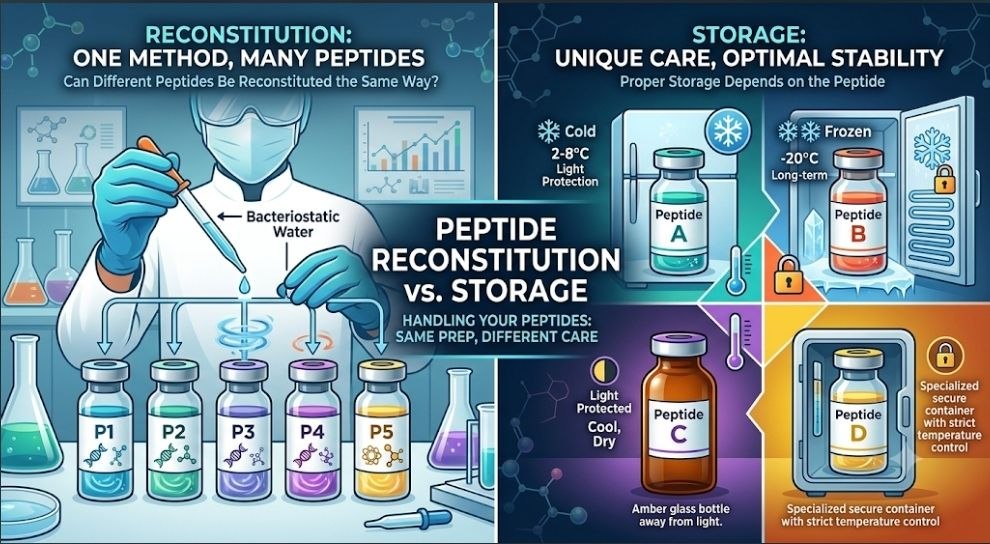
Just as there is no universal reconstitution method, there is also no universal storage protocol for every peptide.
Some peptides remain relatively stable under refrigerated conditions for short periods, while others require immediate freezing after reconstitution.
Several factors influence storage recommendations, including:
• Amino acid composition
• Molecular size
• Structural complexity
• Solvent used
• Experimental timeline
Sensitivity to oxidation and hydrolysis
Always review the manufacturer’s recommendations and Certificate of Analysis before deciding how to store a reconstituted peptide.
Best Practice #1: Aliquot Immediately After Reconstitution
One of the most effective ways to preserve peptide quality is to divide the freshly prepared solution into smaller, single-use aliquots.
Why Aliquoting Is Important
Every freeze-thaw cycle places stress on peptide molecules.
Repeated freezing and thawing can contribute to:
• Structural degradation
• Aggregation
• Concentration changes
• Reduced experimental reproducibility
Instead of repeatedly thawing one large vial, professional laboratories prepare multiple small aliquots that can be used individually.
This approach minimizes unnecessary handling while helping preserve the remaining peptide solution.
Best Practice #2: Store at the Appropriate Temperature
Temperature is one of the biggest factors affecting peptide stability.
Although recommendations vary depending on the peptide, laboratories generally follow these principles.
Short-Term Storage
If the peptide will be used within a relatively short period, refrigeration may be appropriate.
Typical laboratory refrigeration temperatures are approximately 4°C.
This approach is often suitable for short-term experimental use when supported by the manufacturer’s guidance.
Long-Term Storage
For peptides intended for future experiments, freezing is generally recommended.
Many research laboratories store aliquots between:
● 20°C
● 80°C
Lower temperatures significantly slow many degradation processes and help preserve peptide integrity.
Researchers should always verify the recommended storage conditions for their specific peptide.
Best Practice #3: Avoid Repeated Freeze-Thaw Cycles
Repeated freeze-thaw cycling is one of the leading causes of avoidable peptide degradation.
Every thaw introduces:
• Temperature fluctuations
• Physical stress
• Potential concentration changes
• Additional opportunities for contamination
Although some peptides tolerate occasional thawing better than others, minimizing freeze-thaw exposure is considered a standard laboratory practice.
Single-use aliquots remain the preferred solution.
Best Practice #4: Maintain Sterile Technique
Once a peptide has been reconstituted, it becomes more vulnerable to contamination.
Microorganisms introduced during handling may affect solution quality and interfere with research results.
Professional laboratory practices include:
• Using sterile equipment
• Working within clean laboratory environments
• Minimizing unnecessary vial openings
• Avoid repeated needle entries whenever possible
Maintaining sterility protects both the peptide and downstream experiments.
Best Practice #5: Prevent Peptide Loss Through Surface Adsorption
An often-overlooked challenge is surface adsorption.
Some peptides naturally adhere to the walls of storage containers, particularly when prepared at very low concentrations.
Researchers may unknowingly lose a measurable amount of peptide before beginning an experiment.
To reduce adsorption, laboratories often select:
• Low-binding polypropylene tubes
• High-quality laboratory-grade storage containers
• Appropriate glass containers when suitable for the application
These materials help preserve the intended peptide concentration throughout storage.
Best Practice #6: Protect Oxidation-Prone Peptides
Certain amino acids are especially susceptible to oxidation.
Peptides containing higher amounts of:
• Cysteine
• Methionine
• Tryptophan
may require additional precautions during storage.
Oxidation can alter molecular structure and reduce peptide stability.
Depending on the application, researchers may minimize oxygen exposure by:
• Limiting repeated vial openings
• Preparing small aliquots
• Using appropriate storage containers
Following manufacturer-specific handling recommendations
Understanding the peptide sequence provides valuable insight into potential stability concerns.
Best Practice #7: Label Every Aliquot Carefully
A clear peptide solution gives no visual indication of:
• Concentration
• Solvent used
• Preparation date
• Storage duration
Without proper labeling, laboratories risk introducing unnecessary errors into future experiments.
Each aliquot should clearly identify:
• Peptide name
• Final concentration
• Solvent
• Date of reconstitution
• Technician or project identifier (if applicable)
Accurate documentation improves traceability and supports reproducible research.
Which Peptides Require Extra Care?
One reason the answer to Can Different Peptides Be Reconstituted the Same Way remains “no” is that certain peptides require significantly more careful handling than others.
Below are some common examples.
| Peptide Characteristics | Primary Concern | Recommending Handling |
| Oxidation-prone peptides | Oxidation degradation | Reduce oxygen exposure and follow recommended storage guidance |
| Hydrophobic peptides | Aggregation and precipitation | Follow peptide specific-solvent recommendation |
| Highly acidic peptides | Reduced solubility | Use the appropriate pH conditions recommended by the manufacturer |
| Highly basics peptides | pH sensitivity | Select compatible solvent and buffers |
| Long or cyclic peptides | Mechanical instability | Minimize physical stress during handling |
Each peptide should always be evaluated individually rather than grouped into a single handling protocol.
Laboratory Best Practices That Improve Research Reproducibility
Experienced laboratories understand that reproducibility begins long before data collection.
Consistent peptide handling contributes to:
• Improved assay reliability
• Better batch-to-batch consistency
• Reduced experimental variability
• Lower material waste
• Increased confidence in research findings
Establishing standardized operating procedures for peptide reconstitution and storage can significantly improve overall laboratory performance.
Why Reliable Peptide Suppliers Matter
High-quality handling practices begin with high-quality materials.
At PeptideAminoNation, we focus on sourcing high-purity research peptides while providing educational resources that help researchers understand proper handling from reconstitution through storage.
Whether you’re conducting biotechnology research, developing analytical methods, or supporting pharmaceutical discovery, following validated laboratory practices helps protect both your peptide investment and the integrity of your research.
Researchers looking for premium research peptides and educational guidance can explore our growing collection of products and resources at PeptideAminoNation.com.
Key Takeaways
• Can Different Peptides Be Reconstituted the Same Way? No—and storage requirements also vary between peptides.
• Aliquoting helps minimize damaging freeze-thaw cycles.
• Store peptides according to manufacturer recommendations and the Certificate of Analysis.
• Maintain sterile technique throughout handling.
• Use appropriate storage containers to reduce peptide adsorption.
• Protect oxidation-sensitive peptides through proper storage practices.
• Careful labeling improves traceability and research reproducibility.
• High-quality peptide handling extends well beyond the initial reconstitution process.
Can Different Peptides Be Reconstituted the Same Way? Frequently Asked Questions, Common Myths, and Final Recommendations
Throughout this guide, we’ve answered the central question: Can Different Peptides Be Reconstituted the Same Way?
The scientific answer remains no.
Every peptide possesses unique chemical and physical properties that determine how it should be reconstituted, handled, and stored. Applying a “one-size-fits-all” approach increases the risk of precipitation, aggregation, oxidation, and reduced experimental reproducibility.
In this final section, we’ll address frequently asked questions, debunk common myths found online, and summarize the laboratory best practices that every researcher should follow.
Frequently Asked Questions About Peptide Reconstitution
Can Different Peptides Be Reconstituted the Same Way?
No.
Each peptide has unique characteristics—including amino acid sequence, molecular size, net charge, hydrophobicity, and structural complexity—that influence its solubility and stability.
Always consult the manufacturer’s recommendations and Certificate of Analysis (CoA) before selecting a reconstitution method.
Can I Use Sterile Water for Every Peptide?
No.
While sterile water is suitable for many peptides, it is not universally appropriate.
Some peptides require:
• Buffered solutions
• Mildly acidic environments
• Mildly basic environments
• An initial organic solvent such as DMSO before aqueous dilution
Using the wrong solvent may result in incomplete dissolution or aggregation.
Is Bacteriostatic Water Always the Best Choice?
No.
Bacteriostatic water is valuable for certain laboratory applications because it contains a preservative that helps limit bacterial growth.
However, some peptides and experimental protocols require preservative-free solutions.
The appropriate solvent depends on the peptide and the intended research application.
Why Does My Peptide Solution Look Cloudy?
Cloudiness is often a sign that the peptide has not dissolved completely.
Possible causes include:
• Incorrect solvent selection
• Incompatible pH
• Hydrophobic aggregation
• Precipitation
Cloudiness should not automatically be treated by additional shaking or vortexing.
Instead, review the peptide’s recommended reconstitution conditions.
Should I Shake the Vial to Help It Dissolve?
Generally, no.
Most laboratories recommend allowing the peptide to dissolve gradually while gently swirling or rolling the vial.
Aggressive shaking or vortexing may introduce unnecessary mechanical stress, particularly for sensitive or structurally complex peptides.
How Long Can Reconstituted Peptides Be Stored?
There is no universal storage period.
Peptide stability depends on several factors, including:
• Peptide sequence
• Solvent used
• Storage temperature
• Handling practices
• Experimental conditions
Always follow the manufacturer’s storage recommendations and avoid relying on generalized timelines.
Why Are Freeze-Thaw Cycles Harmful?
Repeated freezing and thawing may contribute to:
• Structural degradation
• Aggregation
• Reduced stability
• Increased experimental variability
Preparing single-use aliquots immediately after reconstitution remains one of the most effective methods for minimizing freeze-thaw damage.
Common Myths About Peptide Reconstitution
Researchers frequently encounter conflicting advice on forums, blogs, and social media. Separating myths from evidence-based laboratory practices is essential for obtaining reliable research results.
Myth #1: Every Peptide Can Be Reconstituted the Same Way
Reality:
This is one of the most common misconceptions.
Peptides differ significantly in their chemical behavior.
A successful protocol for one peptide may completely fail for another.
Myth #2: More Shaking Means Faster Dissolution
Reality:
Cloudiness usually indicates chemical incompatibility rather than insufficient mixing.
The solution is often selecting a more appropriate solvent—not increasing mixing intensity.
Myth #3: Bacteriostatic Water Is Always Required
Reality:
Bacteriostatic water is useful in certain situations, but it is not universally recommended.
The appropriate solvent should always match the peptide’s characteristics and research requirements.
Myth #4: Every Reconstituted Peptide Lasts 30 Days
Reality:
There is no universal shelf life.
Some peptides remain relatively stable under recommended storage conditions, while others degrade much more quickly.
Storage recommendations should always be peptide-specific.
Myth #5: If the Peptide Doesn’t Dissolve, the Product Must Be Defective
Reality:
In our experience supporting research laboratories, apparent product failures are frequently traced to incorrect reconstitution techniques rather than peptide quality.
Reviewing solvent compatibility, pH, handling procedures, and storage conditions often resolves the issue.
Best Practices Every Research Laboratory Should Follow
Whether you’re working with Tirzepatide, Retatrutide, BPC-157, TB-500, CJC-1295, GHK-Cu, Epitalon, MOTS-c, Oxytocin, VIP, or other research peptides, these practices help improve consistency:
✓ Review the Certificate of Analysis before beginning.
✓ Select the solvent based on peptide chemistry.
✓ Allow frozen vials to reach room temperature before opening.
✓ Introduce solvent slowly along the inside wall of the vial.
✓ Avoid vigorous shaking and vortexing.
✓ Observe solution clarity before use.
✓ Aliquot immediately after successful reconstitution.
✓ Minimize freeze-thaw cycles.
✓ Store peptides according to manufacturer recommendations.
✓ Label every aliquot clearly.
✓ Maintain sterile laboratory technique throughout handling.
Following these principles can help improve reproducibility while reducing unnecessary peptide loss.
Why Researchers Choose PeptideAminoNation
Choosing a peptide supplier involves more than comparing product catalogs.
Researchers need confidence that their materials are supported by reliable documentation, consistent quality standards, and practical educational resources.
At PeptideAminoNation, we are committed to supporting biotechnology companies, research laboratories, and scientists by:
• Sourcing high-purity research peptides.
• Maintaining rigorous quality standards.
• Providing responsive technical support.
• Publishing educational resources based on laboratory best practices.
• Helping researchers make informed decisions throughout the peptide handling process.
Whether you’re beginning peptide research or managing advanced biotechnology projects, our goal is to provide reliable products and educational content that support reproducible scientific research.
Visit PeptideAminoNation.com to explore our growing collection of research peptides and laboratory resources.
Brows Related Topics Below To Boost Your Knowledge About Peptide
Why Research Peptides Results Differ Between Laboratories
Why Impurities Form During Peptide Synthesis: 7 Critical Mistakes Every Researcher Must Avoid
Common Storage Mistakes That Reduce Peptide Quality
Why Different Peptides Have Different Shelf Lives
How Laboratories Test Peptide Identity: 6 Powerful Methods That Protect You From Costly Mistakes.
Understanding Syringe Units for Peptide Research Calculations
Understanding Peptide Hydrophobicity
Avoiding Measurement Errors During Peptide Reconstitution
Peptide Purity Above 99% isn’t always the best choice for peptide research
Final Thoughts
So, Can Different Peptides Be Reconstituted the Same Way?
The answer is a clear no.
Successful peptide reconstitution requires understanding the unique chemistry of each molecule rather than relying on generalized protocols. Factors such as amino acid composition, net charge, hydrophobicity, structural complexity, solvent compatibility, and storage conditions all influence how a peptide should be handled.
Researchers who take the time to evaluate each peptide individually are more likely to achieve consistent dissolution, preserve molecular integrity, and improve the reproducibility of their experiments.
As a research peptide supplier with extensive experience sourcing high-purity peptides and supporting research laboratories, PeptideAminoNation encourages every researcher to combine high-quality materials with evidence-based laboratory practices. Doing so not only protects valuable peptide resources but also strengthens the reliability of scientific outcomes.
Thank you for reading this comprehensive guide. We hope it serves as a trusted resource for biotechnology professionals, researchers, and peptide users seeking a deeper understanding of peptide reconstitution and best laboratory practices.
