Buffer Solutions in Peptide Research: 12 Powerful Secrets to Improve Peptide Stability and Experimental Success

Table of Contents
1. Introduction
2. What Are Buffer Solutions in Peptide Research?
3. Why Buffer Selection Matters More Than Most Researchers Realize
4. How Buffers Affect Peptide Stability and Solubility
5. Choosing the Right Buffer for Different Peptide Applications
6. Common Buffer Selection Mistakes
7. Professional Buffer Preparation Guidelines
8. Three Real-World Case Studies
9. Quality Control and Buffer Compatibility Testing
10. Common Myths About Buffer Solutions in Peptide Research
11. Frequently Asked Questions
12. Final Thoughts
Buffer Solutions in Peptide Research
https://pubmed.ncbi.nlm.nih.gov/
Buffer Solutions in Peptide Research are among the most overlooked factors affecting experimental success. While researchers often focus on peptide purity, synthesis methods, and analytical instrumentation, the buffer used to dissolve, store, and analyze a peptide can determine whether an experiment produces reliable data or weeks of frustration.
A highly purified peptide can rapidly aggregate, degrade, precipitate, oxidize, or lose biological activity if placed in an unsuitable buffer. Conversely, selecting the correct buffer system helps preserve peptide integrity, improves reproducibility, minimizes degradation, and supports consistent laboratory outcomes.
As specialists who prepare research peptide solutions and advise researchers working with GLP-1 analogs, growth hormone peptides, neuropeptides, antimicrobial peptides, cosmetic peptides, and numerous experimental compounds, we’ve repeatedly seen how a seemingly minor buffer decision can completely change experimental results.
One of the most common questions we receive is:
“Which buffer should I use for my peptide?”
The answer is never as simple as choosing PBS or Tris.
Instead, the correct buffer depends on multiple factors, including:
• Peptide sequence
• Net charge
• Hydrophobicity
• Experimental pH
• Storage temperature
• Metal ion requirements
• Cell culture compatibility
• Chromatography methods
• Mass spectrometry compatibility
• Long-term stability requirements
Understanding these variables helps researchers avoid costly experimental failures while extending peptide stability throughout every stage of research.
This guide explains the science behind professional Buffer Solutions in Peptide Research, shares practical laboratory experience, discusses common mistakes, presents real-world case studies, and provides actionable recommendations researchers can immediately apply.
What Are Buffer Solutions in Peptide Research?
A buffer solution is a carefully prepared chemical system designed to resist changes in pH when acids or bases are introduced. In peptide research, buffers create a stable chemical environment that protects peptides from structural and chemical changes throughout storage, preparation, purification, and biological testing.
Although buffers appear simple, they directly influence almost every characteristic of a peptide solution.
These include:
• Peptide solubility
• Molecular stability
• Secondary structure
• Folding behavior
• Aggregation tendency
• Oxidation rate
• Hydrolysis susceptibility
• Enzyme activity
• Cell compatibility
• Chromatographic performance
• Mass spectrometry sensitivity
Without proper buffering, even research-grade peptides exceeding 98% purity may quickly lose their intended performance.
Think of a peptide as a precision-built instrument. A premium instrument performs poorly if used in the wrong environment. Likewise, an excellent peptide cannot compensate for poor buffer selection.
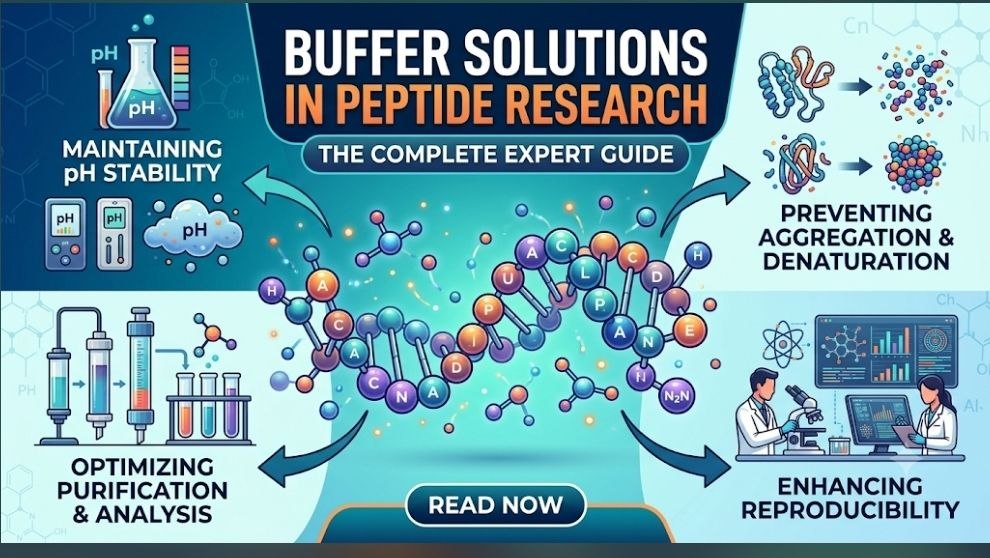
Why Buffers Matter Beyond pH
Many researchers assume buffers only control pH.
In reality, professional laboratories evaluate many additional properties before selecting a buffer.
These include:
Ionic Strength
The concentration of dissolved ions influences peptide folding, electrostatic interactions, receptor binding, and aggregation behavior.
Temperature Stability
Certain buffers undergo substantial pH shifts when temperature changes.
For example, Tris buffer prepared at room temperature may become significantly more alkaline after refrigeration or freezing.
Temperature-sensitive peptides can degrade surprisingly quickly under these conditions.
Metal Ion Compatibility
Many biological assays require calcium or magnesium ions.
Certain buffers interact chemically with these ions, forming insoluble precipitates that interfere with experimental outcomes.
Analytical Compatibility
Not every buffer works with every analytical technique.
For example:
• Volatile buffers are preferred for LC-MS.
• Non-volatile salts can contaminate mass spectrometers.
• Certain buffers interfere with colorimetric assays.
• Others reduce chromatographic resolution.
Professional buffer selection always considers downstream analytical methods before preparation begins.
Why Buffer Selection Matters More Than Most Researchers Realize
One misconception repeatedly encountered when advising laboratories is the belief that peptide purity alone determines experimental success.
In reality, even an exceptionally pure peptide can fail because of an unsuitable buffer.
Professional peptide laboratories often spend as much time validating formulation buffers as they do verifying peptide synthesis.
This is because buffers influence nearly every degradation pathway.
Poor buffer selection may accelerate:
• Hydrolysis
• Oxidation
• Aggregation
• Deamidation
• Precipitation
• Adsorption onto plastic surfaces
• Loss of biological activity
Researchers sometimes interpret these failures as poor peptide quality when the underlying cause is actually the solution environment.
This distinction is critically important.
Replacing a peptide batch will not solve a formulation problem.
Selecting the correct buffer often will.
Professional Insight
One lesson we’ve learned from assisting peptide researchers is that no universal buffer exists.
A buffer ideal for GLP-1 receptor agonists may perform poorly with antimicrobial peptides.
Likewise, a formulation optimized for HPLC purification may be completely unsuitable for cell culture or long-term frozen storage.
Professional laboratories therefore evaluate every peptide individually before recommending a formulation strategy.
Rather than asking:
“Which buffer is best?”
Researchers should ask:
“Which buffer is best for this specific peptide and this specific experiment?”
That small change in perspective often prevents expensive mistakes and significantly improves reproducibility.
Buffer Selection Starts with Understanding Your Peptide
Before choosing any buffer, experienced peptide specialists evaluate several molecular characteristics.
| Peptide Property | Why It Matters |
| Amino acid sequence | Predicts charge, hydrophobicity, and stability |
| Net charge | Influence initial solvent selection |
| Hydrophobicity | Determine solubility challenge |
| Presence of cysteine | Indicate oxidation risk |
| Methionine or tryptophan content | May require antioxidant precautions |
| Intended storage time | Determine formulation requirements |
| Experimental temperature | Influence buffer stability |
| Downstream analysis | Determine analytical compatibility |
Skipping these considerations often leads to unnecessary troubleshooting later in the research process.
The most successful peptide experiments begin with thoughtful buffer selection—not after problems arise.
How Buffer Solutions in Peptide Research Affect Stability and Solubility
Choosing the right Buffer Solutions in Peptide Research is one of the most important decisions a researcher can make before beginning an experiment. A carefully selected buffer not only maintains pH but also protects peptide structure, improves solubility, minimizes degradation, and enhances reproducibility throughout the experimental workflow.
In our experience advising peptide researchers, we’ve found that many failed experiments are not caused by poor peptide quality—they result from using a buffer that is incompatible with the peptide or the intended analytical method.
Understanding how different buffers behave allows researchers to make informed decisions that save time, reduce costs, and improve data quality.
Why Peptide Stability Depends on the Right Buffer
Every peptide exists in a delicate chemical balance.
Changes in pH, ionic strength, temperature, dissolved oxygen, or metal ion concentration can alter that balance within minutes.
An unsuitable buffer may lead to:
• Peptide precipitation
• Protein or peptide aggregation
• Hydrolysis
• Oxidation
• Loss of biological activity
• Reduced receptor binding
• Lower analytical sensitivity
• Poor chromatographic separation
Conversely, selecting the appropriate buffer creates a stable environment that preserves peptide integrity from reconstitution through storage and downstream analysis.
Professional laboratories therefore evaluate buffer compatibility before beginning any long-term study.
How Buffer Solutions in Peptide Research Improve Solubility
Peptide solubility is governed largely by amino acid composition.
Hydrophilic peptides usually dissolve readily in aqueous buffers, while hydrophobic peptides often require a different strategy.
Several buffer characteristics influence solubility, including:
pH
Changing pH alters the peptide’s overall electrical charge.
A small pH adjustment may dramatically improve or reduce solubility.
Ionic Strength
High salt concentrations may either stabilize or promote aggregation depending on the peptide sequence.
Finding the correct ionic strength is often more important than increasing buffer concentration.
Buffer Components
Certain buffer ions interact directly with peptide side chains.
Some stabilize peptide conformations, while others encourage precipitation or unwanted molecular interactions.
Temperature
Lower temperatures generally improve peptide stability but may decrease solubility for highly hydrophobic sequences.
Balancing temperature with buffer composition is therefore essential.
Choosing the Best Buffer Solutions in Peptide Research
There is no universal buffer suitable for every peptide.
Instead, experienced peptide specialists select buffer systems according to:
• Experimental objectives
• Peptide chemistry
• Analytical techniques
• Storage conditions
• Biological compatibility
The following buffers are among the most widely recommended in professional peptide laboratories.
1. HEPES Buffer
Recommended pH Range: 6.8–8.2
HEPES is widely regarded as one of the most reliable biological buffers available.
Unlike many traditional buffers, HEPES maintains exceptional pH stability even when experiments move between refrigerated conditions, room temperature, and incubators.
Advantages
• Excellent pH stability
• Minimal temperature-induced pH drift
• Compatible with calcium and magnesium
• Suitable for cell culture
• Low biological interference
• Excellent enzyme compatibility
Limitations
• More expensive than phosphate buffers
• It is not always necessary for routine laboratory applications
Best Applications
• Cell culture experiments
• GLP-1 analog research
• Growth hormone peptides
• Neuropeptide studies
• Enzyme assays
• Long-term solution storage
Professional Recommendation
Whenever researchers ask us which buffer provides the greatest balance between stability and biological compatibility, HEPES is frequently our first recommendation.
2. Phosphate Buffer (PBS)
Recommended pH Range: 5.8–8.0
PBS remains one of the most commonly used Buffer Solutions in Peptide Research because it closely mimics physiological conditions.
Its affordability and ease of preparation make it a standard choice for many laboratories.
Advantages
• Physiological compatibility
• Economical
• Easy preparation
• Stable at room temperature
• Widely accepted laboratory standard
Limitations
PBS is not universally suitable.
Researchers should avoid PBS when experiments involve:
• Calcium ions
• Magnesium ions
• LC-MS
• Mass spectrometry
Phosphate reacts with divalent metal ions, forming insoluble precipitates that can interfere with peptide assays.
Because phosphate is non-volatile, it may also contaminate sensitive mass spectrometry equipment.
Best Applications
• General peptide handling
• Physiological assays
• Cell washing
• Protein purification
• Routine biological research
3. Tris-HCl Buffer
Recommended pH Range: 7.0–9.0
Tris has served molecular biology laboratories for decades.
Its excellent buffering capacity and affordability make it a popular option for numerous applications.
However, it must be used carefully.
Advantages
• Highly soluble
• Affordable
• Strong buffering capacity
• Suitable for molecular biology
• Compatible with DNA and RNA applications
Limitations
Tris possesses one major weakness:
Its pH changes significantly with temperature.
A buffer adjusted to pH 7.5 at room temperature may approach pH 8.5 after refrigeration.
For temperature-sensitive peptides, this shift may accelerate hydrolysis and reduce stability.
Tris may also interfere with certain analytical assays involving primary amines.
Best Applications
• DNA electrophoresis
• RNA purification
• General molecular biology
• Laboratory workflows conducted at stable temperatures
4. Ammonium Acetate Buffer
Recommended pH Range: 3.8–5.8
When peptide analysis involves LC-MS or RP-HPLC, ammonium acetate is often the preferred choice.
Unlike phosphate buffers, ammonium acetate is volatile.
During mass spectrometry, it evaporates without leaving salt deposits inside the instrument.
Advantages
• Excellent LC-MS compatibility
• Ideal for RP-HPLC
• Volatile
• Improves mass spectrometry sensitivity
• Prevents instrument contamination
Limitations
• Narrow buffering range
• Less suitable for physiological experiments
• Limited usefulness outside acidic conditions
Best Applications
• Peptide purification
• LC-MS
• Analytical chemistry
• RP-HPLC method development
Professional Comparison of Common Buffer Systems
| Buffer | Effective pH | Best Application | Major Limitation |
| HEPES | 6.8-8.2 | cell culture, enzyme assays, peptide stability | Higher cost |
| PBS | 5.8-8.0 | Physiological studies, routine laboratory work | Incompatible with calcium, magnesium and LC-MS |
| Tris-HCI | 7.0-9.0 | Molecular biology, nucleic acid research | significant temperature-dependent pH shifts |
| Ammonium Acetate | 3,8-3.8 | LC-MS, RP-HPLC, peptide purification | Limited buffering range |
Expert Advice for Selecting Buffer Solutions in Peptide Research
Before preparing any peptide solution, we recommend asking the following questions:
• What is the peptide’s expected net charge?
• Does the sequence contain hydrophobic regions?
• Will the peptide be frozen?
• Will calcium or magnesium be present?
• Is the peptide intended for cell culture?
• Will the sample be analyzed using LC-MS?
• Is long-term storage required?
• Could oxidation become a concern?
Answering these questions before selecting a buffer prevents many of the problems that researchers mistakenly attribute to peptide instability.
In our experience assisting laboratories working with research peptides, GLP-1 analogs, cosmetic peptides, antimicrobial peptides, growth hormone peptides, and neuropeptides, investing a few extra minutes in buffer selection consistently saves weeks of troubleshooting later.
Professional peptide research begins long before the first experiment—it begins with selecting the correct buffer.
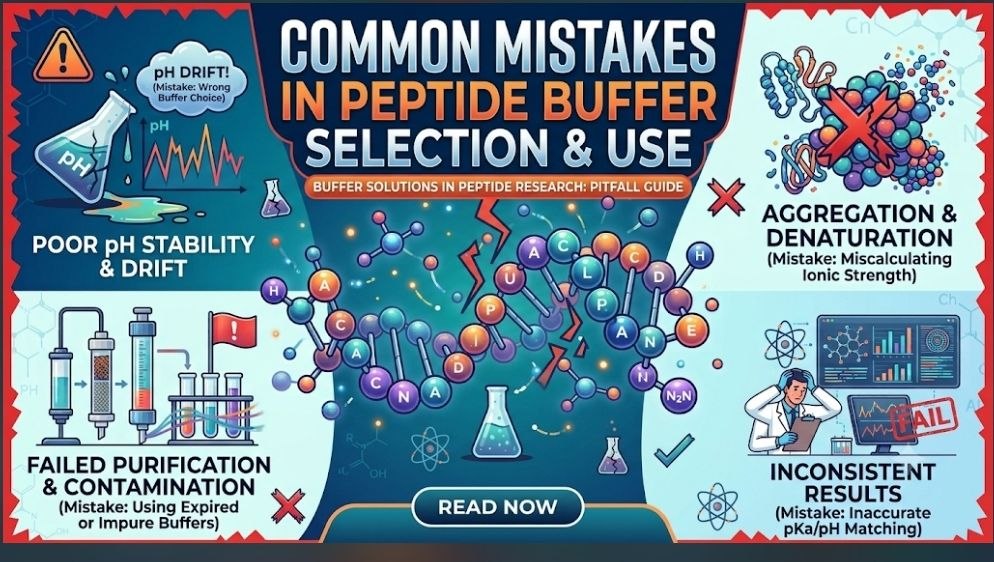
Common Mistakes When Using Buffer Solutions in Peptide Research
Even the highest-quality Buffer Solutions in Peptide Research cannot compensate for poor preparation techniques or incorrect buffer selection. Throughout our experience supporting researchers, we’ve found that many experimental failures originate from avoidable mistakes made before the peptide is ever introduced into an assay.
Most of these errors are subtle. A small pH drift, an incorrect hydration calculation, or an incompatible buffer component can compromise peptide stability, reduce biological activity, and produce misleading analytical data.
The following are the most common mistakes we encounter—and how professional laboratories avoid them.
Mistake #1: Ignoring the Buffer’s pKa
One of the most fundamental principles of buffer chemistry is also one of the most frequently overlooked.
Every buffer has an optimal buffering range, typically within ±1 pH unit of its pKa.
When researchers choose a buffer simply because it is commonly used, rather than because its pKa matches the target pH, buffering capacity decreases dramatically.
Example
Preparing a Tris buffer for a pH 6.0 experiment may seem convenient, but Tris performs best near neutral to mildly alkaline conditions. Outside its effective range, even small additions of acid or base can cause significant pH drift.
Best Practice
Always select a buffer whose pKa closely matches your desired experimental pH. This ensures maximum buffering capacity and minimizes unexpected pH fluctuations during peptide handling.
Mistake #2: Overlooking Buffer Compatibility
A buffer should never be selected based solely on its pH range.
Researchers must also consider how the buffer interacts with:
• Metal ions
• Enzymes
• Detection reagents
• Chromatography systems
• Mass spectrometry instruments
• Cell culture media
For example, phosphate buffers readily react with calcium and magnesium ions to form insoluble precipitates. Likewise, Tris can interfere with certain colorimetric protein assays and react with primary amines under specific conditions.
Professional Tip
Before preparing a peptide solution, evaluate every downstream application—not just the initial experiment.
A buffer compatible with one analytical method may be unsuitable for another.
Mistake #3: Ignoring Temperature Effects
Temperature changes influence buffer chemistry more than many researchers realize.
Certain buffer systems undergo significant pH shifts as temperature changes.
Tris is a classic example.
A Tris buffer adjusted to pH 7.5 at room temperature may become considerably more alkaline after refrigeration or freezing.
For temperature-sensitive peptides, this shift can accelerate hydrolysis, oxidation, and structural degradation.
Best Practice
Adjust buffer pH at the same temperature in which the experiment or storage will occur whenever possible.
For experiments involving repeated temperature changes, consider using buffers such as HEPES, which exhibit much greater temperature stability.
Mistake #4: Preparing the Final Volume Incorrectly
One of the most common laboratory preparation errors involves adding all reagents directly into the final desired volume of water.
Incorrect Method
Adding salts to exactly one liter of water.
After dissolution and pH adjustment, the final volume exceeds one liter, producing an inaccurate buffer concentration.
Correct Method
Professional laboratories follow a much more reliable workflow:
1. Add approximately 70–80% of the final water volume.
2. Dissolve all buffer components completely.
3. Adjust the pH carefully.
4. Bring the solution to the final calibrated volume using purified water.
This approach ensures both concentration and pH remain accurate.
Mistake #5: Poor pH Meter Calibration
A perfectly prepared buffer is worthless if the pH measurement is inaccurate.
Unfortunately, pH meter calibration errors remain surprisingly common.
Typical problems include:
• Skipping daily calibration
• Using expired calibration standards
• Contaminated buffer standards
• Dirty electrodes
• Temperature mismatch between standards and samples
Even small measurement errors can significantly affect peptide stability, particularly during long-term storage.
Professional Recommendation
Calibrate the pH meter each day using fresh certified standards and allow both standards and samples to equilibrate to the same temperature before measurement.
Mistake #6: Forgetting Ionic Strength Changes
Many laboratories prepare concentrated stock buffers for convenience.
However, researchers often assume that a 10× stock adjusted to pH 7.4 will remain at pH 7.4 after dilution.
This assumption is incorrect.
Dilution changes ionic strength, altering ion activity and frequently causing measurable pH shifts.
Best Practice
Always verify the pH after diluting a concentrated stock solution to its final working concentration.
This simple step can significantly improve experimental reproducibility.
Mistake #7: Miscalculating Hydrated Salts
Many laboratory chemicals exist in multiple hydration states.
For example:
• Anhydrous sodium phosphate
• Sodium phosphate dihydrate
• Sodium phosphate heptahydrate
Each form has a different molecular weight.
Using the wrong molecular weight during calculations produces incorrect buffer concentrations, even when weighing is performed accurately.
Professional Recommendation
Always verify the exact chemical form listed on the reagent bottle before performing calculations.
Professional Laboratory Techniques That Improve Peptide Stability
Selecting the right Buffer Solutions in Peptide Research is only part of the equation.
Experienced peptide formulation specialists also follow practical handling techniques that significantly improve stability and reproducibility.
1. Aliquot Dry Peptides Before Reconstitution
Lyophilized peptides rapidly absorb atmospheric moisture once opened.
Repeatedly thawing and refreezing an entire reconstituted vial accelerates hydrolysis and chemical degradation.
Instead:
• Centrifuge the vial briefly before opening.
• Divide the dry peptide into smaller aliquots.
• Store unused aliquots in a desiccated environment.
• Reconstitute only the amount needed for current experiments.
This simple practice extends peptide shelf life and minimizes degradation caused by repeated freeze-thaw cycles.
2. Use Low-Binding Laboratory Tubes
Many peptides—especially hydrophobic or highly charged sequences—readily adsorb to standard polypropylene tubes.
At low concentrations, this adsorption can significantly reduce the effective peptide concentration in solution.
To minimize sample loss:
• Use certified low-retention microcentrifuge tubes.
• Consider glass vials for particularly hydrophobic peptides.
• Avoid unnecessary transfers between containers.
Reducing surface adsorption improves dosing accuracy and experimental reproducibility.
3. Let the Peptide Sequence Guide Solvent Selection
Before selecting a buffer, examine the peptide sequence.
General guidelines include:
• Acidic peptides often dissolve more readily after adding a small amount of dilute ammonium hydroxide before the aqueous buffer.
• Basic peptides frequently benefit from a small amount of dilute acetic acid prior to buffer addition.
• Highly hydrophobic peptides often require initial dissolution in a minimal volume of DMSO or DMF before gradual dilution with the selected aqueous buffer.
Attempting to dissolve hydrophobic peptides directly into water may produce persistent aggregates that are difficult to reverse.
4. Prefer Gentle Sonication Over Aggressive Vortexing
When peptides dissolve slowly, vigorous vortexing is a common reaction.
However, excessive agitation introduces air bubbles that increase oxidation risk and may promote aggregation in sensitive sequences.
Instead:
• Gently invert the tube.
• Use brief sonication in a cool water bath.
• Avoid prolonged mixing that generates excessive heat.
This approach improves dissolution while preserving peptide integrity.
5. Protect Cysteine-Containing Peptides From Oxidation
Peptides containing free cysteine residues are particularly susceptible to oxidation and unwanted disulfide bond formation.
Professional laboratories often:
• Degas buffers before use.
• Minimize air exposure.
• Store solutions under inert gas when appropriate.
• Use compatible reducing agents, such as TCEP, when experimentally justified.
These precautions help maintain peptide activity during storage and analysis.
Key Takeaways
Most peptide stability problems do not originate from peptide synthesis—they arise during preparation and handling.
By selecting appropriate Buffer Solutions in Peptide Research, calibrating equipment correctly, preparing buffers accurately, and following proven laboratory techniques, researchers can dramatically improve peptide stability, reproducibility, and analytical performance.
Small procedural improvements made before an experiment begins often prevent weeks of unnecessary troubleshooting later.
Real-World Case Studies: How Buffer Solutions in Peptide Research Can Make or Break an Experiment
Understanding the theory behind Buffer Solutions in Peptide Research is important, but seeing how buffer selection influences real laboratory outcomes provides even greater insight.
Over the years, we’ve advised researchers investigating GLP-1 analogs, neuropeptides, antimicrobial peptides, cosmetic peptides, growth hormone peptides, and numerous experimental compounds. One recurring lesson stands out:
The wrong buffer can create problems that appear to be peptide failures—but the peptide is often not the problem.
The following case studies demonstrate how seemingly minor buffer decisions dramatically affected peptide stability, chromatography, and biological assays.
Case Study 1: The “Disappearing” Peptide
When PBS Destroyed a Calcium Binding Assay
Research Objective
A research laboratory was evaluating a synthetic peptide designed to bind calcium ions during bone regeneration studies.
Following peptide synthesis and purity verification, the team prepared the assay using Phosphate Buffered Saline (PBS) at physiological pH.
Calcium chloride was then added to initiate the binding experiment.
Everything appeared routine.
Within seconds, however, the entire solution became cloudy.
Large white precipitates rapidly formed, making the peptide appear completely insoluble.
Initial Assumption
The researchers initially suspected:
• Poor peptide synthesis
• Incorrect folding
• Peptide instability
• Aggregation caused by impurities
Several attempts were made using fresh peptide samples.
Every experiment failed.
The Real Problem
The peptide itself was perfectly stable.
The buffer was responsible.
Phosphate ions present in PBS reacted immediately with calcium ions, producing insoluble calcium phosphate crystals.
Instead of observing peptide-calcium interactions, the experiment created chemical precipitation.
The precipitate trapped both calcium and peptide, giving the appearance that the peptide had failed.
The Solution
The research team replaced PBS with a HEPES buffer.
Because HEPES does not precipitate calcium under these experimental conditions, both the calcium ions and peptide remained in solution.
Immediately:
• The precipitation disappeared.
• Binding studies became reproducible.
• Experimental variability decreased dramatically.
Lesson Learned
Never assume a physiological buffer is automatically the correct choice.
When working with calcium- or magnesium-dependent peptides, always evaluate buffer compatibility before beginning the experiment
Case Study 2: Unexpected Peptide Degradation During Frozen Storage
When Tris Buffer Caused Long-Term Stability Problems
Research Objective
A structural biology laboratory was studying a delicate peptide neurotransmitter analogue intended for long-term storage.
The peptide solution was prepared using Tris-HCl buffer adjusted to pH 7.5 at room temperature.
Aliquots were frozen at −20°C and −80°C for future analysis.
Initially, everything appeared normal.
The Unexpected Discovery
After several weeks, quality control analysis revealed:
• Reduced peptide purity
• Increased degradation products
• Additional chromatographic peaks
• Reduced biological activity
The researchers questioned whether the peptide synthesis had failed.
What Actually Happened?
The peptide was not defective.
The formulation was.
Tris exhibits one of the largest temperature-dependent pH shifts among commonly used laboratory buffers.
Although the solution measured pH 7.5 at room temperature, cooling significantly increased the effective pH.
The resulting alkaline environment accelerated base-catalyzed peptide hydrolysis during storage.
The degradation was caused by the buffer—not the peptide.
The Solution
The laboratory reformulated the peptide using HEPES, a buffer with a much smaller temperature coefficient.
After switching buffers:
• Long-term stability improved significantly.
• Chromatographic purity remained consistent.
• Mass spectrometry confirmed reduced degradation.
• Storage reproducibility increased substantially.
Lesson Learned
Researchers planning refrigerated or frozen peptide storage should always consider how temperature influences buffer pH.
A buffer that performs well at room temperature may behave very differently during long-term storage.
Case Study 3: The Mystery of the HPLC Ghost Peaks
How One Incorrect Acid Created Misleading Chromatograms
Research Objective
A peptide purification facility was performing reversed-phase HPLC purification on a highly hydrophobic research peptide.
The protocol required an ammonium acetate mobile phase adjusted to pH 4.5.
During preparation, a technician noticed that the pH was slightly above specification.
To lower the pH quickly, hydrochloric acid (HCl) was added.
The Unexpected Result
Instead of obtaining one clean peptide peak, the chromatogram displayed:
• Multiple overlapping peaks
• Poor peak resolution
• Broad peak shapes
• Apparent impurities
The purification appeared unsuccessful.
The peptide was suspected to contain synthesis-related contaminants.
Root Cause Investigation
Subsequent analysis showed the peptide itself remained chemically pure.
The problem originated from introducing chloride ions through hydrochloric acid.
Hydrophobic peptides interact strongly with counter-ions during reversed-phase chromatography.
Because two different counter-ion species were present:
• Acetate ions
• Chloride ions
The peptide behaved as two separate molecular populations, each exhibiting a different retention profile.
This produced misleading “ghost peaks” during HPLC analysis.
The Solution
The laboratory prepared a fresh mobile phase.
Instead of hydrochloric acid, acetic acid was used to adjust the ammonium acetate buffer.
Maintaining a single counter-ion system restored chromatographic performance.
The result was immediate.
The multiple peaks collapsed into one sharp, symmetrical peak representing the desired peptide.
Lesson Learned
Buffer preparation extends beyond achieving the correct pH.
Using chemically compatible acids and bases preserves chromatographic integrity and improves analytical accuracy.
What These Case Studies Teach Researchers
Although each laboratory encountered a different problem, all three failures shared one common cause:
The peptide was not responsible. The buffer was.
These examples reinforce several important principles.
✔ Always evaluate buffer compatibility before beginning an experiment.
✔ Consider downstream analytical methods when selecting buffers.
✔ Understand how temperature influences buffer chemistry.
✔ Avoid assuming physiological buffers work for every application.
✔ Prepare mobile phases using chemically compatible reagents.
Expert Perspective
From our experience preparing research peptide solutions and advising laboratories worldwide, the majority of peptide troubleshooting requests eventually trace back to formulation rather than synthesis.
Researchers often focus on peptide purity, but formulation chemistry deserves equal attention.
Proper Buffer Solutions in Peptide Research improve:
• Experimental reproducibility
• Peptide stability
• Chromatographic performance
• Biological activity
• Long-term storage
• Analytical accuracy
Investing time in selecting the correct buffer before an experiment begins almost always saves considerably more time than troubleshooting failed experiments afterward.
Professional Quality Control for Buffer Solutions in Peptide Research
Selecting the right Buffer Solutions in Peptide Research is only the first step toward producing reliable experimental data. Professional peptide suppliers understand that even an appropriately selected buffer must undergo rigorous quality control to ensure it preserves peptide integrity throughout storage, transportation, and laboratory use.
Many researchers evaluate a peptide solely by its Certificate of Analysis (CoA) purity value. While purity is essential, it represents only one aspect of quality. A peptide may appear exceptionally pure by HPLC yet still perform poorly if moisture levels are excessive, counter-ion composition is unsuitable, or the formulation lacks stability under real laboratory conditions.
Experienced peptide manufacturers therefore employ multiple quality control strategies to confirm that both the peptide and its formulation buffer meet stringent research standards.
Why Quality Control Matters in Buffer Solutions in Peptide Research
Quality control is more than a regulatory requirement—it is a safeguard for reproducible science.
A well-designed quality control program helps laboratories:
– Verify peptide identity.- Confirm chemical purity.- Measure actual peptide content.
– Evaluate moisture levels.
– Detect degradation products.
– Assess formulation stability.
– Validate buffer compatibility.
– Improve batch-to-batch consistency.
Without these evaluations, researchers risk generating inconsistent or misleading results despite using a high-purity peptide.
1. Establishing the Mass Balance of a Lyophilized Peptide
One of the most misunderstood concepts in peptide research is the difference between HPLC purity and actual peptide content.
Many researchers assume that a vial labeled 10 mg contains exactly 10 mg of pure peptide. In reality, lyophilized peptide powders often include water molecules and counter-ions that contribute to the total weight.
Professional manufacturers therefore establish a mass balance that accounts for every major component of the final product.
The equation typically includes:
– Peptide content
– Residual moisture
– Counter-ion content
– Trace residual solvents
– Minor impurities
When properly evaluated, these values should account for approximately 100% of the sample mass within acceptable analytical limits.
Why Peptide Content Matters
Consider a peptide supplied as 98% HPLC purity.
Although the peptide sequence is highly pure, the vial may contain:
– Residual moisture
– Trifluoroacetate (TFA) counter-ions
– Acetate or hydrochloride salts
As a result, the actual peptide content may be closer to 70–85% by weight.
Ignoring this distinction can lead to incorrect concentration calculations and inaccurate dosing during buffer preparation.
Professional Recommendation
Always review both HPLC purity and peptide content before calculating molar concentrations for experimental work.
2. Measuring Residual Moisture with Karl Fischer Titration
Residual moisture plays a major role in peptide stability.
Even small amounts of water trapped within lyophilized material may accelerate hydrolysis during long-term storage.
Professional laboratories commonly use Karl Fischer titration to determine the precise water content of peptide powders.
Lower moisture levels generally improve storage stability and reduce degradation risk.
For research-grade materials, manufacturers often target low residual moisture to support extended shelf life under recommended storage conditions.
Why Moisture Matters
Excessive moisture can contribute to:
– Hydrolysis
– Aggregation
– Reduced stability
– Shorter shelf life
– Increased batch variability
Proper moisture control helps preserve peptide integrity before reconstitution.
3. Counter-Ion Quantification
During purification, peptides are frequently isolated as salts.
Common counter-ions include:
- Trifluoroacetate (TFA)
- Acetate
- Hydrochloride
These counter-ions influence:
- Solubility
- Buffer compatibility
- Biological activity
- Analytical performance
Professional quality control includes measuring counter-ion content using validated analytical methods.
This information enables researchers to better understand how the peptide will behave in different Buffer Solutions in Peptide Research.
4. Forced Degradation Studies
Professional peptide suppliers do not simply assume a formulation is stable.
Instead, they intentionally expose peptides to harsh conditions to identify potential degradation pathways before recommending storage conditions.
These studies are commonly referred to as forced degradation or stress testing.
Typical evaluations include:
Thermal Stress
Peptides are incubated at elevated temperatures to accelerate degradation and predict long-term stability.
Acidic Conditions
Exposure to strongly acidic environments helps identify acid-sensitive regions within the peptide.
Basic Conditions
Highly alkaline solutions reveal susceptibility to base-catalyzed hydrolysis.
Oxidative Stress
Controlled oxidation studies evaluate the stability of residues such as methionine and cysteine.
Understanding these degradation pathways allows formulation scientists to select buffer systems that maximize peptide stability.
5. RP-HPLC Purity Profiling
Reversed-Phase High-Performance Liquid Chromatography (RP-HPLC) remains one of the most important analytical tools in peptide quality control.
Professional laboratories use RP-HPLC to:
• Measure purity.
• Detect deletion sequences.
• Identify oxidation products.
• Monitor degradation during stability studies.
• Compare production batches.
A well-resolved chromatogram provides significantly more information than a simple purity percentage.
Experienced analysts evaluate peak symmetry, baseline separation, and impurity profiles rather than relying solely on the main peak area.
6. LC-MS Fingerprinting
Liquid Chromatography-Mass Spectrometry (LC-MS) complements HPLC by confirming molecular identity.
While HPLC measures purity, LC-MS verifies that the molecular weight matches the intended peptide sequence.
Together, these techniques provide confidence that researchers are working with the correct compound.
Professional laboratories routinely calibrate LC-MS systems using reference standards before sample analysis to ensure reliable results.
7. Screening for Aggregation and Structural Changes
Chemical purity alone does not guarantee biological performance.
A peptide may remain chemically intact while forming aggregates that reduce activity or alter experimental outcomes.
Advanced quality control therefore includes biophysical techniques that evaluate structural stability.
Common methods include:
Circular Dichroism (CD)
CD spectroscopy monitors secondary structure, allowing researchers to determine whether buffer composition affects alpha-helices, beta-sheets, or random coil structures.
Differential Scanning Calorimetry (DSC)
DSC measures thermal stability by identifying the temperatures at which peptides begin to unfold or aggregate.
These techniques provide valuable insight into how different Buffer Solutions in Peptide Research influence peptide conformation.
How Professional Quality Control Benefits Researchers
Comprehensive quality control provides far more than regulatory documentation.
It helps researchers:
• Select suitable buffers.
• Prepare accurate concentrations.
• Improve reproducibility.
• Reduce experimental failures.
• Extend storage stability.
• Minimize troubleshooting.
• Increase confidence in published results.
In our experience advising peptide researchers, many formulation problems can be prevented simply by reviewing the complete analytical profile rather than relying exclusively on HPLC purity.
Choosing a Trusted Peptide Supplier
Not all peptide suppliers apply the same level of analytical scrutiny.
When selecting a supplier, researchers should look for:
• Comprehensive Certificates of Analysis.
• HPLC purity reports.
• LC-MS confirmation.
• Peptide content information.
• Moisture analysis.
• Batch traceability.
• Transparent quality documentation.
• Knowledgeable technical support.
If you are unsure which Buffer Solutions in Peptide Research are appropriate for your peptide, consulting an experienced supplier before beginning your experiment can prevent unnecessary delays and reduce the risk of costly errors.
At Peptide Amino Nation, we work with researchers by providing research-grade peptides, technical guidance, and practical formulation recommendations to help optimize peptide stability and experimental success. Whether you’re selecting a buffer for a GLP-1 analog, antimicrobial peptide, neuropeptide, or another research compound, our team is available to help you make informed decisions. Visit peptideaminonation.com to explore our peptide catalog or contact us for expert support tailored to your research needs.
Key Takeaways
Professional quality control extends far beyond measuring purity.
Successful Buffer Solutions in Peptide Research depend on understanding peptide content, moisture levels, counter-ion composition, degradation pathways, analytical compatibility, and structural stability.
Researchers who evaluate these factors before beginning experiments are far more likely to achieve reproducible, high-quality results while minimizing unexpected formulation problems.
Common Myths About Buffer Solutions in Peptide Research
Despite significant advances in peptide science, many misconceptions about Buffer Solutions in Peptide Research continue to circulate in laboratories. These myths often lead to poor experimental design, inaccurate results, and unnecessary troubleshooting.
Drawing from our experience supporting researchers and reviewing formulation challenges, here are some of the most common misconceptions—and the scientific reality behind them.
Myth #1: A 98% Pure Peptide Means the Entire Vial Is 98% Peptide
The Myth
If a Certificate of Analysis states 98% purity, many researchers assume the entire contents of the vial are 98% peptide.
The Reality
HPLC purity measures the proportion of peptide-related material, not the percentage of peptide by total weight.
Lyophilized peptide powders typically contain:
• Residual moisture
• Counter-ions such as trifluoroacetate (TFA), acetate, or hydrochloride
• Trace residual solvents
Consequently, the actual peptide content by weight is often lower than the HPLC purity suggests.
Expert Recommendation
Always review the peptide content listed on the Certificate of Analysis when preparing stock solutions or calculating molar concentrations.
Myth #2: PBS Is the Best Buffer for Every Peptide
The Myth
Because phosphate-buffered saline (PBS) closely resembles physiological conditions, it is frequently viewed as the universal solution for peptide experiments.
The Reality
PBS is an excellent buffer for many applications, but it is not universally compatible.
Researchers should avoid PBS when experiments involve:
• Calcium-dependent peptides
• Magnesium-dependent assays
• LC-MS analysis
• Mass spectrometry workflows
Phosphate readily forms insoluble salts with calcium and magnesium, and its non-volatile nature makes it unsuitable for mass spectrometry.
Expert Recommendation
Select a buffer based on the peptide and the intended application—not simply because it is widely used.
Myth #3: More DMSO Always Improves Solubility
The Myth
If a peptide will not dissolve, simply increase the amount of DMSO until it does.
The Reality
DMSO is an effective solvent for many hydrophobic peptides, but excessive concentrations can compromise downstream experiments.
High levels of DMSO may:
• Alter cell membrane permeability
• Reduce cell viability
• Introduce assay variability
• Affect biological activity
Expert Recommendation
Prepare a concentrated stock solution in DMSO, then dilute it into an appropriate aqueous buffer so the final DMSO concentration remains compatible with your experimental system.
Myth #4: The pH of a Concentrated Stock Buffer Never Changes After Dilution
The Myth
If a 10× stock buffer is adjusted to pH 7.4, the diluted 1× solution will also have a pH of 7.4.
The Reality
Dilution changes ionic strength, which can alter ion activity and shift the final pH.
Even small pH changes can affect peptide stability, folding, and enzymatic activity.
Expert Recommendation
Always verify and, if necessary, adjust the pH after preparing the final working solution.
Frequently Asked Questions About Buffer Solutions in Peptide Research
Which buffer is best for peptide research?
There is no universal answer.
The ideal Buffer Solutions in Peptide Research depend on:
• Peptide sequence
• Desired pH
• Solubility
• Storage conditions
• Analytical techniques
• Biological application
For many biological studies, HEPES offers excellent stability, while ammonium acetate is preferred for LC-MS applications.
Can I dissolve every peptide directly in water?
No.
Many hydrophobic peptides dissolve poorly in water.
Some sequences require:
• Dilute acetic acid
• Dilute ammonium hydroxide
• DMSO before buffer addition
Understanding the peptide sequence is essential before selecting a solvent.
How important is buffer pH?
Extremely important.
Even modest pH changes may influence:
• Solubility
• Aggregation
• Hydrolysis
• Oxidation
• Biological activity
Maintaining an appropriate pH is one of the most effective ways to improve peptide stability.
Should peptides be stored in solution?
Whenever possible, long-term storage is best in the lyophilized state.
If storage in solution is necessary:
• Prepare small aliquots.
• Avoid repeated freeze-thaw cycles.
• Use a validated storage buffer.
• Store under recommended conditions.
How can I improve peptide stability?
Researchers can significantly improve stability by:
• Selecting the correct buffer.
• Using low-binding laboratory tubes.
• Minimizing oxygen exposure.
• Avoid repeated freeze-thaw cycles.
• Preparing fresh working solutions when practical.
-Following manufacturer storage recommendations.
Troubleshooting Guide for Buffer Solutions in Peptide Research
| Problem | Possible Causes | Recommended Solution |
| Peptide will not dissolve | Hydrophobic sequence | Dissolve first in the minimal amount of DMSO or DMF, then dilute into the selected buffer |
| White precipitation forms | Buffer incomplete with calcium or magnesium | Replace PBS with HEPES or another compatible buffer |
| Rapid degradation during storage | Temperature induced pH shift or oxidation | Select a more stable buffer, reduce oxygen exposure, store in aliquots |
| Multiple HPLC peaks | Incomplete counter-iron or buffer composition | Prepare fresh mobile phase using chemical compatible reagents |
| Unexpected concentration loss | Peptide absorption to plastic | Use certified low-binding tubes or glass vials |
Boost Your Peptide Education Knowledge With The Following Related Topics
Calculating Peptide Molar Concentration: A Step-by-Step Guide:
Peptide Reconstitution: The Science Behind Proper Mixing
Peptide Formulation Challenges: A Complete Guide for Researchers and Peptide Suppliers
Peptide Reconstitution: The Science Behind Proper Mixing
Why Research Peptides Results Differ Between Laboratories
Why Impurities Form During Peptide Synthesis: 7 Critical Mistakes Every Researcher Must Avoid
Common Storage Mistakes That Reduce Peptide Quality
Final Thoughts
Successful peptide research depends on far more than peptide purity.
From buffer selection and preparation to storage and analytical compatibility, every step influences experimental reliability.
Choosing the appropriate Buffer Solutions in Peptide Research helps researchers:
• Improve peptide stability.
• Reduce degradation.
• Increase solubility.
• Enhance chromatographic performance.
• Generate reproducible results.
• Minimize costly experimental failures.
In our experience supporting researchers across a wide range of peptide applications, careful buffer selection consistently delivers better outcomes than relying on trial and error.
Whether you are working with GLP-1 analogs, growth hormone peptides, antimicrobial peptides, cosmetic peptides, neuropeptides, or other research compounds, investing time in selecting the right buffer is one of the most valuable decisions you can make.
If you need guidance on peptide formulation, buffer compatibility, or selecting high-quality research peptides, visit Peptide Amino Nation at peptideaminonation.com. Our team is committed to helping researchers choose the right products and formulation strategies to support reliable, reproducible scientific research.
Key Takeaways
• Buffer selection directly affects peptide stability and reproducibility.
• Always choose a buffer based on your peptide and application.
• Consider pH, temperature, ionic strength, and analytical compatibility.
• Avoid common formulation mistakes that lead to degradation or precipitation.
• Work with an experienced peptide supplier when developing new peptide formulations.
