Calculating Peptide Molar Concentration: A Step-by-Step Guide

Accurate concentration calculations are fundamental to peptide research. Whether preparing a peptide solution for laboratory analysis, cell culture studies, receptor binding assays, or other research applications, understanding how to calculate molar concentration ensures consistency, reproducibility, and accurate experimental documentation.
Many researchers receive a vial containing a specific mass of peptide but are uncertain how to convert that quantity into a meaningful concentration. Because peptides differ in molecular weight, the same mass of two different peptides can produce vastly different molar concentrations. This is why researchers rely on molarity rather than mass alone when preparing solutions.
This guide explains the principles behind peptide molar concentration calculations, provides a practical worked example, highlights common mistakes, and includes a reference table that can be used when documenting research procedures.
Peptide Dosing Calculation & Reconstitution Guide (For Research Use)
https://peptideaminonation.com/peptide-reconstitution-guide/
Understanding peptide dosing calculation is essential for anyone involved in peptide research or laboratory preparation. Incorrect measurements can lead to inaccurate results, wasted materials, and unreliable research outcomes. This guide breaks down the process in a simple, scientific, and practical way.
🔬 What is Peptide Dosing Calculation?
Peptide dosing calculation refers to the process of determining the exact amount of peptide (in milligrams or micrograms) that should be used in a solution to achieve a desired concentration or effect.
In research applications, dosing is often based on:
• Body weight (mg/kg)
• Concentration (mg/mL)
• Molarity (mM)
The goal is precision—ensuring that every measurement is scientifically accurate.
💧 Peptide Reconstitution Guide for Weight Loss (Research Context)
A proper peptide reconstitution guide for weight loss research involves mixing a freeze-dried peptide (lyophilized powder) with a sterile liquid such as bacteriostatic water.
🧬 Basic Reconstitution Steps:
1. Identify vial dosage (e.g., 5mg, 10mg, 15mg)
2. Choose correct diluent volume (e.g., 1mL, 2mL, 5mL)
3. Slowly inject diluent into vial (avoid shaking)
4. Gently swirl until fully dissolved
👉 The final concentration determines how easy it is to measure each dose accurately.
📊 Key Formula for Peptide Research
At the core of all peptide calculations is this relationship:
M = n divided by V
M = concentration
n = amount of substance (moles)
V = volume of solution (liters)
This formula helps researchers convert between mass (mg) and molar concentration (mM) for accurate dosing.
🧠 Practical Example: Peptide Dosing Calculation
Let’s break it down into a real-world research example:
Scenario:
You have:
5mg peptide vial
2mL bacteriostatic water added
Step 1: Convert mg to mL concentration
5mg ÷ 2mL = 2.5mg/mL
Step 2: Determine dose volume
If your research protocol requires 0.5mg:
f
0.5mg ÷ 2.5mg/mL = 0.2mL (or 20 units on an insulin syringe)
Calculating Peptide Molar Concentration: A Step-by-Step Guide ( see full details below)
What Is Molar Concentration?
Molar concentration, commonly referred to as molarity, describes the number of moles of a substance dissolved in a specific volume of solution.
Molarity is expressed as:
Moles per Liter (mol/L or M)
Because peptide solutions are often prepared in relatively small volumes, concentrations are frequently reported in:
• Millimolar (mM)
• Micromolar (µM)
• Nanomolar (nM)
Using molar concentration allows researchers to standardize experiments regardless of the peptide’s molecular weight.
For example, 1 mg of a peptide with a molecular weight of 1000 g/mol does not contain the same number of molecules as 1 mg of a peptide with a molecular weight of 5000 g/mol. Molarity corrects for these differences and provides a universal measurement that can be compared across studies.
Why Molecular Weight Matters
Every peptide has a unique molecular weight based on its amino acid sequence and any modifications added during synthesis.
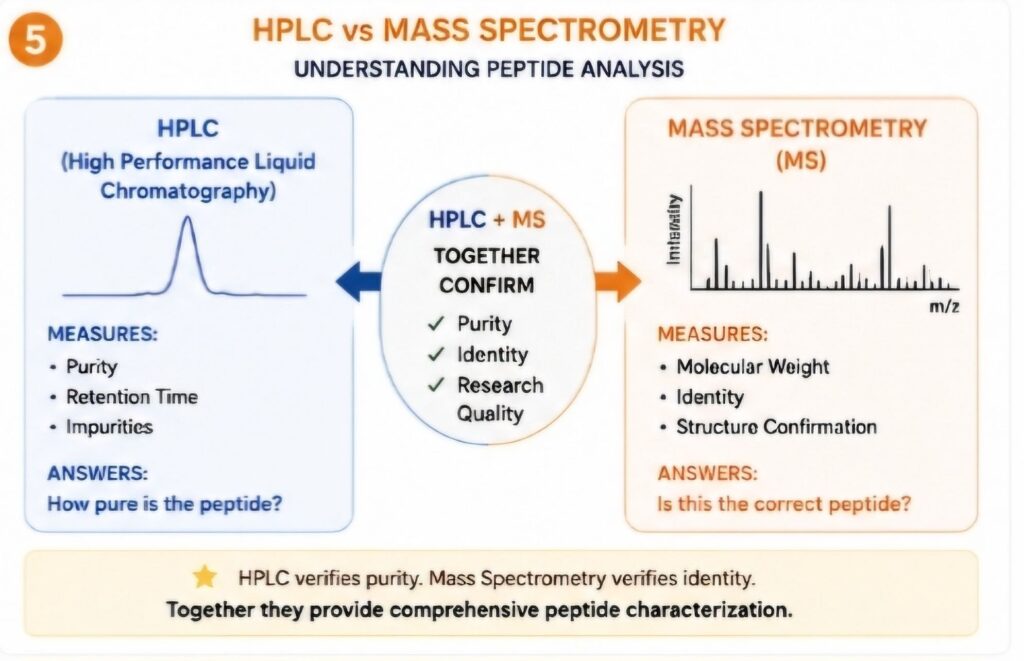
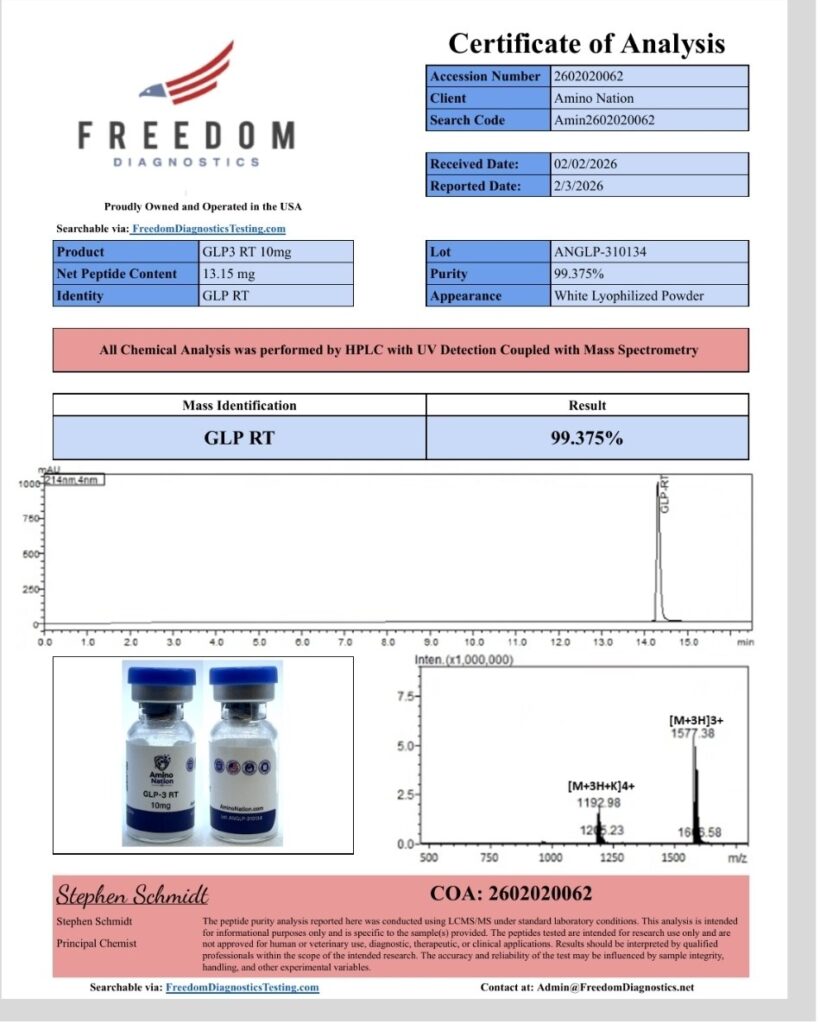
The molecular weight is reported on the Certificate of Analysis (CoA) and is typically expressed in grams per mole (g/mol).
Researchers should never assume a molecular weight based on a product description alone. Always verify the exact value listed on the CoA because factors such as:
• Sequence length
• Terminal modifications
• Salt forms
• Hydration state
• Conjugations
can alter the molecular weight and, therefore, affect concentration calculations.
Even small differences in molecular weight can influence final concentrations and experimental outcomes.
The Core Formula
To calculate the molarity of a reconstituted peptide solution, three variables are required:
1. Mass of the Peptide (m)
The amount of peptide supplied in the vial.
Example:
2 mg
2. Molecular Weight (MW)
Found on the Certificate of Analysis.
Example:
2000 g/mol
3. Volume of Solvent (V)
The volume used during reconstitution.
Example:
1 mL
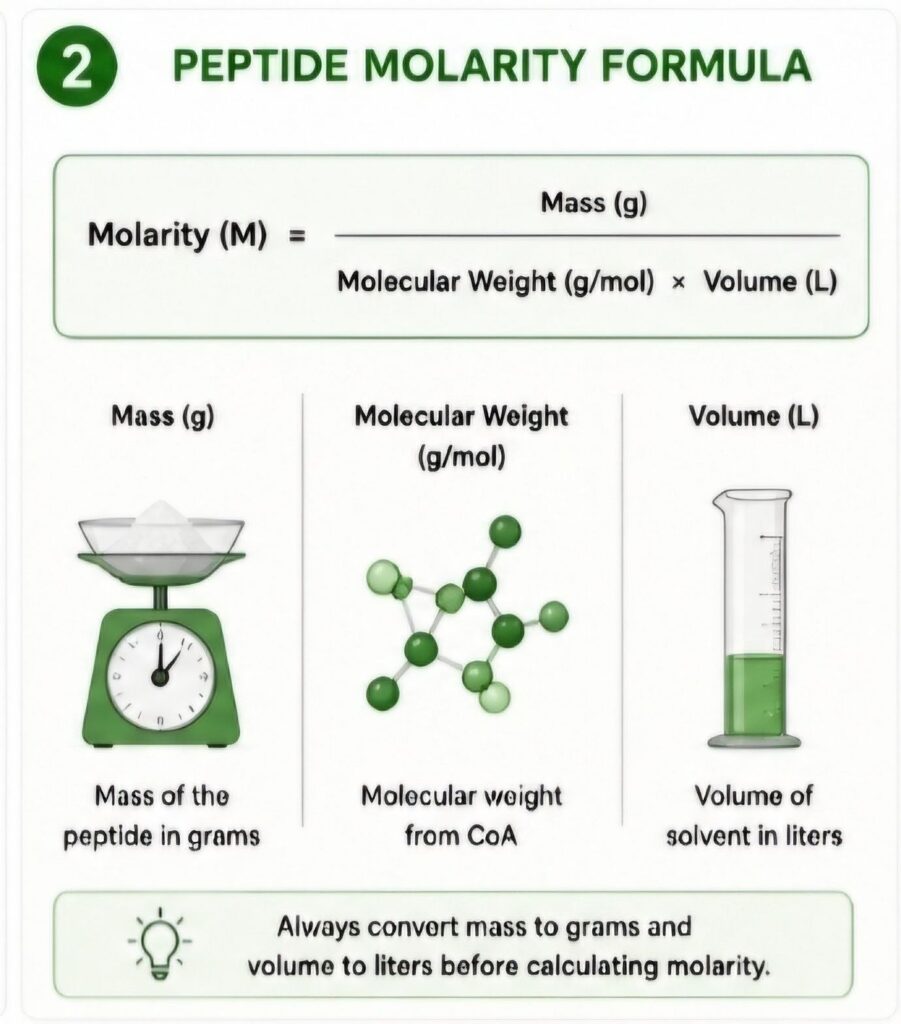
Standard Formula
The equation used to calculate molarity is:
Molarity (M) = Mass (g) ÷ [Molecular Weight (g/mol) × Volume (L)]
This formula converts the mass of peptide into moles and determines how many moles are present per liter of solution.
Understanding the Formula
Before performing any calculation, it helps to understand what the formula is doing.
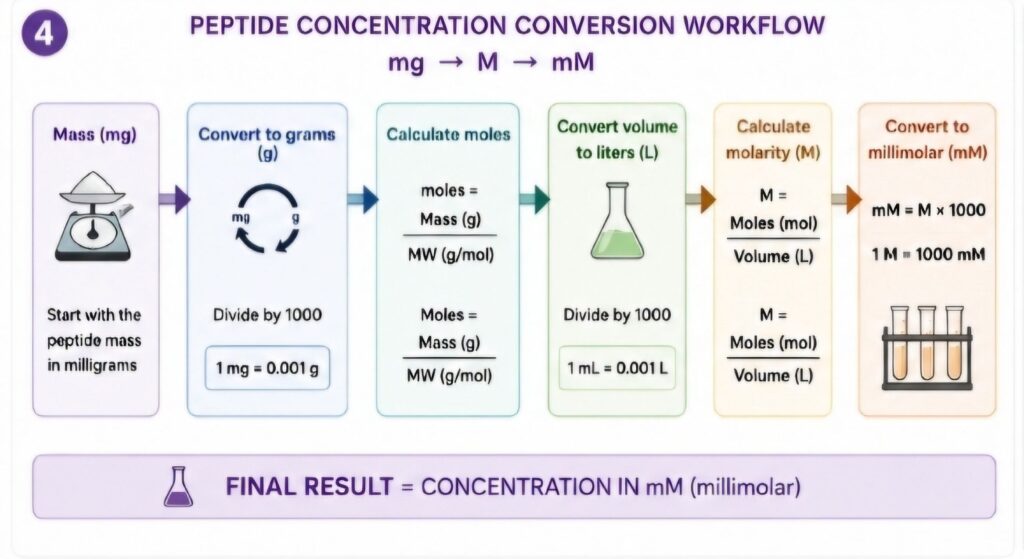
Step One: Convert Mass to Moles
A mole represents a specific number of molecules.
To determine the number of moles present:
Moles = Mass ÷ Molecular Weight
Example:
0.002 g ÷ 2000 g/mol
= 0.000001 mol
Step Two: Divide by Volume
Molarity measures how many moles are dissolved per liter.
Example:
0.000001 mol ÷ 0.001 L
= 0.001 mol/L
Step Three: Convert to Millimolar
Many peptide solutions are reported in millimolar.
Since:
1 M = 1000 mM
Then:
0.001 M × 1000
= 1 mM
Final concentration:
1 mM
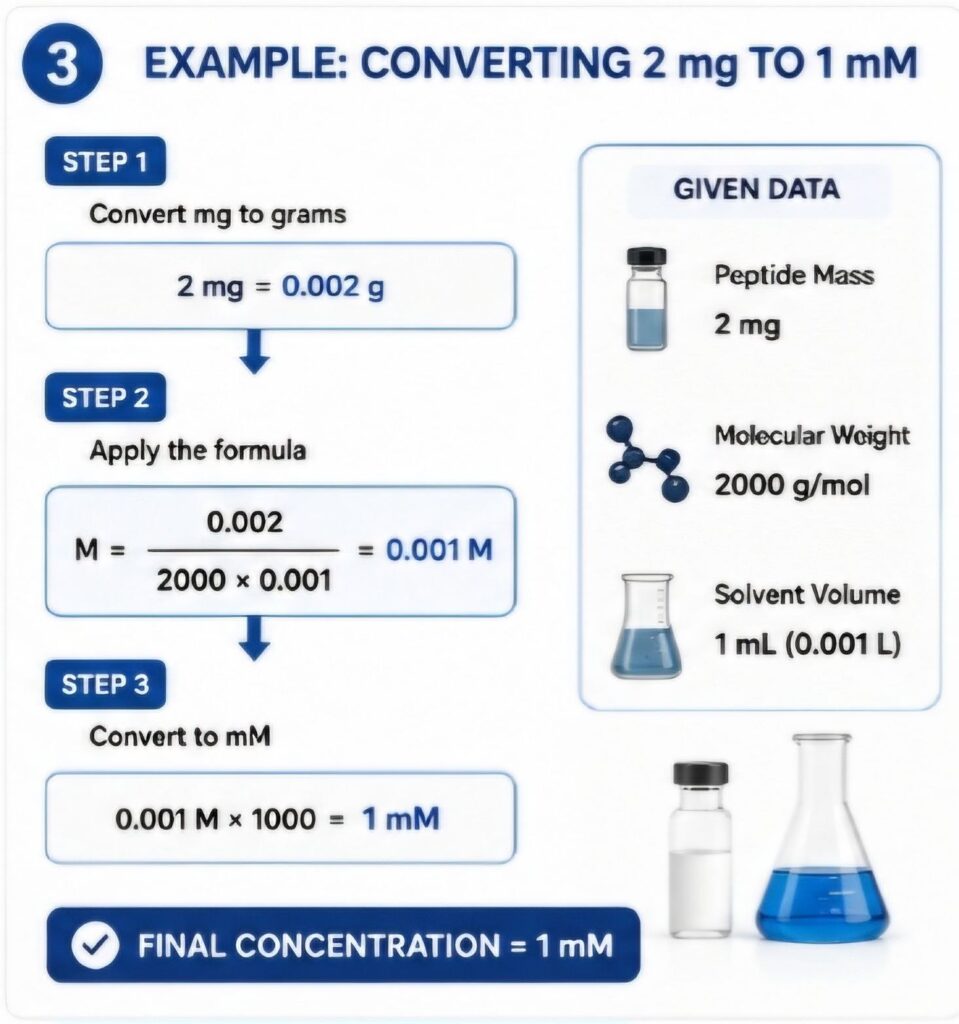
Practical Example: Converting mg to mM
Let’s assume the following information is provided on a Certificate of Analysis.
Given Data
• Peptide Mass: 2 mg
• Molecular Weight: 2000 g/mol
• Solvent Volume: 1 mL
Step 1: Convert Milligrams to Grams
Because molecular weight is expressed in grams per mole, peptide mass must first be converted from milligrams to grams.
2 mg = 0.002 g
Step 2: Convert Volume to Liters
1 mL = 0.001 L
Step 3: Apply the Formula
Molarity (M)
= 0.002 ÷ (2000 × 0.001)
= 0.001 M
Step 4: Convert to Millimolar
0.001 M × 1000
= 1 mM
Final Answer
The peptide solution concentration is:
1 mM
This means every liter of solution would contain one millimole of peptide molecules.
Conversion Reference Table
The following examples provide a quick reference when preparing peptide solutions.
| Peptide Mass (mg) | Solvent Volume (ml) | MW (g/mol) | Concentration (mM) |
| 1 mg | 1 mL | 1000 | 1 mM |
| 2 mg | 1 mL | 2000 | 1 mM |
| 5 mg | 2 mL | 2500 | 1 mM |
| 10 mg | 5 mL | 2000 | 1 mM |
| 5 mg | 1 mL | 1000 | 5 mM |
| 10 mg | 2 mL | 5000 | 1 mM |
| 2 mg | 0.5 mL | 2000 | 2 mM |
| 5 mg | 0.5 mL | 2500 | 4 mM |
Researchers should always verify calculations manually rather than relying solely on reference tables.
Common Pitfalls in Peptide Calculations
Even experienced researchers occasionally make calculation errors. Understanding the most common mistakes can improve accuracy and consistency.
Assuming Solvent Volume Incorrectly
One common misconception involves confusing solvent volume with total solution volume.
When peptides are reconstituted, the peptide powder occupies a very small volume compared to the solvent. For most research applications, this volume displacement is negligible.
As a result, the volume of solvent added is generally treated as the final solution volume.
For example:
Adding 1 mL of solvent to a vial containing a few milligrams of peptide is typically considered a final volume of 1 mL.
Forgetting Unit Conversions
Many concentration errors occur because researchers fail to convert:
• Milligrams to grams
• Milliliters to liters
before performing calculations.
Always remember:
• 1000 mg = 1 g
• 1000 mL = 1 L
Skipping these conversions can result in concentration errors by a factor of one thousand.
Ignoring Hydration and Salt Content
Peptides are frequently supplied as:
• Acetate salts
• Trifluoroacetate (TFA) salts
• Hydrochloride salts
The reported vial weight often includes the weight of these additional components.
For maximum precision, researchers should examine the peptide content percentage listed on the Certificate of Analysis.
For example:
If a peptide is reported as 90% peptide content, only 90% of the vial weight represents the actual peptide sequence.
This adjustment becomes increasingly important in highly quantitative experiments.
Using the Wrong Molecular Weight
Different batches may have slightly different molecular weights because of:
• Counterions
• Modifications
• Purity differences
Always use the exact molecular weight reported for the batch being studied.
Best Practices for Research DocumentationCertificate of Analysis (COA)
Accurate calculations are only one part of proper peptide handling.
Researchers should also maintain detailed records that include:
• Peptide name
• Batch number
• Date of preparation
• Molecular weight
• Amount reconstituted
• Solvent used
• Final concentration
Detailed records improve reproducibility and simplify future analysis.
Many laboratories maintain dedicated preparation logs specifically for peptide solutions.
Why Researchers Prefer Molarity Over Mass
Reporting concentrations in milligrams alone can be misleading because different peptides have different molecular weights.
For example:
5 mg of Peptide A may contain significantly more molecules than 5 mg of Peptide B.
Molarity eliminates this discrepancy and allows researchers to compare concentrations directly.
This is especially important when:
• Comparing experimental conditions
• Reproducing published studies
• Performing receptor binding assays
• Conducting dose-response experiments
Because biological activity often depends on the number of molecules present rather than the total mass, molarity provides a more meaningful measurement.
Summary Checklist for Researchers
Before using any peptide solution, verify the following:
✓ Verify Molecular Weight
Always use the exact molecular weight listed on the Certificate of Analysis.
✓ Convert Units Correctly
Convert all masses to grams and all volumes to liters before calculation.
✓ Double-Check Calculations
Review calculations carefully to avoid order-of-magnitude errors.
✓ Account for Salt Forms
Consider peptide content percentage when maximum precision is required.
✓ Document Everything
Record concentration, preparation date, solvent volume, and batch number in research logs.
Conclusion
Calculating peptide molar concentration is a fundamental skill for any researcher working with synthetic peptides. By understanding the relationship between mass, molecular weight, and solution volume, researchers can accurately determine molarity and prepare standardized solutions for experimental use.
The process is straightforward:
1. Convert peptide mass to grams.
2. Convert solvent volume to liters.
3. Apply the molarity formula.
4. Convert the result to millimolar if required.
5. Document the final concentration.
Following a consistent calculation method improves reproducibility, reduces experimental variability, and ensures that peptide preparations remain reliable across studies. Whether preparing a single vial or managing large research projects, accurate molarity calculations are an essential part of high-quality scientific practice. For more information visit peptideaminonation.com

Popular Comments
7 Dangerous Peptide Reconstitution Measurement Errors That Can Ruin Your Research Accuracy (Expert Guide)
[…] 7. STEP-BY-STEP CALCULATION EXAMPLE (REAL-WORLD SCENARIO)https://peptideaminonation.com/peptide-dosing-molar-concentration-mg-to-mm/ […]
Why Peptide HPLC Purity And Biological Activity Are Different: 7 Powerful Truths That Can Save Your Research
[…] https://peptideaminonation.com/peptide-dosing-molar-concentration-mg-to-mm/ […]
7 Essential Peptide Volume And Concentration Secrets For Accurate Research Results
[…] https://peptideaminonation.com/peptide-dosing-molar-concentration-mg-to-mm/ […]