Peptide Formulation Challenges: A Complete Guide for Researchers and Peptide Suppliers

Peptide Formulation Challenges are among the most overlooked factors affecting research quality, peptide stability, and experimental consistency. While many researchers focus on peptide purity and identity, formulation-related issues such as solubility, aggregation, storage degradation, and pH incompatibility can significantly influence the reliability of research outcomes.
Through personal research experience and extensive analysis of peptide quality documentation, one lesson becomes clear: even a highly pure peptide can underperform when formulation variables are ignored.
Understanding these challenges is essential for peptide suppliers, beginner researchers, and intermediate investigators seeking reliable and reproducible results.
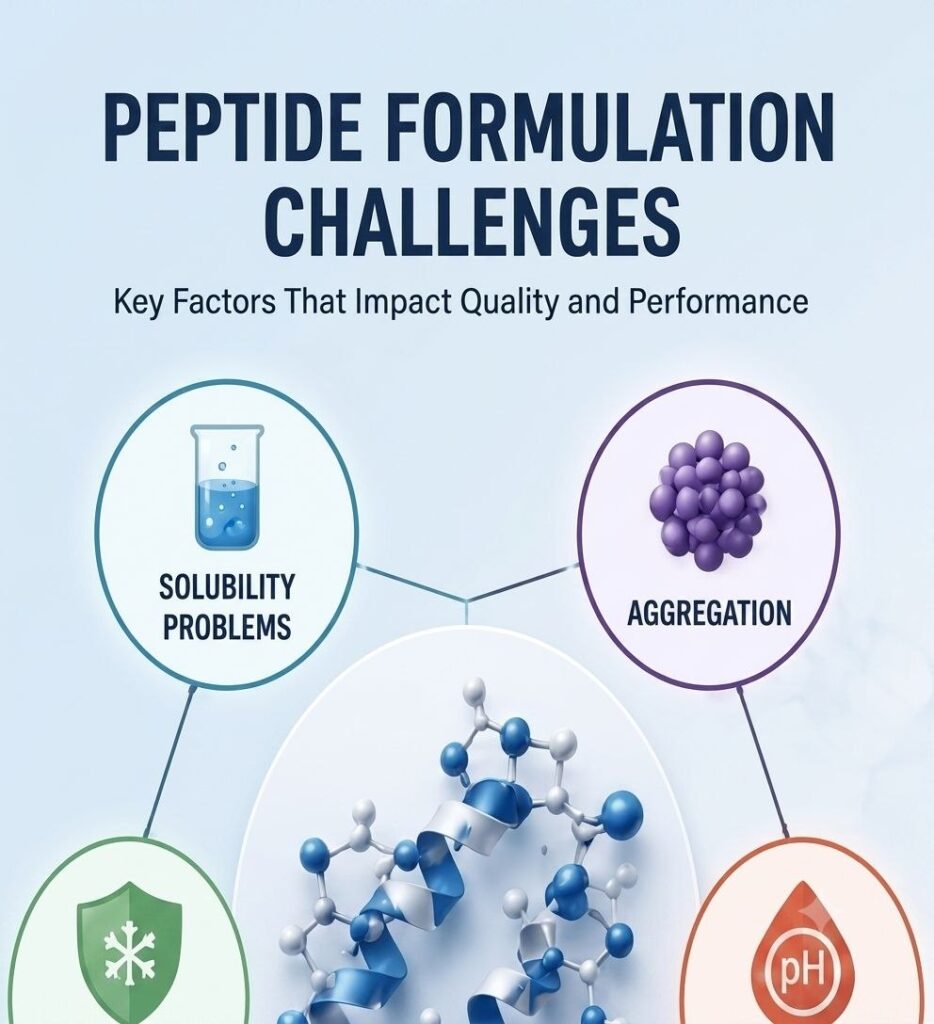
Table of Contents
1. What Are Peptide Formulation Challenges?
2. Why Peptide Formulation Matters
3.Peptide Formulation Challenges: Poor Solubility
4. Peptide Formulation Challenges: Aggregation
5. Peptide Formulation Challenges: Stability Issues
6. Peptide Formulation Challenges: pH Incompatibility
7. Peptide Formulation Challenges: Storage Degradation
8. Peptide Formulation Challenges: Reconstitution Difficulties
9. The Stability Fallacy
10. Solvent Simplification: A Common Mistake
11. Why One-Size-Fits-All Handling Fails
12. Assessing Quality with HPLC and Mass Spectrometry
13. The Importance of Stability and Sterility Testing
14. Best Practices for Researchers and Suppliers
15. How to Evaluate a Peptide COA
16. Frequently Asked Questions
17. Final Thoughts
What Are Peptide Formulation Challenges?
Peptide Formulation Challenges refer to scientific and practical issues that affect how a peptide behaves during storage, transportation, reconstitution, and use.
These challenges may impact:
• Solubility
• Stability
• Structural integrity
• Storage life
• Research consistency
• Analytical performance
Even peptides with excellent purity can experience performance issues if formulation considerations are ignored.
Why Peptide Formulation Matters
Many researchers assume that peptide purity alone determines quality.
This assumption is incomplete.
A peptide may show excellent analytical results while still experiencing degradation, aggregation, or reduced functionality due to poor formulation practices
.
For this reason, modern peptide quality assessment extends beyond purity percentages and includes formulation-related evaluations.
Peptide Formulation Challenges: Poor Solubility
Why Solubility Matters
One of the most common Peptide Formulation Challenges is poor solubility.
Certain peptides dissolve readily in aqueous solutions, while others require carefully selected solvents and preparation methods.
Popular research peptides such as:
• BPC-157
• TB-500
• CJC-1295
• Ipamorelin
• Semaglutide
• Tirzepatide
may demonstrate different dissolution characteristics depending on sequence composition and formulation conditions.
Causes of Poor Solubility
Hydrophobic Amino Acid Content
Peptides containing hydrophobic residues often resist dissolution in water.
Incorrect Solvent Selection
Researchers sometimes assume a single solvent works for all peptides.
This misconception frequently leads to incomplete dissolution.
Improper Mixing
Aggressive shaking can create foaming and aggregation rather than proper dissolution.
Peptide Formulation Challenges: Aggregation
What Is Peptide Aggregation?
Aggregation occurs when peptide molecules interact and cluster together.
These clusters can reduce effective concentration and compromise research consistency.
Factors That Promote Aggregation
High Concentrations
Overly concentrated preparations increase intermolecular interactions.
Temperature Variations
Repeated temperature fluctuations encourage aggregation.
Inappropriate pH Conditions
Some peptides become unstable when exposed to unsuitable pH ranges.
Peptide Formulation Challenges: Stability Issues
Understanding Peptide Stability
Stability refers to a peptide’s ability to maintain its structure and integrity over time.
Many researchers mistakenly believe that lyophilized peptides remain stable indefinitely.
This is known as the Stability Fallacy.
The Stability Fallacy
A peptide is not automatically stable simply because it is freeze-dried.
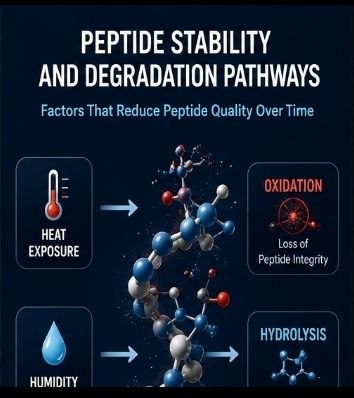
Environmental exposure, humidity, oxygen, temperature fluctuations, and storage duration can all contribute to degradation.
Common Degradation Mechanisms
Oxidation
Sensitive amino acids may undergo oxidation.
Hydrolysis
Moisture exposure can promote chemical breakdown.
Deamidation
Certain amino acid residues are vulnerable to structural modification.
Peptide Formulation Challenges: pH Incompatibility
NCBI.peptide.research.reshttps://pubmed.ncbi.nlm.nih.gov/ources
pH plays a critical role in peptide behavior.
Some peptides remain stable under mildly acidic conditions while others perform better near neutral pH.
Ignoring pH compatibility can result in:
• Reduced stability
• Increased aggregation
• Altered analytical profiles
• Reduced shelf life
Proper formulation requires understanding peptide-specific pH requirements rather than relying on generic assumptions.
Peptide Formulation Challenges: Storage Degradation
The Hidden Impact of Storage
Storage degradation is frequently underestimated.
A peptide’s condition upon arrival does not guarantee its condition months later.
Common Storage Errors
Excessive Heat Exposure
Temperature stress accelerates degradation.
Moisture Intrusion
Humidity can compromise peptide integrity.
Repeated Freeze-Thaw Cycles
Multiple freeze-thaw events often reduce stability.
Storage Best Practices
• Follow manufacturer recommendations.
• Minimize temperature fluctuations.
• Protect from moisture.
• Avoid unnecessary handling.
Peptide Formulation Challenges: Reconstitution Difficulties
https://peptideaminonation.com/peptide-reconstitution-guide/
Reconstitution is another major source of formulation-related errors.
Even high-quality peptides can encounter problems when reconstituted incorrectly.
Common Reconstitution Errors
Incorrect Dilution Volumes
Miscalculations may affect concentration accuracy.
Inappropriate Solvents
Not all peptides behave similarly in solution.
Aggressive Mixing
Vigorous agitation may promote aggregation.
The Stability Fallacy
Many researchers incorrectly assume that stability is a fixed property.
In reality, stability depends on:
• Storage conditions
• Formulation design
• Environmental exposure
• Reconstitution practices
• Transportation handling
Understanding this concept is essential for reliable peptide research.
Solvent Simplification: A Common Mistake
Another frequent misconception is that a single solvent strategy applies universally.
Different peptides possess different physicochemical properties.
Successful formulation requires peptide-specific evaluation rather than generalized assumptions.
Why One-Size-Fits-All Handling Fails
No two peptides are exactly alike.
Differences in:
• Sequence length
• Amino acid composition
• Hydrophobicity
• Molecular structure
mean handling procedures should be tailored accordingly.
Researchers who recognize these differences often experience more consistent outcomes.
Assessing Quality with HPLC and Mass Spectrometry
HPLC Analysis
High-Performance Liquid Chromatography (HPLC) is commonly used to assess peptide purity.
HPLC helps identify:
• Main peptide peak
• Impurities
• Peak distribution
• Purity percentage
Mass Spectrometry Analysis
Mass Spectrometry confirms molecular identity.
Researchers use Mass Spectrometry to verify that the detected molecular weight matches the expected peptide structure.
Together, HPLC and Mass Spectrometry provide a strong foundation for peptide quality assessment.
The Importance of Stability and Sterility Testing
Stability Testing
Stability testing evaluates how peptides perform under specific environmental conditions over time.
Sterility Testing
Sterility testing helps ensure that products intended for research applications meet established quality standards.
These analytical tools provide additional confidence beyond purity testing alone.
Best Practices for Researchers and Suppliers
Follow Peptide-Specific Handling Procedures
Avoid assuming all peptides behave similarly.
Maintain Proper Storage Conditions
Storage conditions directly influence peptide integrity.
Review Analytical Documentation
Always examine quality documentation before relying on research materials.
Monitor Stability
Regular stability assessments help identify degradation risks.
How to Evaluate a Peptide COA
https://peptideaminonation.com/blog/how-to-read-a-peptide-coa-10-critical-things-to-learn/
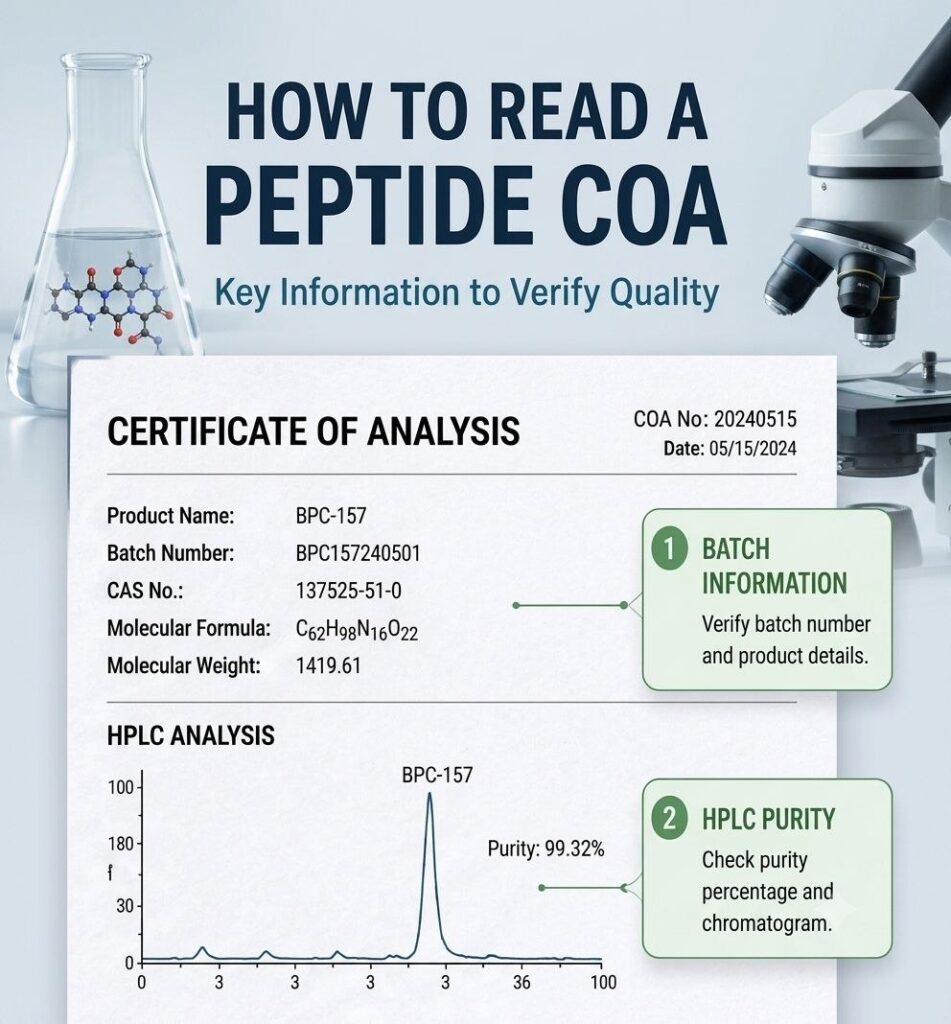
A Certificate of Analysis (COA) provides essential quality information.
Before accepting a peptide, researchers should verify:
HPLC Results
Review purity data carefully.
Mass Spectrometry Results
Confirm molecular identity.
Batch Information
Ensure traceability is available.
Testing Dates
Recent testing improves confidence in documentation.
Laboratory Details
Verify that testing information is complete and transparent.
Careful COA review can help identify potential quality concerns before research begins.
Frequently Asked Questions
What are Peptide Formulation Challenges?
Peptide Formulation Challenges are issues involving solubility, stability, storage, aggregation, pH compatibility, and reconstitution that may affect peptide quality and research consistency.
Why do peptides aggregate?
Aggregation occurs when peptide molecules interact and form clusters due to concentration, pH conditions, temperature changes, or formulation variables.
Why is peptide stability important?
Stability helps maintain structural integrity and consistent analytical performance throughout storage and use.
How does HPLC help evaluate peptides?
HPLC measures purity and helps identify impurities within a peptide sample.
Why should researchers review COAs?
COAs provide critical information regarding purity, identity, testing results, and quality verification.
Final Thoughts
Peptide Formulation Challenges extend far beyond simple purity measurements. Solubility, aggregation, stability, pH compatibility, storage degradation, and reconstitution practices all influence research quality.
Researchers and peptide suppliers who understand these factors gain a significant advantage in evaluating peptide products and interpreting analytical results.
\
By combining proper formulation practices with careful review of HPLC reports, Mass Spectrometry data, Stability Testing results, and Certificates of Analysis, researchers can make more informed decisions and improve confidence in their peptide research.
