How Peptide Length Influences Stability: 9 Powerful Scientific Insights Every Researcher Should Know

Understanding how peptide length influences stability is one of the most important yet frequently misunderstood aspects of peptide research. Whether you’re working with a simple tripeptide, a therapeutic peptide consisting of 20 amino acids, or a long-chain peptide approaching protein size, peptide length directly affects how the molecule behaves during synthesis, purification, storage, shipping, reconstitution, and laboratory experiments.
At Peptide Amino Nation, we’ve worked with researchers from universities, biotechnology companies, and pharmaceutical laboratories who often assume that peptide stability depends solely on storage temperature. In reality, peptide length is only one part of a much larger picture—but it is a critical factor that influences nearly every stage of a peptide’s lifecycle.
In fact, most support requests we receive are related to improper reconstitution rather than peptide quality, while the majority of stability issues we investigate are traced back to repeated freeze-thaw cycles instead of manufacturing defects. These recurring challenges highlight an important truth: even the highest-purity peptide can perform poorly if researchers overlook how peptide length influences its physical and chemical behavior.
This comprehensive guide explains how peptide length influences stability, why it matters in real laboratory settings, and how researchers can avoid costly mistakes by applying proven handling techniques used throughout the peptide industry.
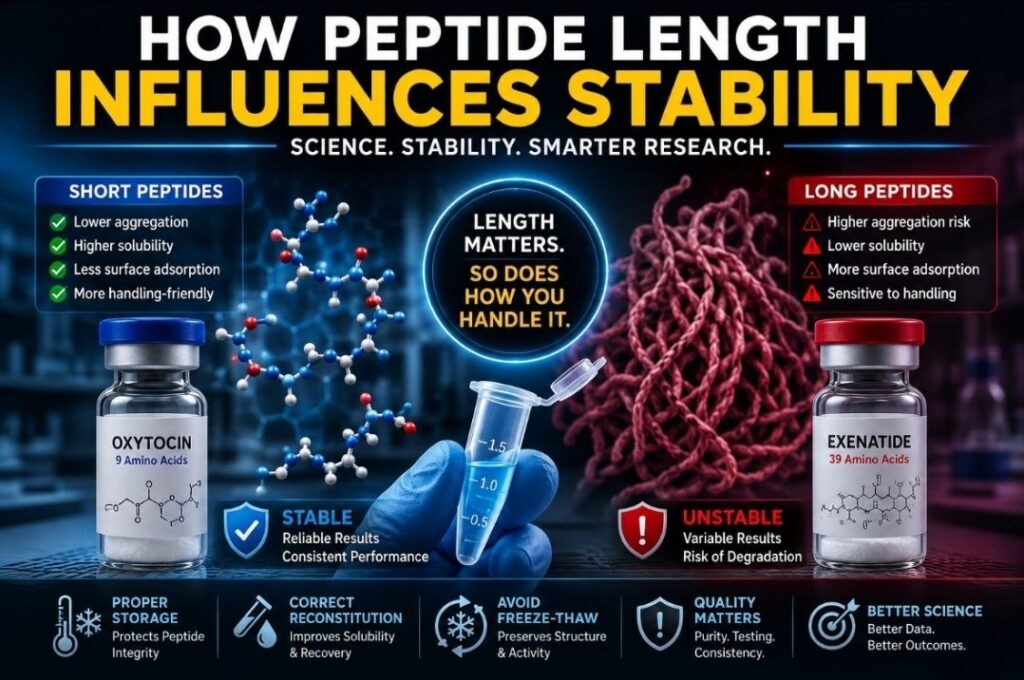
Table of Contents
1. What Does Peptide Length Mean?
2. How Peptide Length Influences Stability at the Molecular Level
3. Why Longer Peptides Behave Differently from Short Peptides
4. Comparing Stability Across Different Peptide Lengths
5. The Hidden Factors That Matter More Than Length Alone
6. Real Laboratory Experience from Peptide Researchers
7. Practical Tips for Maximizing Peptide Stability
8. Case Studies from Commercial Peptide Applications
9. Frequently Asked Questions
10. Final Thoughts
What Does Peptide Length Mean?
https://pubmed.ncbi.nlm.nih.gov/
Peptide length simply refers to the number of amino acids connected together within a peptide chain.
Although this definition sounds straightforward, the number of amino acids dramatically changes the peptide’s physical chemistry.
Researchers commonly classify peptides into several practical categories:
| Peptide Type | Typical Length | General Characteristics |
| Tripeptides | 3 amino acids | Highly flexible, often hygroscopic |
| Short peptides | 4-10 amino acids | Usually very soluble and structural flexible |
| Medium peptides | 10-20 amino acids | Moderate structural complexity |
| Long peptides | 20-40 amino acids | Increased folding and aggregation potential |
| Long-chain peptides | 40+ amino acids | Behave similarly to small proteins and requires careful handling |
As peptide length increases, the molecule gains additional opportunities to fold, interact with neighboring molecules, and undergo structural changes that influence stability.
This explains why two peptides stored under identical laboratory conditions can exhibit completely different shelf lives and experimental performance.
How Peptide Length Influences Stability at the Molecular Level
Understanding how peptide length influences stability begins with understanding molecular motion.
Every peptide exists in a continuous state of movement.
Atoms vibrate.
Chemical bonds rotate.
Water molecules collide with the peptide thousands of times every second.
For short peptides, these movements rarely create major structural problems because the molecule remains relatively flexible and uncomplicated.
Longer peptides behave very differently.
Additional amino acids create more opportunities for:
• Intramolecular hydrogen bonding
• Hydrophobic interactions
• Secondary structure formation
• Partial unfolding
• Molecular aggregation
• Surface adsorption
• Oxidation of exposed residues
These interactions make longer peptides far more sensitive to environmental conditions than shorter sequences.
Instead of behaving like a simple linear chain, longer peptides begin acting more like miniature proteins whose biological activity depends on maintaining the correct three-dimensional structure.
This distinction is one of the primary reasons why peptide manufacturers invest heavily in advanced purification techniques, optimized lyophilization protocols, moisture-resistant packaging, and carefully controlled cold-chain logistics.
Why Longer Peptides Behave Differently from Short Peptides
One of the biggest misconceptions we encounter is the belief that adding a few amino acids cannot significantly change peptide stability.
In reality, every additional residue introduces new opportunities for molecular interactions.
Consider the progression:
A tripeptide contains only a handful of chemical interactions.
A 15-amino-acid peptide possesses dozens.
A 39-amino-acid therapeutic peptide contains hundreds of possible internal interactions.
By the time a peptide reaches approximately 40–50 amino acids, its behavior begins resembling that of a small protein.
At this stage, stability is no longer determined solely by the peptide bond itself.
Researchers must also consider:
• Three-dimensional folding
• Disulfide bridge integrity
• Hydrophobic surface exposure
• Aggregation pathways
• Conformational flexibility
• Buffer compatibility
• Storage conditions
Ignoring these factors often leads to poor reproducibility, unexpected assay failures, and unnecessary replacement of perfectly good peptide batches.
Comparing Stability Across Different Peptide Lengths
https://www.sciencedirect.com/
The table below summarizes how peptide length typically affects laboratory handling and stability.
| Property | Short Peptides (2-10 AAs) | Medium Peptides (10-20AAs | Long Peptides (20-40 AAs) |
| Flexible | Very high | Moderate | Lower |
| Folding | Minimal | Partial | Significant |
| Aggregation Risk | Low | Moderate | High |
| Oxidation Sensitivity | Depends on Sequence | Moderate | Higher |
| Adsorption to Plastic | Low | Moderate | High |
| Freeze-Thaw Sensitivity | Moderate | High | Very High |
| Formulation Complexity | Simple | Moderate | Advanced |
While these trends provide useful guidance, peptide length alone never tells the entire story.
We’ve supplied peptides of similar lengths that displayed remarkably different stability profiles because their amino acid compositions were completely different. This is why experienced researchers evaluate peptide length alongside sequence composition, purity, intended application, and storage environment before designing handling protocols.
The Hidden Truth: Peptide Length Is Only One Piece of the Puzzle
Although this article focuses on how peptide length influences stability, our experience supporting research laboratories has shown that peptide length rarely acts alone.
Some short peptides degrade surprisingly quickly.
Meanwhile, certain long peptides remain exceptionally stable for extended periods when manufactured and handled correctly.
Why?
Because several additional factors often have an even greater influence on stability than peptide length itself.
These include:
• Amino acid sequence
• Oxidation-prone residues such as cysteine, methionine, and tryptophan
• Lyophilization quality
• Storage temperature
• Buffer composition
• Solution pH
• Moisture exposure
• Light exposure
• Freeze-thaw frequency
• Laboratory handling techniques
Understanding how these variables interact with peptide length is essential for achieving consistent experimental results.
Real-World Evidence of How Peptide Length Influences Stability
How Peptide Length Influences Stability
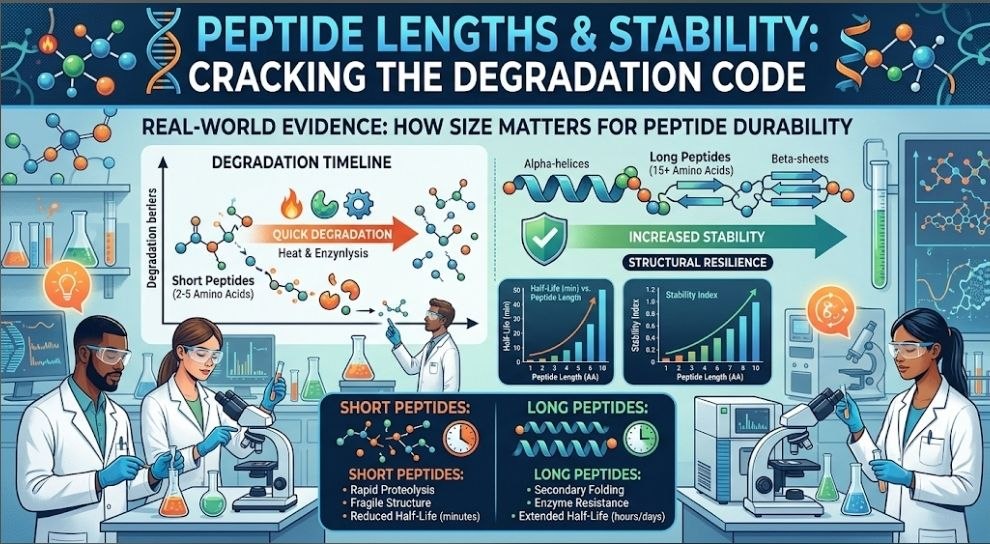
Theory is important, but real laboratory and manufacturing examples provide the clearest understanding of how peptide length influences stability.
Throughout our experience supporting peptide researchers, we’ve found that many stability questions become much easier to answer when comparing commercially successful peptides. These examples demonstrate that peptide length is far more than just a number—it directly influences formulation strategies, quality control, packaging, transportation, and laboratory handling.
Let’s examine three well-known examples that illustrate these principles in action.
Case Study #1: Leuprolide (9 Amino Acids) vs. Insulin (51 Amino Acids)
A Perfect Example of How Peptide Length Influences Stability
One of the best demonstrations of how peptide length influences stability is the comparison between Leuprolide and insulin.
Although both are clinically important peptide therapeutics, their structural complexity creates entirely different stability challenges.
| Characteristic | Leuprolide | Insulin |
| Length | 9 amino acids | 51 amino acids |
| Structure | Linear peptide | Two-chain peptide with disulfide bonds |
| Folding | Minimal | Highly structured |
| Aggregation Risk | Very low | High |
| Manufacturing Complexity | Moderate | Very High |
Why Leuprolide Is Naturally More Stable
Leuprolide is a synthetic GnRH agonist composed of only nine amino acids.
Because of its relatively short sequence, the molecule lacks an extensive three-dimensional structure.
That may sound like a disadvantage—but from a stability standpoint, it’s actually a major strength.
Without complicated folding patterns, Leuprolide has:
• Fewer opportunities to unfold
• Minimal hydrophobic core exposure
• Reduced aggregation tendency
• Excellent physical stability during processing
This allows manufacturers to formulate Leuprolide into long-acting depot injections using biodegradable polymers without worrying about extensive structural damage during encapsulation.
Its flexibility enables it to tolerate manufacturing conditions that would destabilize much larger peptide molecules.
Why Insulin Requires Much More Care
Insulin tells a completely different story.
Although often referred to as a peptide, insulin behaves much more like a small protein.
Its 51 amino acids are organized into two separate chains connected by three disulfide bridges.
Every one of those structural features contributes to biological activity—but also creates potential instability.
Unlike Leuprolide, insulin depends on maintaining its precise three-dimensional conformation.
When exposed to:
• excessive agitation,
• repeated pumping,
• elevated temperatures,
• hydrophobic plastic surfaces,
• or prolonged storage,
the molecule begins to partially unfold.
Once unfolded, neighboring insulin molecules rapidly associate into β-sheet fibrils.
These fibrils are biologically inactive and can not return to their functional state.
Manufacturing Lessons from Insulin
Because insulin has a much higher tendency to aggregate, manufacturers can not simply synthesize, purify, and bottle the peptide.
Instead, they employ sophisticated formulation strategies, including:
• Zinc ions to stabilize insulin hexamers
• Phenolic preservatives
• Carefully optimized pH conditions
• Controlled mixing speeds
• Low-shear manufacturing equipment
• Strict cold-chain distribution
These precautions dramatically reduce aggregation throughout manufacturing and storage.
This comparison clearly illustrates how peptide length influences stability by increasing structural complexity and creating additional pathways for degradation.
What Researchers Can Learn from This Comparison
Many laboratory researchers unknowingly expose long peptides to the same stresses that pharmaceutical manufacturers spend millions of dollars trying to avoid.
For example:
• Vigorous vortex mixing,
• Repeated pipetting,
• Multiple freeze-thaw cycles,
• Extended room-temperature exposure,
• And prolonged storage in working solutions.
Each of these practices increases the likelihood that longer peptides will partially unfold and aggregate.
In our technical support discussions, we frequently remind researchers that peptide stability depends just as much on handling practices as it does on manufacturing quality.
A peptide synthesized to 98–99% purity can still perform poorly if improper laboratory handling compromises its structural integrity.
Case Study #2: Glutathione (3 Amino Acids)
When Very Short Peptides Create Their Own Stability Challenges
One common misconception is that shorter peptides are always easier to handle.
In reality, extremely short peptides introduce an entirely different set of stability concerns.
A perfect example is Glutathione, one of the most widely studied tripeptides in biological research.
Composed of only three amino acids, Glutathione behaves very differently from larger therapeutic peptides.
Why Glutathione Is So Hygroscopic
Because Glutathione contains only three amino acids, its terminal amino and carboxyl groups make up a relatively large proportion of the molecule.
These highly polar chemical groups readily attract atmospheric moisture.
As a result, Glutathione powder is extremely hygroscopic.
In laboratories with high humidity, researchers may observe:
• powder becoming sticky,
• clumping,
• loss of free-flowing consistency,
• accelerated oxidation,
• reduced shelf life.
In severe cases, material that initially appeared as a fine white powder can transform into a gummy mass within minutes after opening.
Why Moisture Is the Real Enemy
Moisture doesn’t simply make Glutathione difficult to weigh.
It also accelerates oxidation of the peptide’s sulfhydryl (-SH) group.
Instead of remaining in its reduced, biologically active form, Glutathione rapidly converts into oxidized glutathione (GSSG).
This chemical transformation changes the molecule’s biological properties and can significantly affect experimental outcomes.
For manufacturers, this creates unique production challenges.
Unlike many longer peptides, Glutathione demands:
• Humidity-controlled manufacturing rooms,
• Rapid packaging,
• Moisture-resistant containers,
• Desiccant protection,
• M inimal atmospheric exposure.
Practical Laboratory Insight
One question we hear surprisingly often is:
“Why did my peptide become sticky immediately after opening the vial?”
In many situations, researchers assume the product arrived damaged.
However, the actual culprit is often condensed.
Removing a frozen vial from storage and opening it immediately exposes the cold peptide to warm, humid laboratory air.
Moisture condenses almost instantly inside the vial.
Highly hygroscopic peptides absorb that water within seconds.
This is why our technical team consistently recommends allowing sealed peptide vials to reach room temperature before opening them.
That simple habit prevents unnecessary moisture exposure and preserves peptide quality.
Why These Examples Matter
Together, Leuprolide, insulin, and glutathione demonstrate an important principle:
How peptide length influences stability depends not only on the number of amino acids but also on how peptide length changes molecular behavior.
• Short peptides generally resist aggregation but may be highly hygroscopic.
• Medium-length peptides begin developing more complex structural interactions.
• Long peptides become increasingly vulnerable to unfolding, adsorption, and aggregation.
Recognizing these differences allows researchers to choose more appropriate storage conditions, formulation strategies, and handling procedures.
Case Study #3: Exenatide (39 Amino Acids) vs. Oxytocin (9 Amino Acids)
How Peptide Length Influences Stability Through Surface Adsorption
Another fascinating example of how peptide length influences stability appears long before a peptide begins to degrade chemically.
Sometimes, researchers lose their peptide before the experiment even starts.
The culprit?
Surface adsorption, commonly referred to as peptide “stickiness.”
This overlooked phenomenon can significantly reduce experimental accuracy, especially when working with low peptide concentrations.
At Peptide Amino Nation, we’ve helped researchers troubleshoot inconsistent assay results that were eventually traced not to peptide purity or synthesis quality, but to peptide molecules adhering to the walls of standard laboratory tubes.
Let’s see why peptide length makes such a dramatic difference.
Oxytocin: Small Size, Minimal Surface Adsorption
Oxytocin is a cyclic peptide containing nine amino acids.
Although it possesses a disulfide bond that contributes to its structure, its compact size provides relatively little hydrophobic surface area.
As a result, Oxytocin generally:
• Remains well dispersed in solution.
• Exhibits relatively low adsorption to laboratory plastics.
• Can often be prepared in standard polypropylene tubes without major peptide loss.
• Maintains consistent concentrations during routine laboratory handling.
This doesn’t mean Oxytocin is immune to degradation, but surface adsorption is usually a much smaller concern compared with longer peptide molecules.
Exenatide: When Peptide Length Becomes a Challenge
Exenatide tells a very different story.
Containing 39 amino acids, Exenatide is considerably larger and possesses a pronounced amphipathic structure, meaning different regions of the molecule have different chemical properties.
Some sections are highly water-loving (hydrophilic).
Others are strongly water-repelling (hydrophobic).
When dissolved in standard laboratory tubes, the hydrophobic regions naturally seek out hydrophobic plastic surfaces.
Instead of remaining completely dissolved, peptide molecules begin attaching themselves to the container walls.
This process is known as surface adsorption.
The Hidden Loss Researchers Rarely Notice
Surface adsorption often occurs silently.
The peptide solution still appears perfectly clear.
Nothing looks unusual.
Yet the actual peptide concentration may be dramatically lower than expected.
Published laboratory observations have shown that under unfavorable conditions, 50–80% of certain peptide solutions can be lost to container walls before an experiment even begins, particularly at low working concentrations.
Researchers may then incorrectly conclude that:
The peptide synthesis failed,
The biological assay is unreliable,
The analytical instrument is malfunctioning,
• Or the peptide itself lacks activity.
In reality, a significant portion of the peptide never reached the experiment.
Practical Ways to Prevent Surface Adsorption
Fortunately, preventing adsorption is usually straightforward.
Depending on the peptide sequence and application, researchers can improve recovery by:
• Using low-binding polypropylene tubes specifically designed for protein and peptide work.
• Pre-conditioning laboratory containers when appropriate.
• Adding compatible surfactants such as low concentrations of Tween-20, where experimental protocols permit.
• Preparing fresh working solutions immediately before use.
• Avoiding unnecessarily dilute stock solutions.
These simple precautions can dramatically improve reproducibility, especially for longer peptides.
Beyond Length: Amino Acid Sequence Often Has the Final Say
Throughout this article, we’ve emphasized how peptide length influences stability, but experienced peptide researchers know that length never acts alone.
Two peptides of identical length can display completely different stability profiles.
Why?
Because amino acid sequence ultimately determines the peptide’s chemical behavior.
At Peptide Amino Nation, we routinely remind researchers that peptide length provides valuable guidance, but sequence composition often predicts real-world stability more accurately.
Oxidation-Prone Amino Acids
Certain amino acids are naturally more vulnerable to oxidation than others.
These include:
• Cysteine (Cys)
• Methionine (Met)
• Tryptophan (Trp)
Even relatively short peptides containing these residues may degrade faster than much longer peptides lacking oxidation-sensitive amino acids.
For example:
• Cysteine residues may form unwanted disulfide bonds.
• Methionine can oxidize into methionine sulfoxide.
• Tryptophan is highly sensitive to ultraviolet light and prolonged laboratory illumination.
Understanding these sequence-specific risks is just as important as understanding peptide length.
Hydrophobic Amino Acids Increase Aggregation
Longer peptides often contain larger hydrophobic regions.
Common hydrophobic amino acids include:
• Leucine (Leu)
• Isoleucine (Ile)
• Valine (Val)
• Phenylalanine (Phe)
• Tryptophan (Trp)
• Methionine (Met)
These residues naturally avoid water.
Instead, they tend to interact with one another.
As peptide length increases, these hydrophobic interactions become stronger.
The result is an increased likelihood of:
• Aggregation,
• Precipitation,
• Reduced solubility,
• And loss of biological activity.
This is one reason why many hydrophobic peptides require careful solvent selection during reconstitution.
The Factors That Often Matter More Than Peptide Length
One of the biggest misconceptions we encounter is the belief that simply purchasing a shorter peptide automatically guarantees better stability.
Unfortunately, stability is rarely that simple.
In our experience supporting research laboratories, we’ve seen excellent-quality peptides fail because researchers overlooked basic handling practices.
In fact, most support requests we receive are related to improper reconstitution rather than peptide quality, while the majority of stability issues we investigate are traced back to repeated freeze-thaw cycles instead of manufacturing defects.
This highlights an important lesson:
Even the highest-purity peptide can not compensate for poor laboratory techniques.
The following factors frequently have a greater impact on peptide stability than peptide length itself:
| Stability Factors | Why It Matters |
| Amino acid sequence | Determine oxidation, aggregation, and solubility |
| Storage temperature | Slows chemical degradation |
| Lyophilization quality | Protects peptide structure during storage |
| Buffer composition | Influence solubility and stability |
| Solution pH | Affects peptide bond integrity |
| Moisture exposure | Accelerate hydrolysis and oxidation |
| Light exposure | Damages photosensitive residues like Trp |
| Freeze-Thaw cycles | Promotes aggregation and denaturation |
| Laboratory handling | Often determines real-world peptide performance |
How Peptide Length Influences Stability
Why High-Purity Manufacturing Still Matters
Although laboratory handling plays a major role, manufacturing quality should never be overlooked.
At Peptide Amino Nation, we recognize that peptide stability begins long before a product reaches the researcher’s bench.
High-quality peptide manufacturing includes:
• High-purity peptide synthesis.
• Advanced HPLC purification.
• LC-MS identity confirmation.
• Carefully optimized lyophilization.
• Moisture-resistant packaging.
• Batch-specific quality testing.
• Cold-chain shipping when required.
These quality assurance measures help ensure researchers receive peptides that maintain their integrity during transportation and storage.
However, even the best-manufactured peptide still depends on proper handling after delivery.
Proper storage, careful reconstitution, and minimizing environmental stress remain essential for preserving stability.
Common Laboratory Mistakes That Reduce Peptide Stability
Understanding how peptide length influences stability is only part of the equation. The next step is avoiding the everyday laboratory mistakes that silently shorten peptide shelf life and compromise research results.
At Peptide Amino Nation, many of the troubleshooting requests we receive are not caused by poor peptide synthesis. Instead, they are linked to routine handling practices that expose peptides to unnecessary physical and chemical stress.
Below are the four most common mistakes we encounter and the practical solutions we recommend.
Mistake #1: Opening a Frozen Peptide Vial Immediately
The “Cold-Vial Pop” Condensation Problem
One of the most frequent questions we receive is:
“Why did my lyophilized peptide turn into a sticky film as soon as I opened the vial?”
In most cases, the peptide itself is not defective.
The problem is condensation.
When a peptide vial is removed directly from a -20°C or -80°C freezer and opened immediately, warm laboratory air rushes into the cold vial. Moisture from the air condenses on the peptide powder within seconds.
For short peptides—especially tripeptides and other highly hygroscopic sequences—this absorbed moisture can quickly:
• Turn a free-flowing powder into a sticky paste.
• Accelerate hydrolysis of peptide bonds.
• Increase oxidation of sensitive amino acids.
• Make accurate weighing nearly impossible.
Best Practice
Always allow the sealed vial to warm to room temperature before opening it.
Our technical recommendation is to leave the vial sealed for 45–60 minutes, preferably in a desiccator if one is available. Only open the vial once both the glass and the contents have fully equilibrated to room temperature.
This simple habit can significantly improve peptide stability and preserve sample integrity.
Mistake #2: Repeated Freeze-Thaw Cycles
How Peptide Length Influences Stability
The Silent Destroyer of Peptide Stability
If there is one handling mistake that consistently reduces peptide performance, it is repeated freeze-thaw cycling.
As we’ve observed while supporting researchers, the majority of stability issues we investigate are traced back to repeated freeze-thaw cycles rather than manufacturing defects.
Every time a peptide solution freezes, ice crystals form. During freezing, peptides and salts become concentrated in the remaining liquid phase, creating localized areas of extremely high concentration.
When the sample thaws, those concentrated peptide molecules may no longer return to their original state.
Instead, they can:
• Aggregate.
• Partially unfold.
• Form insoluble particles.
• Lose biological activity.
Longer peptides are particularly vulnerable because they contain more complex structural elements and larger hydrophobic regions.
Best Practice: The One-and-Done Rule
Whenever possible:
• Reconstitute the peptide only once.
• Divide the solution into single-use aliquots immediately.
• Freeze each aliquot separately.
• Thaw each aliquot only once.
• Discard any remaining solution after use.
Although this approach requires a few extra tubes, it dramatically reduces degradation and improves experimental reproducibility.
Mistake #3: Using Frost-Free Freezers for Long-Term Storage
How Peptide Length Influences Stability
Many researchers assume that all freezers provide the same storage conditions.
Unfortunately, this is not true.
Consumer-grade and many laboratory frost-free freezers automatically warm themselves at regular intervals to prevent ice buildup.
While convenient for food storage, these temperature fluctuations are far from ideal for sensitive peptides.
Each warming cycle creates tiny, repeated thawing events that can gradually damage peptides over weeks or months.
Researchers often believe their samples have remained frozen continuously, when in reality they have experienced dozens of micro-thaw cycles.
Why This Matters
Repeated thermal cycling accelerates:
• Chemical degradation.
• Oxidation.
• Aggregation.
• Reduced purity.
• Loss of biological activity.
This is especially problematic for longer peptides that already possess higher structural complexity.
Best Practice
Store valuable research peptides in:
• Manual-defrost laboratory freezers.
• Dedicated ultra-low temperature (-80°C) freezers.
• Temperature-stable storage systems that avoid automatic warming cycles.
Maintaining a consistent storage temperature is one of the simplest ways to improve long-term peptide stability.
Mistake #4: Assuming Every Peptide Dissolves Easily in Water
How Peptide Length Influences Stability
Another common misconception is that all peptides behave like table salt.
Researchers often attempt to dissolve every peptide directly into sterile water or PBS.
When the peptide refuses to dissolve, they increase vortexing or sonication in an effort to force it into solution.
Unfortunately, this approach can make the problem worse.
Why Some Peptides Resist Dissolution
Solubility depends primarily on amino acid composition.
Peptides rich in hydrophobic amino acids—such as Leucine (Leu), Isoleucine (Ile), Valine (Val), Phenylalanine (Phe), Methionine (Met), and Tryptophan (Trp)—naturally resist dissolving in water.
Instead of forming a clear solution, they may:
• Float on the surface.
• Form cloudy suspensions.
• Aggregate.
• Precipitate.
Extended sonication generates localized heat and mechanical stress, increasing the risk of degradation.
Best Practice: The Minimal Solvent Strategy
For hydrophobic peptides:
1. Add the smallest possible volume of sterile DMSO or Acetonitrile to completely dissolve the peptide.
2. Once the solution is clear, slowly add the desired aqueous buffer while gently mixing.
3. Avoid aggressive vortexing or prolonged sonication.
This gradual approach minimizes aggregation and improves solubility.
Our Four Golden Rules for Maximizing Peptide Stability
After years of supporting peptide researchers, these are the practical recommendations our technical team repeats most often.
Rule 1: Plan Your Aliquots Before Reconstitution
Calculate the volume required for each experiment before adding solvent.
Preparing single-use aliquots from the beginning prevents unnecessary freeze-thaw cycles and reduces waste.
Rule 2: Treat Reconstitution as a Chemical Procedure
Do not assume every peptide behaves the same.
Review the peptide sequence, evaluate its hydrophobicity, and select the most appropriate solvent before reconstitution.
Careful planning at this stage can prevent many downstream stability problems.
Rule 3: Never Open a Cold Vial
Allow frozen peptide vials to reach room temperature before opening them.
This simple step minimizes condensation and protects hygroscopic peptides from rapid moisture absorption.
Rule 4: Protect Sensitive Amino Acids
Peptides containing Cysteine (Cys), Methionine (Met), or Tryptophan (Trp) require additional protection.
Depending on your protocol:
• Store light-sensitive peptides in amber vials or wrap them in aluminum foil.
• Minimize exposure to air when working with oxidation-prone sequences.
• Consider using inert gases such as nitrogen or argon for long-term storage if appropriate.
• Where compatible with the experiment, reducing agents may help prevent unwanted oxidation.
Quality Control: Why Stability Starts Before the Peptide Reaches Your Lab
Even perfect laboratory handling can not compensate for poor manufacturing quality.
At Peptide Amino Nation, we believe peptide stability begins with rigorous quality control during production.
Our quality-focused approach emphasizes:
• High-purity peptide synthesis.
• Comprehensive HPLC purity analysis.
• LC-MS confirmation of molecular identity.
• Stability testinwasre appropriate.
• Careful lyophilization procedures.
• Moisture-resistant packaging.
• Batch-specific quality verification.
• Reliable cold-chain shipping for temperature-sensitive peptides.
These measures help ensure researchers receive peptides that are ready to perform consistently when handled according to recommended laboratory practices.
Frequently Asked Questions About How Peptide Length Influences Stability
Below are some of the most common questions our technical team receives from researchers, biotechnology professionals, and first-time peptide buyers. These answers are designed to provide practical guidance while reinforcing the key principles discussed throughout this guide.
Does a longer peptide always mean lower stability?
No. Although how peptide length influences stability is an important consideration, peptide length alone does not determine stability.
A longer peptide generally has a greater tendency to fold, aggregate, and adsorb to laboratory surfaces. However, the amino acid sequence, oxidation-prone residues, storage conditions, buffer composition, and handling practices often have an equal—or even greater—impact on overall stability.
Why do longer peptides aggregate more easily?
Longer peptides contain more amino acids, creating additional opportunities for:
• Hydrophobic interactions
• Hydrogen bonding
• Partial unfolding
• Self-association
These interactions increase the likelihood of aggregation, particularly during repeated freeze-thaw cycles or improper reconstitution.
Can short peptides become unstable?
Absolutely.
Short peptides generally resist aggregation better than longer peptides, but they are not immune to degradation.
For example, highly hygroscopic short peptides can rapidly absorb atmospheric moisture if a frozen vial is opened too quickly, accelerating hydrolysis and oxidation.
Does peptide purity affect stability?
Yes.
High-purity peptides contain fewer synthesis-related impurities that may interfere with experimental reproducibility.
However, even a peptide with 98–99% purity can lose activity if it is exposed to poor storage conditions, repeated freeze-thaw cycles, or improper handling.
How should I store research peptides?
For optimal stability:
• Store lyophilized peptides in a dry environment.
• Keep peptides protected from moisture and light.
• Use manual-defrost or ultra-low temperature freezers for long-term storage.
• Allow frozen vials to reach room temperature before opening.
• Prepare single-use aliquots after reconstitution.
Following these practices helps preserve peptide integrity and minimizes degradation.
Which amino acids are most sensitive to oxidation?
Researchers should pay particular attention to peptides containing:
• Cysteine (Cys)
• Methionine (Met)
• Tryptophan (Trp)
These residues are more susceptible to oxidation and may require additional protection from oxygen and light during storage and handling.
Why does my peptide stick to plastic tubes?
Some medium and long peptides possess hydrophobic regions that readily adsorb to polypropylene and other laboratory plastics.
Using low-binding tubes, appropriate surfactants (when compatible with your protocol), and minimizing unnecessary transfers can significantly reduce peptide loss.
Key Takeaways: How Peptide Length Influences Stability
After examining the science, commercial case studies, and laboratory best practices, several important conclusions become clear.
✅ Peptide length influences stability by affecting folding, aggregation, solubility, and adsorption.
✅ Longer peptides generally require more careful handling than shorter peptides because of their increased structural complexity.
✅ Peptide length is only one factor—amino acid sequence, oxidation-prone residues, storage conditions, and handling techniques are equally important.
✅ Repeated freeze-thaw cycles remain one of the leading causes of peptide instability in research laboratories.
✅ Proper reconstitution, moisture control, and thoughtful storage practices often have a greater impact on experimental success than peptide length alone.
Researcher’s Stability Checklist
Before beginning your next experiment, review this simple checklist:
✔ Allow frozen peptide vials to reach room temperature before opening.
✔ Reconstitute peptides only once whenever possible.
✔ Divide stock solutions into single-use aliquots.
✔ Avoid repeated freeze-thaw cycles.
✔ Select solvents based on peptide sequence rather than convenience.
✔ Protect oxidation-sensitive peptides from light and oxygen.
✔ Use low-binding laboratory tubes for adsorption-prone peptides.
✔ Verify peptide quality using HPLC and LC-MS documentation.
✔ Store peptides in stable, low-temperature, moisture-free conditions.
Following these straightforward practices can significantly improve reproducibility and help maximize the value of every peptide sample.
Final Thoughts
Understanding how peptide length influences stability allows researchers to make better decisions from the moment a peptide is synthesized until the final experimental data are collected.
While peptide length plays a significant role in determining physical behavior, it should always be evaluated alongside amino acid sequence, formulation, purity, storage conditions, and laboratory handling techniques.
At Peptide Amino Nation, we’ve worked with researchers across academic institutions, biotechnology companies, and pharmaceutical laboratories, and one lesson consistently stands out:
The highest-quality peptide can only deliver reliable results when matched with proper handling practices.
That’s why we go beyond simply supplying research peptides. We strive to provide researchers with the technical knowledge needed to preserve peptide stability, improve experimental reproducibility, and achieve more consistent research outcomes.
Whether you’re working with a simple tripeptide or a complex long-chain therapeutic peptide, investing a few extra minutes in proper storage, reconstitution, and handling can save weeks of troubleshooting later.
Explore High-Quality Research Peptides at Peptide Amino Nation
If you’re searching for premium research peptides backed by rigorous quality control, Peptide Amino Nation is committed to supporting your research with products manufactured to the highest standards.
Our commitment includes:
• High-purity peptide synthesis
• Analytical HPLC purity verification
• LC-MS identity confirmation
• Careful lyophilization procedures
• Moisture-resistant packaging
• Reliable cold-chain shipping where required
• Batch-specific quality testing
• Technical support to help researchers select and handle peptides correctly
Explore our growing peptide catalog at peptideaminonation.com and discover research peptides designed to meet the demanding standards of modern laboratories.
Read Related Content Below To Boost Your Knowledge on Peptide
Peptide Reconstitution: 7 Essential Facts About Proper Mixing.
Peptide Formulation Challenges: A Complete Guide for Researchers and Peptide Suppliers
Why Impurities Form During Peptide Synthesis: 7 Critical Mistakes Every Researcher Must Avoid
Why Different Peptides Have Different Shelf Lives
Understanding Syringe Units for Peptide Research Calculations
Understanding Peptide Hydrophobicity: 9 Powerful Insights That Prevent Costly Research Failures.
