Understanding Peptide Hydrophobicity: 9 Powerful Insights That Prevent Costly Research Failures

Understanding Peptide Hydrophobicity
https://pubmed.ncbi.nlm.nih.gov/
Understanding Peptide Hydrophobicity is one of the most important yet misunderstood aspects of peptide research. Researchers often focus on peptide purity, concentration, and storage conditions while overlooking the physical property that determines whether a peptide will dissolve properly, remain stable in solution, or become a costly laboratory problem.
After helping researchers since 2003 and supporting thousands of peptide projects, I have learned that many peptide failures are not caused by poor synthesis or low purity. Instead, they result from a lack of understanding of peptide hydrophobicity.
Whether you work with BPC-157, CJC-1295, AOD-9604, MOTS-c, Thymosin Beta-4, Retatrutide, Semaglutide, Tirzepatide, or custom research peptides, understanding peptide hydrophobicity can save significant time, money, and frustration.
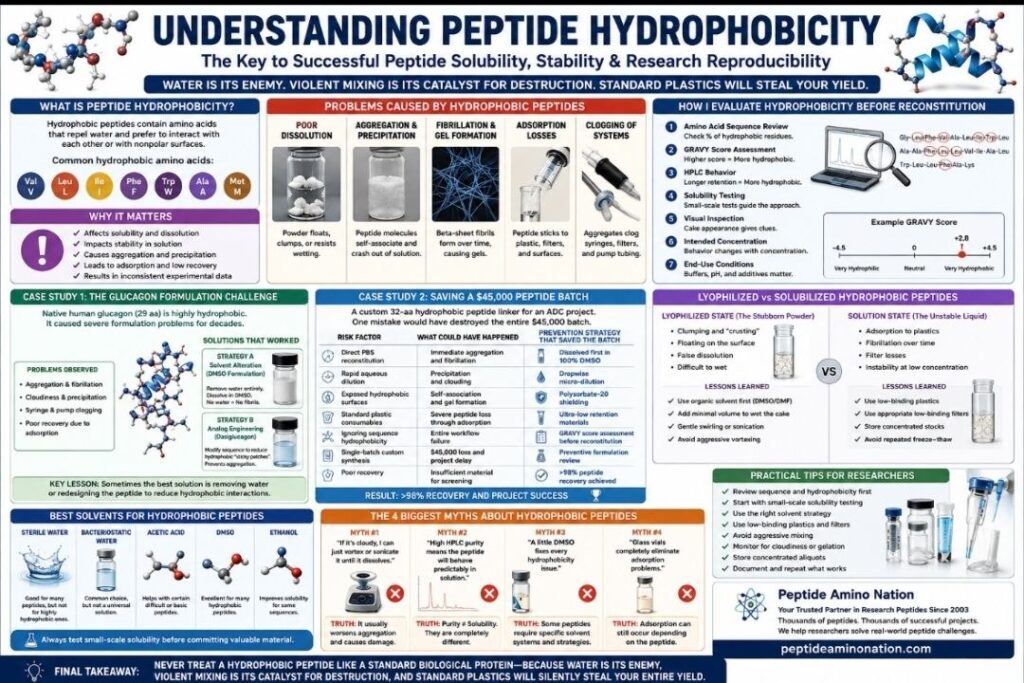
Table of Contents
1. What Is Understanding Peptide Hydrophobicity?
2. Why Understanding Peptide Hydrophobicity Matters
3. What Makes a Peptide Hydrophobic?
4. Common Problems Caused by Hydrophobic Peptides
5. How I Evaluate Peptide Hydrophobicity Before Reconstitution
6. Case Study: The Glucagon Formulation Challenge
7. Case Study: Saving a $45,000 Hydrophobic Peptide Batch
8. Lyophilized vs Solubilized Hydrophobic Peptides
9. Best Solvents for Hydrophobic Peptides
10. The 4 Biggest Myths About Peptide Hydrophobicity
11. Practical Tips for Researchers
12. Conclusion
Why Understanding Peptide Hydrophobicity Matters https://www.ncbi.nlm.nih.gov/
Understanding peptide hydrophobicity is critical because hydrophobic peptides do not behave like standard biological proteins.
Many researchers assume that adding bacteriostatic water or sterile water will solve every dissolution problem. Unfortunately, this assumption often leads to:
• Cloudy solutions
• Aggregation
• Precipitation
• Gel formation
• Syringe clogging
• Low peptide recovery
• Poor experimental reproducibility
Understanding peptide hydrophobicity helps researchers predict these problems before they occur.
What Makes a Peptide Hydrophobic? https://www.sciencedirect.com/
Understanding peptide hydrophobicity begins with understanding amino acid composition.
Hydrophobic peptides contain large numbers of amino acids such as:
• Valine
• Leucine
• Isoleucine
• Phenylalanine
• Tryptophan
• Alanine
• Methionine
These amino acids dislike interacting with water molecules.
As a result, hydrophobic regions naturally seek to minimize water exposure by clustering together, often causing peptide aggregation.
The stronger these hydrophobic interactions become, the more difficult dissolution and long-term stability become.
Common Problems Caused by Hydrophobic Peptides
Understanding Peptide Hydrophobicity and Aggregation
Aggregation occurs when hydrophobic regions stick together.
Instead of remaining evenly dispersed, peptide molecules self-associate and form larger structures.
This can dramatically alter biological activity and experimental outcomes.
Understanding Peptide Hydrophobicity and Precipitation
Many researchers observe a peptide dissolve initially, only to discover a cloudy solution later.
This often occurs because hydrophobic interactions continue developing after reconstitution.
The peptide eventually crashes out of solution.
Understanding Peptide Hydrophobicity and Surface Adsorption
Hydrophobic peptides often bind aggressively to:
• Syringes
• Pipette tips
• Tubes
• Filters
• Storage containers
Researchers may unknowingly lose a large percentage of their peptide before experiments even begin.
How I Evaluate Peptide Hydrophobicity Before Reconstituting Any Peptide
Understanding peptide hydrophobicity starts long before adding a solvent.
My evaluation process typically includes:
1. Amino Acid Sequence Review
I examine the percentage of hydrophobic amino acids within the sequence.
2. GRAVY Score Assessment
The Grand Average of Hydropathy (GRAVY) score provides valuable insight into expected peptide behavior.
Higher scores generally indicate increased hydrophobicity.
3. HPLC Behavior
Hydrophobic peptides often exhibit longer retention times during reverse-phase HPLC analysis.
4. Solubility Testing
Small-scale solubility testing helps identify optimal dissolution conditions before valuable material is used.
5. Visual Inspection
Lyophilized cake appearance often provides clues regarding peptide characteristics.
6. Intended Working Concentration
Hydrophobic peptides can behave very differently at various concentrations.
Understanding peptide hydrophobicity requires considering final concentration requirements.
Case Study: The Glucagon Formulation Challenge
One of the most famous examples of understanding peptide hydrophobicity comes from glucagon development.
Glucagon is a highly hydrophobic 29-amino acid peptide hormone.
For years, scientists struggled to create stable liquid formulations because glucagon rapidly formed:
• Aggregates
• Beta-sheet fibrils
• Precipitates
• Pump-clogging structures
Problems Observed
Researchers experienced:
• Cloudiness
• Gel formation
• Delivery system blockages
• Massive adsorption losses
Solution 1: Eliminate Water
Scientists developed a non-aqueous formulation using DMSO.
Without water, hydrophobic interactions could no longer drive fibril formation.
Solution 2: Sequence Engineering
Researchers created Dasiglucagon by strategically modifying amino acids responsible for aggregation.
The result was a significantly more stable peptide formulation.
This case demonstrates why understanding peptide hydrophobicity is essential in pharmaceutical development.
Case Study: Saving a $45,000 Hydrophobic Peptide Batch
A biotech company commissioned a custom 32-amino acid peptide linker for an antibody-drug conjugate project.
The purified batch weighed 500 mg and cost approximately $45,000.
A standard protocol called for direct reconstitution in PBS.
This would have been disastrous.
Fortunately, sequence analysis revealed extreme hydrophobicity before the experiment began.
Factors That Prevented Failure
| Risk Factor | Potential Outcome | Prevention Strategy |
| Direct PBS reconstitution | Immediate aggregation | Initial dissolution is 100% DMSO |
| Rapid aqueous dilution | Precipitation | Controlled dropwise dilution |
| Hydrophobic exposure | Self-association | Polysorbate-20 stabilization |
| Standard plastics | Severe peptide loss | Ultra-low retention materials |
| Ignoring hydrophobicity | Project failure | GRAVY score review |
| Single batch available | $45,000 loss | Formulation redesign |
| Poor recovery | Insufficient material | >98 peptide recovery |
The project proceeded successfully, demonstrating how understanding peptide hydrophobicity can prevent catastrophic losses.
Lyophilized vs Solubilized Hydrophobic Peptides
Understanding Peptide Hydrophobicity in Lyophilized Peptides
Hydrophobic lyophilized peptides often present unique challenges.
Common observations include:
• Floating powders
• Clumping
• Incomplete wetting
• False dissolution
Lessons Learned
• Use an organic solvent first when appropriate.
• Avoid dumping large volumes of water directly onto the peptide.
• Employ gentle mixing techniques.
Understanding Peptide Hydrophobicity in Solution
Once dissolved, new challenges emerge.
These include:
•Adsorption
•Fibrillation
• Gel formation
• Filter losses
Lessons Learned
• Use low-binding plastics.
• Use appropriate membrane filters.
• Store concentrated stock solutions whenever possible.
• Avoid repeated freeze-thaw cycles.
Best Solvents for Hydrophobic Peptides
Understanding peptide hydrophobicity requires selecting the correct solvent.
Common options include:
Sterile Water
Suitable for many peptides but often inadequate for highly hydrophobic sequences.
Bacteriostatic Water
Commonly used but not a universal solution.
Acetic Acid
Useful for certain difficult peptides.
DMSO
Often highly effective for hydrophobic peptides.
Ethanol
May improve dissolution for select sequences.
Always evaluate peptide-specific requirements before selecting a solvent.
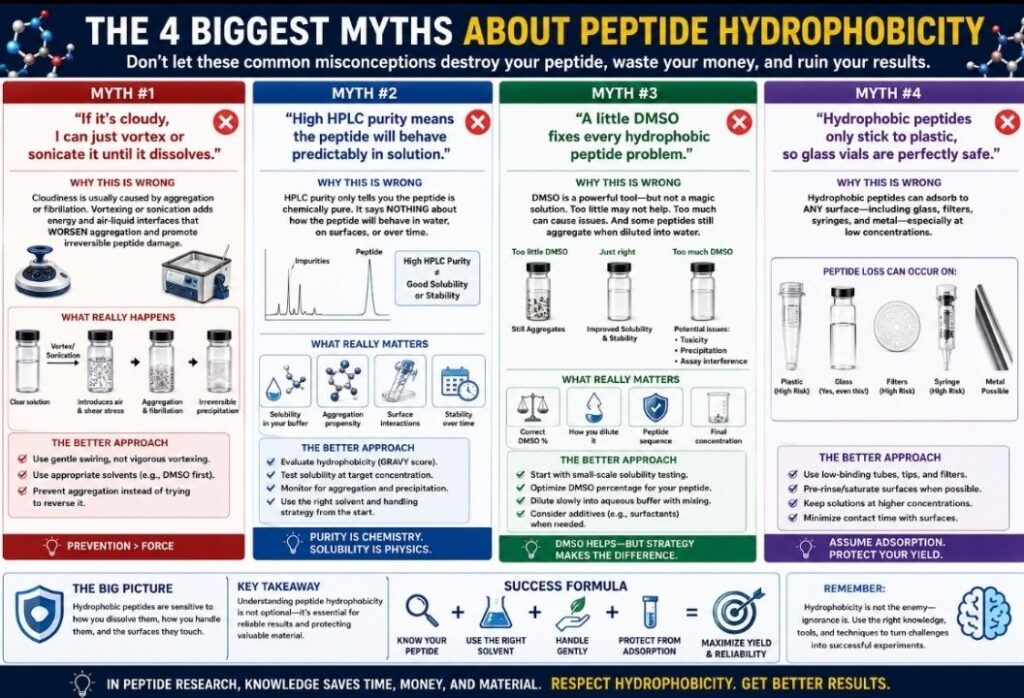
The 4 Biggest Myths About Peptide Hydrophobicity
Myth #1: If It’s Cloudy, I Can Just Vortex It
Aggressive vortexing often worsens aggregation.
Myth #2: High HPLC Purity Guarantees Good Solubility
Purity and solubility are completely different characteristics.
Myth #3: A Little DMSO Fixes Every Problem
Some peptides require carefully designed solvent systems.
Myth #4: Glass Completely Eliminates Adsorption
Hydrophobic peptides can still adsorb to glass surfaces under certain conditions.
Practical Tips for Researchers
If you are working with hydrophobic peptides:
•Review the amino acid sequence first.
• Evaluate the GRAVY score.
• Start with small-scale solubility testing.
• Use low-binding laboratory consumables.
• Avoid aggressive vortexing.
• Select solvents strategically.
• Monitor solutions for cloudiness.
• Store concentrated aliquots whenever possible.
At Peptide Amino Nation, we frequently help researchers troubleshoot peptide dissolution, storage, and stability challenges. Many problems that appear to be purity issues are actually hydrophobicity-related problems that can be corrected through proper handling and formulation strategies.
FAQ Schema Questions
1. What is peptide hydrophobicity?
Peptide hydrophobicity refers to the tendency of certain peptide regions to avoid water due to the presence of hydrophobic amino acids such as leucine, valine, isoleucine, phenylalanine, and tryptophan.
2. Why is understanding peptide hydrophobicity important?
Understanding peptide hydrophobicity helps researchers prevent aggregation, precipitation, adsorption losses, poor recovery, and formulation failures during peptide research.
3. How can I tell if a peptide is hydrophobic?
Researchers can evaluate peptide hydrophobicity by reviewing the amino acid sequence, calculating the GRAVY score, analyzing HPLC retention behavior, and performing solubility testing.
4. What problems do hydrophobic peptides cause?
Hydrophobic peptides commonly cause poor dissolution, precipitation, aggregation, fibrillation, gel formation, filter losses, and adsorption to laboratory plastics.
5. Which solvents work best for hydrophobic peptides?
Common solvents for hydrophobic peptides include DMSO, acetic acid, ethanol, sterile water, and bacteriostatic water, depending on the peptide sequence and intended application.
6. Why do hydrophobic peptides stick to plastic surfaces?
Hydrophobic peptides are attracted to less polar surfaces such as polypropylene tubes, syringe walls, filters, and pipette tips, leading to significant peptide loss.
7. Does high HPLC purity guarantee good peptide solubility?
No. HPLC purity measures chemical purity, while solubility depends on the peptide’s physical and chemical properties, including hydrophobicity.
8. Can vortexing improve hydrophobic peptide dissolution?
Aggressive vortexing often worsens aggregation and may introduce air-liquid interfaces that promote peptide denaturation and fibrillation.
9. What is the best way to reconstitute highly hydrophobic peptides?
Many highly hydrophobic peptides dissolve more effectively when first wetted with a small amount of DMSO or another suitable organic solvent before gradual dilution into aqueous solutions.
10. How can researchers reduce peptide adsorption losses?
Using low-protein-binding tubes, low-retention pipette tips, appropriate filter membranes, and concentrated stock solutions can significantly reduce adsorption losses.
Related Peptide Research Topics
The Role of pH in Peptide Solubility
Understanding Syringe Units for Peptide Research Calculations
Why Different Peptides Have Different Shelf Lives
Common Storage Mistakes That Reduce Peptide Quality
Why Impurities Form During Peptide Synthesis: 7 Critical Mistakes Every Researcher Must Avoid
Why Research Peptides Results Differ Between Laboratories
Conclusion
Understanding Peptide Hydrophobicity is not simply an academic concept—it is one of the most practical skills a peptide researcher can develop.
Hydrophobicity influences dissolution, stability, adsorption, aggregation, filtration, storage, and ultimately the success of an experiment. By understanding how hydrophobic peptides interact with water, surfaces, and solvents, researchers can avoid common mistakes that lead to wasted material and failed studies.
After helping researchers since 2003 and supporting thousands of peptide projects, I have learned that successful peptide research often depends less on complicated protocols and more on understanding fundamental peptide behavior.
Remember this principle:
Never treat a hydrophobic peptide like a standard biological protein—because water is its enemy, violent mixing is its catalyst for destruction, and standard plastics will silently steal your entire yield.
Understanding Peptide Hydrophobicity before reconstitution can save thousands of dollars, preserve valuable peptide material, and prevent months of unnecessary research setbacks.
