The Role of pH in Peptide Solubility: 9 Powerful Rules That Prevent Costly Peptide Dissolution Mistakes

Table of Contents
1. Introduction
2. Why The Role of pH in Peptide Solubility Matters
3. Understanding Peptide Charge and the Isoelectric Point (pI)
4. The Rule of Two: The Most Important Solubility Principle
5. Quick Reference: Rules of Thumb for Reconstitution
6. The Role of pH in Peptide Solubility for Different Peptide Types
7. Real-World Case Study: BPC-157 and pH Adjustment
8. Why GHK-Cu Requires Special pH Control
9. The 4 Biggest Myths About The Role of pH in Peptide Solubility
10. Common Peptide Dissolution Failures and Their Solutions
11. Step-by-Step Peptide Reconstitution Workflow
12. Lessons Learned From Helping More Than 10,000 Researchers
13 Conclusion
The Role of pH in Peptide Solubility
https://pubmed.ncbi.nlm.nih.gov/
The Role of pH in Peptide Solubility is one of the most misunderstood aspects of peptide research. Since 2003, I have helped more than 10,000 researchers, laboratories, and customers troubleshoot peptide handling, storage, and reconstitution challenges.
One pattern appears repeatedly: when a peptide refuses to dissolve, most researchers assume they have a mechanical problem. They shake harder, sonicate longer, or apply heat. In reality, peptide solubility is usually a chemical problem driven by pH, charge distribution, and the peptide’s isoelectric point (pI).
Understanding The Role of pH in Peptide Solubility can save researchers from wasted material, failed experiments, and expensive peptide losses.
Why The Role of pH in Peptide Solubility Matters
Peptides are not all created equal.
Each peptide contains a unique combination of amino acids that determines its charge, hydrophobicity, structure, and behavior in solution.
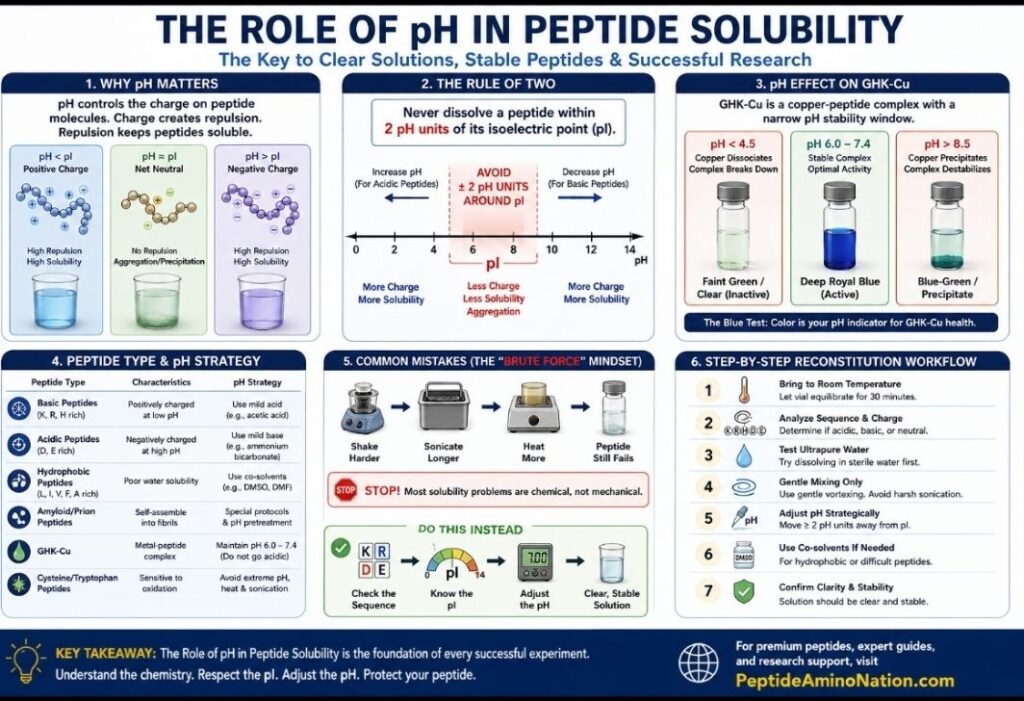
The Role of pH in Peptide Solubility becomes critical because pH controls whether a peptide carries a positive charge, negative charge, or no net charge at all.
When the peptide loses its charge, molecules stop repelling one another and begin sticking together.
The result is:
•Cloudiness
• Aggregation
• Gel formation
• Precipitation
• Reduced biological activity
• Experimental failure
Understanding Peptide Charge and the Isoelectric Point (pI)
https://peptideaminonation.com/how-humidity-affects-lyophilized-peptides/
The isoelectric point (pI) is the pH at which a peptide carries a net charge of zero.
At this point, electrostatic repulsion disappears.
Without repulsion, peptide molecules attract each other and form aggregates.
This is why The Role of pH in Peptide Solubility revolves around staying away from the peptide’s pI.
Why Peptides Precipitate Near Their pI
When a peptide approaches its isoelectric point:
• Positive and negative charges balance
•The net charge falls toward zero
• Solubility decreases dramatically
• Aggregation increases rapidly
Many researchers accidentally trigger precipitation by dissolving peptides directly in pH 7.4 buffers without checking the peptide’s pI first.
The Rule of Two: The Most Important Principle in The Role of pH in Peptide Solubility https://www.ich.org/
If there is one rule every researcher should remember, it is this:
Never Dissolve a Peptide Within 2 pH Units of Its pI
This simple guideline dramatically improves peptide solubility.
For example:
Avoid Dissolving
| Pepetide Pl | Between |
| 5.0 | pH 3.0-70 |
| 6.5 | pH 4.5-8.5 |
| 7.4 | pH 5.4-9.4 |
| 8.0 | pH 6.0-10.0 |
The farther you move from the pI, the stronger the peptide’s net charge becomes, increasing electrostatic repulsion and improving solubility.
Quick Reference: Rules of Thumb for Reconstitution
Peptide Reconstitution: The Science Behind Proper Mixing
| Peptide Type | Recommended Approach |
| Basic Peptides ( K, R, H, rich) | Use sterile water first, then mild acetic acid if needed |
| Acidic Peptides (D,E rich) | Use sterile water first, then mild ammonium bicarbonate |
| Peptide Near Their Pl | Shift pH away from the pl immediately |
| Hydrophobic Peptide | Use minimal DMSO or DMF before aqueous |
| Amyloid-Forming Peptides | Follow specialized protocol |
| GHK-Cu | Maintain pH between 6.0 and 7.4 |
| Cysteine Peptides | Avoid oxidation and excessive sonication |
| Tryptophan Peptides | Protect from air, light, and heat |
The Role of pH in Peptide Solubility for Different Peptide Types
Basic Peptides
Basic peptides contain:
• Lysine (K)
• Arginine (R)
• Histidine (H)
These peptides typically dissolve better under mildly acidic conditions.
Adding a small amount of acetic acid increases positive charge and promotes electrostatic repulsion.
Acidic Peptides
Acidic peptides contain:
• Aspartic Acid (D)
• Glutamic Acid (E)
These peptides often dissolve more effectively under mildly basic conditions.
A slight pH increase increases negative charge and improves solubility.
Hydrophobic Peptides
Hydrophobic peptides are among the most challenging molecules to dissolve.
Common hydrophobic residues include:
• Leucine
• Isoleucine
• Valine
• Phenylalanine
• Alanine
When hydrophobic content exceeds 50%, pH adjustments alone may not be enough.
These peptides often require DMSO, DMF, urea, or guanidine hydrochloride.
Amyloid and Prion Peptides
Amyloid-beta peptides and prion-derived peptides frequently confuse researchers.
These molecules naturally self-assemble into fibrils.
Specialized dissolution strategies often involve extreme pH pretreatments before dilution into experimental buffers.
Real-World Case Study: BPC-157 and pH Adjustment
One of the best examples of The Role of pH in Peptide Solubility comes from BPC-157.
The Problem
A researcher attempted to prepare a high-concentration BPC-157 solution.
Instead of a clear solution, the vial became cloudy and developed micro-precipitates.
The Cause
BPC-157 has a calculated pI of approximately 3.4–3.8.
Residual acetate from peptide synthesis lowered the solution pH directly into the peptide’s pI region.
As a result:
• Net charge approached zero
• Electrostatic repulsion disappeared
• Molecules aggregated
The Solution
The researcher gently increased the pH using sodium bicarbonate.
The pH shifted from approximately 3.8 to around 7.0.
The Outcome
The cloudiness disappeared almost immediately.
The peptide became completely clear, stable, and homogeneous.
This case perfectly demonstrates The Role of pH in Peptide Solubility.
Why GHK-Cu Requires Special pH Control
GHK-Cu behaves differently from traditional peptides.
It is a copper-peptide complex that depends on stable metal coordination.
Optimal pH Range
The practical sweet spot for GHK-Cu is:
pH 6.0 to 7.4
What Happens Below pH 4.5
Excess hydrogen ions attack the peptide’s copper-binding sites.
The copper ion dissociates from the complex.
The result:
• Loss of biological activity
• Structural breakdown
• Oxidative damage
The Blue Test
Healthy GHK-Cu:
• Deep royal blue
Degrading GHK-Cu:
•Blue-green
•Turquoise
Destroyed GHK-Cu:
Nearly colorless
Always maintain GHK-Cu within its safe pH window.
The 4 Biggest Myths About The Role of pH in Peptide Solubility
Myth 1: Every Peptide Should Be Dissolved at pH 7.4
Reality:
Many peptides precipitate at physiological pH.
Always evaluate the peptide’s pI first.
Myth 2: Water Is Always Neutral and Safe
Reality:
Residual acetate or TFA salts can dramatically alter pH after reconstitution.
Myth 3: DMSO Solves Every Solubility Problem
Reality:
DMSO helps initial solvation but cannot prevent precipitation after dilution.
Myth 4: Cloudy Solutions Just Need More Mixing
Reality:
Cloudiness often indicates aggregation, not incomplete dissolution.
Common Peptide Dissolution Failures and Their Solutions
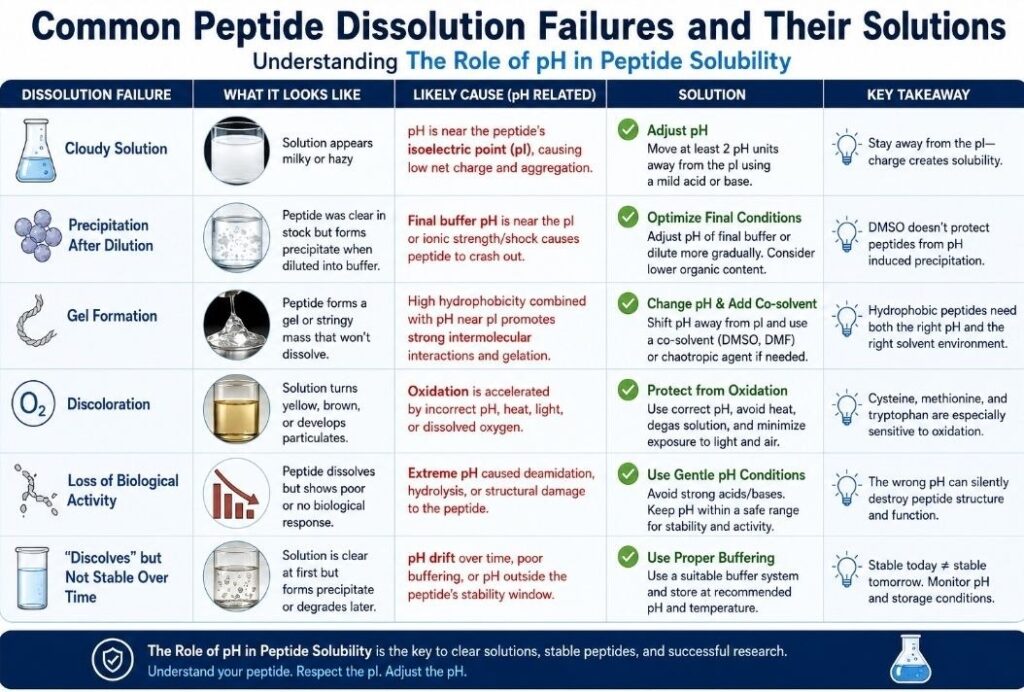
| Problem | Likely Cause |
| Cloudy solution | pH near pl |
| Precipitation after dilution | Hydrophobic aggregation |
| Discoloration | DMSO dilution crash |
| Gel formation | Oxidation |
| Loss of activity | Improper pH |
Step-by-Step Peptide Reconstitution Workflow
Step 1: Bring Vial to Room Temperature
Never open frozen peptide vials.
Allow at least 30 minutes for equilibration.
Step 2: Analyze Sequence Charge
Count:
• Lysine (K)
• Arginine (R)
• Histidine (H)
• Aspartic Acid (D)
• Glutamic Acid (E)
Determine whether the peptide is acidic or basic.
Step 3: Test Ultrapure Water
Attempt dissolution using sterile ultrapure water.
Step 4: Apply Gentle Mixing
Use gentle vortexing only.
Avoid aggressive sonication.
Step 5: Adjust pH
Basic peptides → mild acetic acid.
Acidic peptides → mild ammonium bicarbonate.
Step 6: Use Co-Solvents If Necessary
For highly hydrophobic sequences, use DMSO or DMF before gradual dilution.
Lessons Learned From Helping More Than 10,000 Researchers
Since 2003, the biggest mistake I have observed is the brute-force mindset.
Researchers often:
• Shake harder
• Sonicate longer
• Heat the solution
• Blame the peptide
The actual solution is usually much simpler:
Check the sequence.
Check the charge.
Check the pI.
Adjust the pH.
The Role of pH in Peptide Solubility is ultimately a chemistry problem, not a mechanical one.
Related Topics That Will Help You In The Peptide Industry As a Professional
Peptide Reconstitution: The Science Behind Proper Mixing
Peptide Formulation Challenges: A Complete Guide for Researchers and Peptide Suppliers
Why Research Peptides Results Differ Between Laboratories
Conclusion
The Role of pH in Peptide Solubility is the single most important factor determining whether a peptide remains clear, stable, and biologically active or becomes cloudy, aggregated, and unusable. Understanding The Role of pH in Peptide Solubility allows researchers to avoid many of the most common and costly peptide reconstitution mistakes.
Remember the Rule of Two:
Never dissolve a peptide within 2 pH units of its isoelectric point (pI).
When a peptide refuses to dissolve, stop shaking it, stop heating it, and stop forcing it. Most peptide dissolution problems are not mechanical—they are chemical. The Role of pH in Peptide Solubility should always be evaluated before applying aggressive mixing, sonication, or heat.
Instead, analyze the peptide sequence, determine its charge profile, identify its isoelectric point, and adjust the pH strategically. In my experience helping more than 10,000 researchers and customers since 2003, a proper understanding of The Role of pH in Peptide Solubility has prevented countless cases of peptide precipitation, aggregation, oxidation, and loss of biological activity.
If there is one principle to remember from this guide, it is this:
The Role of pH in Peptide Solubility is an electrostatic numbers game. A peptide that carries sufficient charge stays soluble; a peptide that loses its charge tends to aggregate and precipitate.
So, if your peptide solution becomes cloudy, do not assume the peptide is defective. Instead, remember the golden rule:
If it’s cloudy, stop shaking it, check the sequence, and shift the pH.
Mastering The Role of pH in Peptide Solubility will help you achieve better peptide stability, more reliable reconstitution results, improved experimental reproducibility, and greater long-term success in peptide research.
For more expert peptide handling guides, peptide reconstitution protocols, and peptide research education, visit PeptideAminoNation.com.
