Why Impurities Form During Peptide Synthesis: 7 Critical Mistakes Every Researcher Must Avoid

Introduction
Why Impurities Form During Peptide Synthesis is one of the most important questions peptide researchers and buyers can ask.
Many researchers assume that impurities are simply manufacturing mistakes. In reality, impurity formation is a natural consequence of peptide chemistry. Even under highly optimized manufacturing conditions, side reactions, incomplete coupling events, degradation pathways, and handling errors can generate unwanted peptide variants.
The challenge is not whether impurities form—it is understanding where they originate, how they are detected, and how they influence experimental outcomes.
Based on analytical workflows used throughout the peptide industry and best practices expected in pharmaceutical-grade manufacturing, researchers should view peptide purity as a continuously evolving characteristic rather than a fixed number printed on a Certificate of Analysis (COA).
This guide explains the major causes of peptide impurities, how advanced laboratories identify them, and what researchers should look for when evaluating peptide quality.
We don`t only educate people about Why Impurities Form During Peptide Synthesis. Learn more educational contents to a reliable source http://peptideaminonation.com/blog/
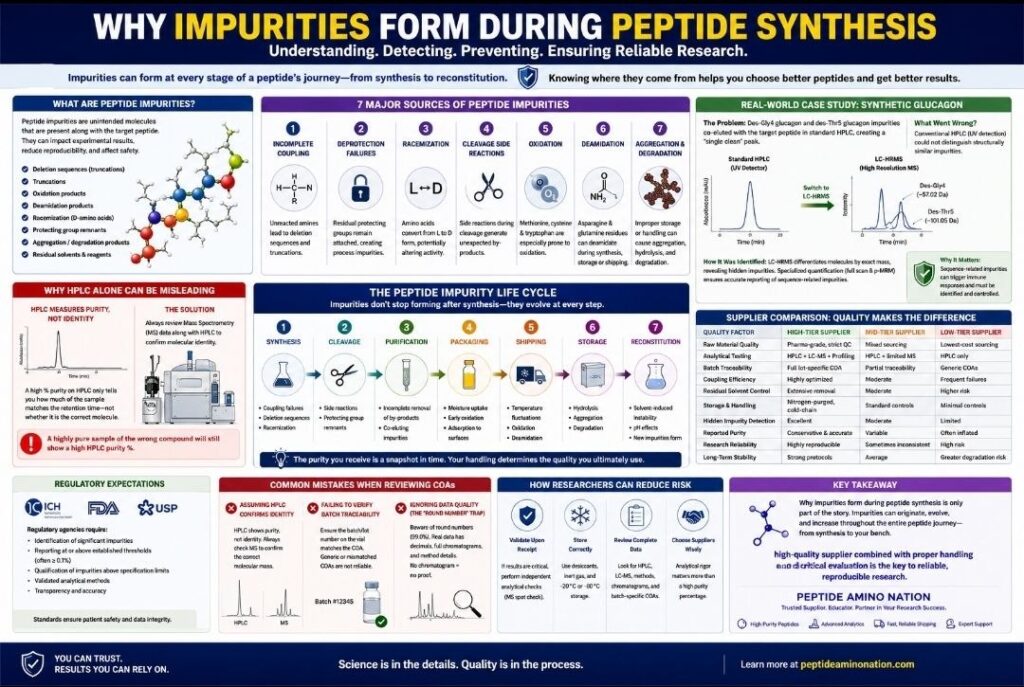
Table of Contents
1. What Are Peptide Impurities?
2. Why Impurities Form During Peptide Synthesis
3. The 7 Major Sources of Peptide Impurities
4. Real-World Case Study: Hidden Glucagon Impurities
5. Why HPLC Alone Can Miss Critical Impurities
6. LC-MS and Modern Impurity Detection
7. Supplier Comparison Table
8. The Peptide Impurity Life Cycle
9. Regulatory Expectations for Impurity Reporting
10. Common COA Review Mistakes
11. How Researchers Can Reduce Risk
12. Key Takeaways
What Are Peptide Impurities?
https://pubmed.ncbi.nlm.nih.gov/
Peptide impurities are unintended molecules present alongside the target peptide.
These may include:
• Deletion sequences
• Truncation products
• Oxidation products
• Deamidation products
• Racemized amino acids
• Aggregated peptides
• Residual protecting groups
• Residual solvents and reagents
Some impurities differ from the intended peptide by only a single amino acid, making them extremely difficult to detect and remove.
Because many impurities retain biological activity, they may interfere with receptor binding studies, cell assays, and pharmacological research.
Why Impurities Form During Peptide Synthesis
H3: Peptide Chemistry Is Never 100% Efficient
Even modern peptide synthesis methods such as Fmoc Solid-Phase Peptide Synthesis (SPPS) and Boc chemistry involve hundreds of individual chemical reactions.
Every coupling cycle introduces a small probability of failure.
When these failures accumulate across long peptide sequences, impurities become inevitable.
A peptide containing 30 amino acids may require dozens of successful coupling and deprotection reactions. Even a coupling efficiency of 99% can generate measurable impurity levels by the end of synthesis.
The 7 Major Sources of Peptide Impurities
H2: 1. Incomplete Amino Acid Coupling
Incomplete coupling remains one of the most common causes of peptide impurities.
When an amino acid fails to attach correctly, synthesis continues, producing shortened peptide chains known as deletion sequences or truncations.
These impurities often closely resemble the target peptide and can be difficult to remove during purification.
H2: 2. Deprotection Failures
Protecting groups prevent unwanted reactions during synthesis.
If deprotection reactions do not proceed completely, residual protecting groups remain attached to the peptide.
These modified molecules become process-related impurities.
H2: 3. Racemization
Racemization occurs when an amino acid changes from its natural L-form to its D-form.
Although the molecular weight remains unchanged, biological activity can change significantly.
Certain residues such as cysteine and histidine are particularly susceptible.
H2: 4. Cleavage-Related Side Reactions
Following synthesis, peptides are cleaved from the resin using strong acidic conditions.
During this process, side reactions may occur, generating unexpected molecular variants.
These impurities often require extensive purification to remove.
H2: 5. Oxidation
Oxidation commonly affects methionine, cysteine, and tryptophan residues.
Exposure to oxygen, heat, moisture, or light can convert the intended peptide into oxidized variants.
In many laboratories, oxidation represents one of the most frequently observed post-synthesis impurities.
H2: 6. Deamidation
Asparagine and glutamine residues are vulnerable to deamidation.
This reaction changes the peptide’s chemical properties and may alter biological performance.
Deamidation can occur during storage, shipping, or reconstitution.
H2: 7. Aggregation and Degradation
Peptides are dynamic molecules.
Improper storage conditions may cause aggregation, hydrolysis, or degradation.
These degradation products often emerge after the original purity analysis has already been completed.
Real-World Case Study: Hidden Glucagon Impurities
One of the most instructive examples involves synthetic glucagon.
Researchers discovered that impurities such as des-Gly4 glucagon and des-Thr5 glucagon escaped detection during standard RP-HPLC analysis.
What Went Wrong?
These deletion impurities were co-eluting.
In other words, they appeared at virtually the same retention time as the intended glucagon molecule.
The chromatogram displayed a seemingly clean peak.
The impurities remained hidden.
How Was the Problem Identified?
Researchers transitioned to LC-HRMS (Liquid Chromatography–High Resolution Mass Spectrometry).
Unlike UV detection, HRMS distinguished molecules based on exact molecular mass.
Although the impurities traveled through the chromatographic system alongside the target peptide, their slightly lower molecular weights revealed their presence.
This discovery demonstrated an important lesson:
A clean HPLC chromatogram does not always guarantee a pure peptide.
Why HPLC Alone Can Miss Critical Impurities
https://peptideaminonation.com/peptide-analytical-vs-preparative-hplc/
H3: HPLC Measures Purity, Not Identity
Many researchers incorrectly assume that a high HPLC purity percentage proves product authenticity.
This is not true.
HPLC primarily measures relative peak area.
It does not confirm molecular structure.
A highly pure peak can still represent the wrong molecule.
This is why reputable suppliers combine:
• HPLC
• LC-MS
• MALDI-TOF
• Amino acid analysis
• Additional analytical methods when required
LC-MS and Modern Impurity Detection
Advanced laboratories increasingly rely on LC-MS workflows because they provide both chromatographic separation and molecular confirmation.
Benefits include:
• Verification of molecular mass
• Detection of hidden impurities
• Identification of deletion sequences
• Detection of oxidation products
• Quantification of trace impurities
For critical research applications, LC-MS verification should be considered essential.
Supplier Comparison Table
| Quality Factors | High-Tier Supplier | Mid-Tier Supplier | Low-Tier Supplier |
| Raw Material Quality | Pharmaceutical-grade amino acids | Mixed sourcing | Lowest-cost sourcing |
| Analytical Testing | HPLC + LC-MS | Primarily HPLC | Basic HPLC only |
| Batch Traceability | Full lot-specific COA | Partial traceability | Generic COAs |
| Coupling Efficiency | Highly optimized | Moderate optimization | Greater failure rates |
| Residual Solvent Control | Extensive purification | Moderate purification | Limited purification |
| Storage Controls | Nitrogen-purged, cold-chain | Standard controls | Minimal control |
| Hidden Impurity Detection | Excellent | Moderate | Limited |
| Research Reliability | High | Variable | Inconsistent |
We don`t only educate people about Why Impurities Form During Peptide Synthesis. Learn more educational contents to a reliable source http://peptideaminonation.com/blog/
The Peptide Impurity Life Cycle
https://peptideaminonation.com/peptide-reconstitution-guide/
Most discussions about peptide purity stop at synthesis.
However, impurities evolve throughout the peptide’s life cycle.
Stage 1: Synthesis
• Coupling failures
• Deletion sequences
• Racemization
Stage 2: Cleavage
• Side reactions
• Protecting-group remnants
Stage 3: Purification
• Incomplete impurity removal
• Co-eluting contaminants
Stage 4: Packaging
• Moisture absorption
• Early degradation
Stage 5: Shipping
• Temperature-induced oxidation
• Deamidation
Stage 6: Storage
• Hydrolysis
• Aggregation
Stage 7: Reconstitution
• Solvent-induced instability
• New impurity formation
Understanding this life cycle helps researchers evaluate peptide quality beyond the initial COA.
Regulatory Expectations for Impurity Reporting
Regulatory authorities recognize the importance of impurity characterization.
Guidelines from ICH, FDA, and pharmacopeial standards generally require:
• Identification of significant impurities
• Reporting thresholds for trace components
• Qualification of impurities exceeding specified limits
• Validation of analytical methods
In many peptide applications, impurities above approximately 0.1% may require reporting, while higher levels often require additional qualification depending on the product and regulatory pathway.
Common COA Review Mistakes
https://peptideaminonation.com/how-to-read-a-peptide-coa-10-critical-things-to-learn/
Mistake #1: Assuming HPLC Confirms Identity
Always review mass spectrometry data.
Mistake #2: Ignoring Batch Numbers
Ensure the COA matches the specific lot received.
Mistake #3: Trusting Round Numbers
A purity value of exactly 99.0% without supporting chromatograms may warrant additional scrutiny.
Look for:
• Actual chromatograms
• Peak integration data
• Method details
• Precise analytical values
How Researchers Can Reduce Risk
Researchers seeking consistent results should adopt an audit mindset.
Validate Upon Receipt
For critical experiments, perform an independent analytical verification when possible.
Store Correctly
Use:
• Desiccants
• Nitrogen or argon protection
• Appropriate low-temperature storage
Review Complete Analytical Packages
Evaluate:
• HPLC
• LC-MS
• Chromatograms
• Batch-specific documentation
Choose Suppliers Carefully
A supplier’s analytical rigor often matters more than a headline purity number.
At Peptide Amino Nation, we believe researchers should understand not only what a purity percentage means but also what it does not mean. Education remains one of the most powerful tools for improving research reliability.
Key Takeaways
Understanding Why Impurities Form During Peptide Synthesis is essential for every peptide buyer and researcher.
Impurities can originate during synthesis, purification, storage, shipping, and reconstitution.
Modern analytical techniques such as LC-MS reveal impurities that standard HPLC may miss.
The most successful researchers do not treat a COA as a guarantee. They treat it as a starting point for quality evaluation.
Ultimately, peptide reliability depends on both manufacturing quality and handling practices throughout the entire peptide life cycle.
The best results come from combining rigorous analytical verification, proper storage protocols, and partnerships with suppliers committed to transparency, education, and scientific excellence.
We don`t only educate people about Why Impurities Form During Peptide Synthesis. Learn more educational contents to a reliable source http://peptideaminonation.com/blog/

Comment
Common Storage Mistakes That Reduce Peptide Quality: 7 Powerful Errors That Can Destroy Peptide Integrity
[…] https://peptideaminonation.com/why-impurities-form-during-peptide-synthesis/ […]