Peptide Analytical vs Preparative HPLC: 9 Powerful Differences Every Researcher Must Understand

Peptide Analytical vs Preparative HPLC
When evaluating peptide quality, few topics create more confusion than Peptide Analytical vs. Preparative HPLC. Many beginner researchers assume that both processes serve the same purpose, but that assumption can lead to costly mistakes when interpreting Certificates of Analysis (COAs) and selecting peptide suppliers.
As someone who has reviewed numerous peptide laboratory reports and quality-control documents, I have seen researchers place too much trust in a single purity percentage without understanding how that number was generated. In reality, analytical and preparative HPLC serve entirely different functions.
Understanding the distinction can help you interpret chromatograms correctly, identify red flags in supplier documentation, and make more informed purchasing decisions.
Most importantly, it helps you recognize why independent third-party testing remains the gold standard for peptide verification.
Table of Contents
1. What Is HPLC?
2. What Is Analytical HPLC?
3. What Is Preparative HPLC?
4. Peptide Analytical vs 5. Preparative HPLC: Key Differences
5. Why Researchers Often Get Confused
6. The Purity vs Identity Fallacy
7. The Invisible Peptide Content Variable
8. The Snapshot Bias
9.Methodological Noise and Discrepancies
10.Real-World Case Study
11. How to Read a Peptide Chromatogram
12. Critical Red Flags in COAs
13. Common Supplier Manipulation Tactics
14. Why Third-Party Testing Matter.
15. BPC-157 Example
16. TB-500 Example
17. Frequently Asked Questions
17. Final Thoughts
What Is HPLC?
https://pubmed.ncbi.nlm.nih.gov/
High-Performance Liquid Chromatography (HPLC) is one of the most important analytical techniques used in peptide science.
The method separates compounds within a sample and measures their relative abundance.
Researchers use HPLC to:
• Assess purity
• Detect impurities
• Monitor synthesis quality
• Verify batch consistency
• Support quality-control procedures
However, not all HPLC methods are designed for the same purpose.
This is where understanding Peptide Analytical vs. Preparative HPLC becomes critical.
What Is Analytical HPLC?
https://peptideaminonation.com/how-to-read-a-peptide-coa-10-critical-things-to-learn/
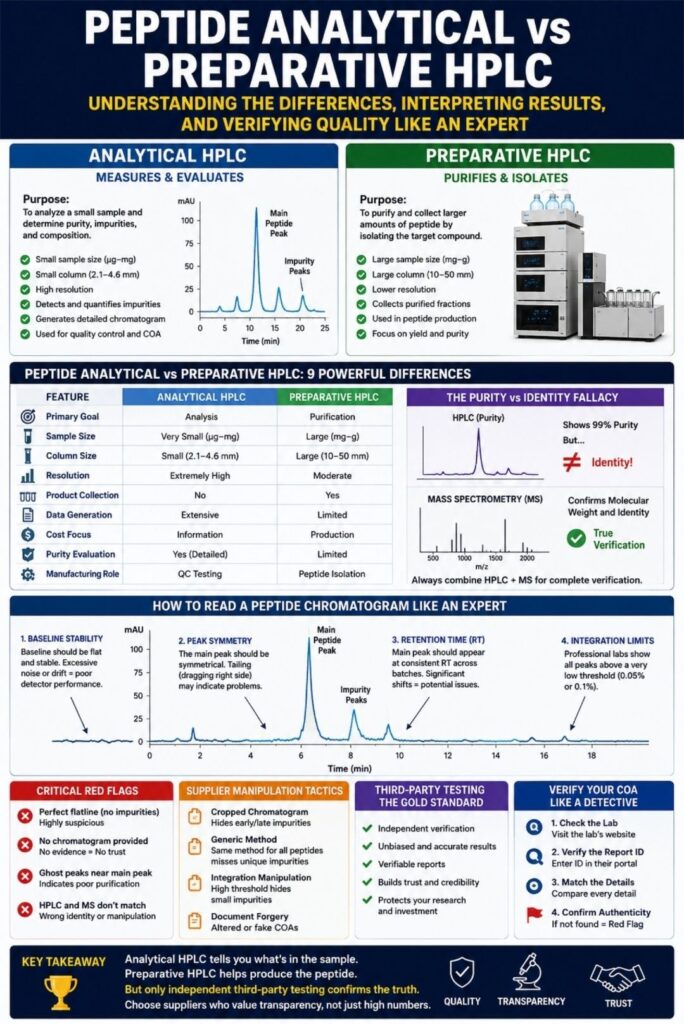
Analytical HPLC is designed to measure and evaluate a peptide sample.
Its primary objective is information gathering rather than production.
Analytical HPLC typically uses:
- Small sample quantities
- Narrow chromatography columns
- High-resolution separation
- Detailed impurity analysis
Researchers use analytical HPLC to determine:
• Purity percentage
• Retention time
• Peak profile
• Batch consistency
The chromatogram generated during analytical HPLC testing becomes a key component of the Certificate of Analysis.
Think of analytical HPLC as the laboratory’s microscope. Its job is to examine the sample in detail.
What Is Preparative HPLC?
Preparative HPLC serves a different purpose.
Instead of measuring a sample, preparative HPLC is designed to purify and collect the target peptide.
Preparative systems use:
• Larger columns
• Greater sample loads
• Higher flow rates
• Fraction collection systems
The goal is to isolate the desired peptide from unwanted impurities generated during synthesis.
In simple terms:
• Analytical HPLC tells you what is present.
• Preparative HPLC helps produce what you want.
Peptide Analytical vs Preparative HPLC: 9 Powerful Differences
| Primary Goal | Analysis | Purificati0n |
| Sample Size | Very Small | Large |
| Column Size | Small | Large |
| Resolution | Extremely High | Moderate |
| Product Collection | No | Yes |
| Data Generation | Extensive | Limited |
| Cost Focus | Information | Production |
| Purity Evaluation | Yes | Limited |
| Manufactural Role | QC Testing | Peptide Isolation |
This table highlights why Peptide Analytical vs Preparative HPLC should never be treated as interchangeable concepts.
Why Researchers Often Get Confused
Many suppliers advertise:
“99% HPLC Purity”
Unfortunately, they rarely specify:
• Which HPLC method was used
• Whether independent testing was performed
• How was purity calculated
• Whether the chromatogram was properly integrated
As a result, many buyers assume the purity number tells the entire story.
It does not.
The Purity vs Identity Fallacy
One of the most dangerous misconceptions in peptide testing is assuming purity equals identity.
A sample may appear:
• 99% pure by HPLC
• Completely wrong by mass spectrometry
HPLC measures separation and abundance.
It does not directly confirm molecular identity.
This means a chromatogram can show a dominant peak while the actual molecule differs from the intended peptide.
That is why reputable laboratories combine:
• Analytical HPLC
• Mass Spectrometry (MS)
Together, they provide a much more complete picture.
The Invisible Peptide Content Variable
Another overlooked issue is peptide content.
A peptide can show excellent purity while containing:
• Excess moisture
• Residual solvents
• Counterions
• Manufacturing residues
The chromatogram alone may not reveal these variables.
This creates a false sense of confidence among inexperienced buyers.
Purity should never be interpreted without considering peptide content and supporting analytical data.
The Snapshot Bias
Analytical HPLC provides a snapshot of a sample at a specific moment.
It does not predict:
• Long-term stability
• Future degradation
• Storage performance
• Shipping damage
A peptide that tested well months ago may no longer reflect the material currently being sold.
This is why recent third-party testing is so important.
Methodological Noise and Discrepancies
Different laboratories often use different:
• Columns
• Solvents
• Flow rates
• Gradients
• Detection wavelengths
As a result, two laboratories can produce slightly different chromatograms from the same sample.
Understanding this variability helps prevent incorrect conclusions when comparing reports.
Real-World Case Study
A researcher compared two peptide suppliers offering BPC-157.
Supplier A claimed:
• 99.4% purity
Supplier B claimed:
•98.7% purity
At first glance, Supplier A appeared superior.
However, a deeper review revealed:
• Cropped chromatogram
• Missing MS data
• No third-party verification
Supplier B provided:
• Full chromatogram
• Mass spectrometry results
• Independent laboratory verification
Despite the lower purity number, Supplier B presented significantly stronger evidence of product quality.
This example demonstrates why purity percentages alone can be misleading.
How to Read a Peptide Chromatogram Like an Expert
https://peptideaminonation.com/how-to-read-a-peptide-coa-10-critical-things-to-learn/
Examine Baseline Stability
The baseline should appear clean and relatively stable.
Excessive drift or noise may indicate:
• Detector instability
• Poor calibration
• Questionable integration
Evaluate Peak Symmetry
A well-formed peak should be relatively symmetrical.
Severe tailing may indicate:
• Degradation
• Poor method development
•Column interactions
Review Retention Time
Retention time should remain reasonably consistent across batches.
Major shifts can suggest:
• Method changes
• Sample composition changes
• Manufacturing inconsistencies
Check Integration Limits
Professional laboratories report very small peaks.
Overly aggressive integration thresholds may hide impurities.
Red Flags Every Researcher Should Know
The Perfect Flatline
No synthesis process is perfect.
A chromatogram showing absolutely zero impurities should raise questions.
Missing Chromatogram
No chromatogram means no independent verification.
Always request original documentation.
Ghost Peaks Near the Main Peak
Large neighboring peaks may indicate:
• Incomplete purification
• Structural analogs
•Failed synthesis separation
HPLC and MS Disagreement
If HPLC and mass spectrometry conflict, investigate further before trusting the report.
Common Supplier Manipulation Tactics
The Cropped Chromatogram
Some suppliers intentionally remove early and late sections of the chromatogram to hide impurities.
Generic Testing Methods
Using the same analytical method for every peptide can miss peptide-specific impurities.
Integration Manipulation
Raising integration thresholds can artificially inflate purity percentages.
Document Forgery
Some unethical suppliers modify genuine laboratory templates.
Always verify reports independently.
Why Third-Party Testing Is the Gold Standard
After reviewing numerous peptide COAs over the years, one lesson consistently stands out:
Independent third-party testing is the single most important factor when evaluating a peptide supplier.
Supplier-generated reports can be useful.
However, independent laboratories provide a crucial layer of verification.
Whenever possible:
1. Verify laboratory credentials.
2. Confirm report authenticity.
3. Comparere chromatograms
4. Reviewiew MS data.
5.Check report dates.
Trust evidence, not marketing claims.
BPC-157 Example
https://peptideaminonation.com/shop/
For BPC-157:
Analytical HPLC may show:
• 99% purity
• Strong primary peak
Preparative HPLC may reveal:
• Challenging impurity separation
• Yield limitations
• Manufacturing complexity
Both datasets provide valuable information but answer different questions.
TB-500 Example
TB-500 is another peptide where analytical and preparative performance can differ significantly.
Researchers should evaluate:
• Chromatographic profile
• Retention consistency
• Mass verification
• Third-party confirmation
Rather than focusing solely on purity percentages.
Frequently Asked Questions
Which is more important: Analytical or Preparative HPLC?
https://peptideaminonation.com/powerful-signs-of-a-reliable-peptide-research-report/
Neither is inherently more important.
They serve different purposes
.Analytical HPLC evaluates quality.
Preparative HPLC enables purification.
Can a peptide be 99% pure and still be problematic?
Yes.
Purity does not automatically confirm identity, stability, or peptide content.
Should I trust supplier-provided COAs?
Only after verifying authenticity and supporting analytical data.
Why is third-party testing important?
Because it provides independent confirmation that the reported results are accurate.
Final Thoughts
Understanding Peptide Analytical vs Preparative HPLC is essential for anyone involved in peptide research, quality assessment, or supplier evaluation.
Analytical HPLC helps determine what is present in a sample.
Preparative HPLC helps isolate and produce the desired peptide.
The most informed researchers look beyond purity percentages and examine chromatograms, mass spectrometry data, testing methodology, and independent verification.
Most importantly, remember this principle:
A high purity number is valuable, but independently verified third-party testing is the strongest indicator of peptide quality and supplier credibility. Read more about Peptide Analytical vs Preparative HPLC: 9 Powerful Differences Every Researcher Must Understand here https://peptideaminonation.com/blog/

Comment
Why Impurities Form During Peptide Synthesis: 7 Critical Mistakes Every Researcher Must Avoid
[…] Why HPLC Alone Can Miss Critical Impuritieshttps://peptideaminonation.com/peptide-analytical-vs-preparative-hplc/ […]