How Humidity Affects Lyophilized Peptides: 10 Critical Risks That Can Secretly Destroy Peptide Stability

Table of Contents
1. Introduction
2. How Humidity Affects Lyophilized Peptides
3. Why Lyophilized Peptides Are Vulnerable to Moisture
4. Hydrolytic Cleavage: The Silent Threat
5. How Humidity Causes Peptide Aggregation
6. Which Peptides Are Most Sensitive to Humidity?
7. Signs That Humidity Has Damaged Your Peptides
8. Case Study: The “Ghost Peak” GLP-1 Incident
9. Case Study: Calcitonin Hydrolytic Breakdown
10. Common Storage Mistakes That Invite Moisture Damage
11. Professional Storage Recommendations
12. The Biggest Myth About Lyophilized Peptide Storage
13. How Experts Protect Peptides from Humidity
14. Frequently Asked Questions
15. Conclusion
Introduction
How Humidity Affects Lyophilized Peptides is one of the most overlooked topics in peptide storage and stability. Many researchers assume that a sealed vial automatically protects a peptide from environmental moisture. In reality, humidity can gradually compromise peptide purity, reduce potency, alter structural integrity, and ultimately ruin valuable research materials.
Having worked with peptides since 2003, I have seen countless examples of moisture-related degradation. In many cases, researchers blamed manufacturers, shipping conditions, or experimental errors when the true culprit was humidity exposure.
Understanding how humidity affects lyophilized peptides is essential for anyone handling research peptides, including laboratory technicians, scientists, peptide suppliers, and advanced peptide enthusiasts.
How Humidity Affects Lyophilized Peptides
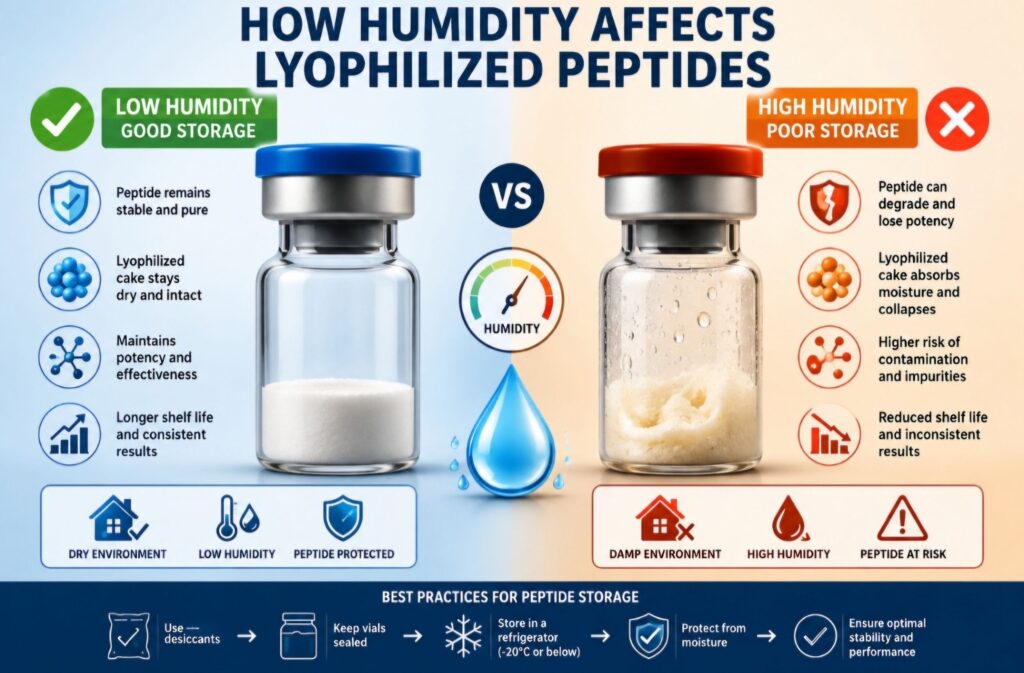
Lyophilization removes water from peptides through a freeze-drying process. The resulting dry powder is significantly more stable than a liquid solution.
However, lyophilized does not mean indestructible.
When moisture enters a peptide vial, several destructive processes can begin almost immediately:
• Hydrolytic cleavage of peptide bonds
• Peptide aggregation
• Oxidation reactions
• Reduced solubility
• Loss of biological activity
• Lower analytical purity
Even brief exposure to humid air can initiate degradation that becomes evident weeks or months later.
Why Lyophilized Peptides Are Vulnerable to Moisture
Lyophilized peptides are designed to remain stable in an extremely dry environment.
Many peptide molecules naturally attract water from their surroundings. This characteristic makes them highly susceptible to atmospheric humidity.
The risk increases significantly in tropical and humid regions where environmental moisture levels remain elevated throughout the year.
Moisture exposure becomes particularly dangerous when peptides are repeatedly removed from cold storage and opened before reaching room temperature.
Hydrolytic Cleavage: How Humidity Affects Lyophilized Peptides at the Molecular Level
https://peptideaminonation.com/blog/
Hydrolytic cleavage is one of the most damaging consequences of humidity exposure.
Water molecules attack the amide bonds that hold amino acids together within the peptide chain.
Over time, these attacks can break the peptide backbone and generate smaller fragments.
What Happens During Hydrolysis?
The process involves:
1. Moisture entering the vial.
2. Water molecules interacting with peptide bonds.
3. Bond cleavage occurring over time.
4. Formation of degraded peptide fragments.
This degradation often appears in HPLC analysis as additional peaks surrounding the primary peptide peak.
Researchers may notice:
• Reduced purity
• Lower assay performance
• Inconsistent results
• Shortened peptide half-life
How Humidity Affects Lyophilized Peptides Through Aggregation
Humidity does not always destroy peptides through hydrolysis alone.
Many peptides undergo aggregation when exposed to moisture.
Aggregation occurs when partially hydrated peptide molecules begin sticking together.
Why Aggregation Is Dangerous
Aggregated peptides often become:
• Difficult to dissolve
• Less biologically active
• Structurally altered
• It is impossible to accurately quantify
Long-chain and hydrophobic peptides are especially vulnerable.
Once aggregation occurs, even aggressive sonication may fail to fully restore solubility
Which Peptides Are Most Sensitive to Humidity?
While all peptides benefit from proper storage, some categories are exceptionally moisture-sensitive.
Long-Chain Hydrophobic Peptides
These peptides readily aggregate when moisture enters the vial.
Examples include certain GLP-1 receptor agonists and complex research peptides.
Highly Charged Peptides
Peptides rich in:
• Arginine
• Lysine
• Histidine
can rapidly absorb atmospheric moisture.
In humid environments, these peptides may transition from a dry powder to a sticky or syrup-like material within minutes.
Unprotected Synthetic Peptides
Peptides lacking:
• N-terminal acetylation
• C-terminal amidation
often show increased susceptibility to terminal degradation after moisture exposure.
Signs That Humidity Has Damaged Your Lyophilized Peptides
https://peptideaminonation.com/peptide-dosing-molar-concentration-mg-to-mm/
Clumping or Hard Pellet Formation
A healthy lyophilized peptide typically appears as follows:
• A fluffy cake
• Fine powder
• Uniform dry material
A dense pellet or glass-like shard often indicates moisture exposure.
Yellowing or Discoloration
Most lyophilized peptides should remain white.
Unexpected yellowing may indicate:
• Oxidation
• Hydrolysis
• Chemical degradation
Incomplete Reconstitution
One of the clearest warning signs is poor reconstitution.
• Indicators include:
• Floating particles
• Cloudiness
• Gel-like masses
• Persistent insoluble material
Case Study: How Humidity Affects Lyophilized Peptides — The “Ghost Peak” Incident
One memorable case involved a research team working with a GLP-1 receptor agonist peptide.
Two laboratories received aliquots from the same batch.
Lab A
• Vacuum-sealed storage
• Desiccated environment
• Manual-defrost -80°C freezer
Lab B
• Frost-free convenience freezer
• Frequent temperature cycling
• Minimal humidity protection
The Result
Lab B reported reduced peptide potency and required approximately 15% higher dosing.
HPLC analysis revealed:
• Lab A purity: 98.5%
• Lab B purity: 92%
A noticeable secondary peak appeared beside the main peak.
The culprit was gradual moisture exposure caused by repeated condensation cycles within the frost-free freezer.
This additional peak became known internally as the “ghost peak.”
Case Study: Calcitonin Hydrolytic Breakdown
Another example involved calcitonin samples.
Researchers routinely removed frozen vials and opened them immediately upon removal from storage.
The Mistake
The cold vial attracted atmospheric moisture through condensation.
Water droplets formed directly on the lyophilized peptide.
Analytical Findings
HPLC analysis later revealed:
• Hydrolysis products
• Secondary peaks
• Reduced potency
The handling procedure was ultimately redesigned to require room-temperature equilibration before opening.
Common Storage Mistakes That Invite Humidity Damage
https://peptideaminonation.com/peptide-reconstitution-guide/
Leaving Vials Open Too Long
Even brief exposure to humid laboratory air can be damaging.
Frequent Freeze-Thaw Cycles
Repeated temperature fluctuations promote condensation.
Storing Peptides Without Desiccants
Many users underestimate the importance of moisture control.
Poor Shipping Conditions
Inadequate packaging can expose peptides to humidity during transit.
Professional Storage Recommendations for Lyophilized Peptides
Temperature Control
Recommended storage conditions:
• Short-term: -20°C
• Long-term: -80°C
Humidity Control
Maintain relative humidity below 10%.
Light Protection
Store peptides in:
• Amber vials
• Foil-wrapped containers
Inert Gas Protection
When possible, use:
• Argon
• Nitrogen
to reduce oxygen and moisture exposure.
Secondary Containment
Store peptide vials inside:
• Airtight containers
• Gasket-sealed storage boxes
• Desiccant-equipped chambers
This additional barrier significantly improves long-term stability.
The Biggest Myth About How Humidity Affects Lyophilized Peptides
Many users believe a standard vial cap creates an airtight seal.
This assumption is dangerously incorrect.
Plastic materials slowly allow water vapor to pass through them.
Cap threads are also not perfectly airtight.
Over time, moisture can migrate into the vial even when the cap appears securely closed.
In humid environments, this process accelerates substantially.
How Experts Protect Lyophilized Peptides from Humidity
Professional laboratories rarely rely on a single storage barrier.
Instead, they employ a layered protection strategy.
The Double-Wall Method
1. Primary peptide vial
2. Secondary airtight container
3. Desiccant packs
4. Controlled cold storage
The Gas Blanket Method
Many advanced laboratories flush peptide vials with:
• Argon
• Nitrogen
before sealing.
This minimizes oxygen exposure while reducing moisture-related degradation.
Frequently Asked Questions
Can humidity ruin lyophilized peptides?
Yes. Humidity can cause hydrolysis, aggregation, oxidation, and reduced peptide activity.
How quickly can moisture damage occur?
Damage may begin within minutes of exposure, although measurable degradation often appears over days or weeks.
What humidity level is considered safe?
Most laboratories aim for less than 10% relative humidity when handling sensitive lyophilized peptides.
Is refrigeration enough?
No. Refrigeration without desiccants and proper containment may still allow moisture-related degradation.
Why should frozen vials reach room temperature before opening?
This prevents condensation from forming directly on the peptide when exposed to humid air.
Conclusion
How Humidity Affects Lyophilized Peptides is a subject that deserves far more attention than it typically receives. Moisture exposure can trigger hydrolysis, aggregation, oxidation, reduced purity, and loss of biological activity long before visible signs appear.
Through decades of peptide handling experience, one lesson remains consistent: most peptide failures attributed to manufacturing defects are actually storage and handling failures.
By controlling humidity, maintaining proper cold-chain procedures, using desiccants, and adopting professional storage practices, researchers can dramatically improve peptide stability, preserve purity, and protect valuable experimental outcomes.

Popular Comments
7 Essential Peptide Volume And Concentration Secrets For Accurate Research Results
[…] Human Error During Reconstitutionhttps://peptideaminonation.com/how-humidity-affects-lyophilized-peptides/ […]
Common Storage Mistakes That Reduce Peptide Quality: 7 Powerful Errors That Can Destroy Peptide Integrity
[…] Common Storage Mistakes That Reduce Peptide Quality https://peptideaminonation.com/how-humidity-affects-lyophilized-peptides/ […]