Why Different Peptides Have Different Shelf Lives

If you’ve ever wondered why different peptides have different shelf lives, you’re not alone. One of the most common misconceptions among peptide buyers and beginners is assuming that all peptides degrade at the same rate. In reality, peptide shelf life is determined by a combination of amino acid sequence, molecular structure, storage conditions, lyophilization quality, packaging, and reconstitution methods.
After more than 20 years of working with research peptides, reviewing HPLC reports, evaluating Certificates of Analysis (CoAs), and helping customers troubleshoot storage problems, I have learned one important lesson:
Shelf life is determined by peptide chemistry, not just expiration dates.
Two peptides stored side-by-side in the same freezer can age completely differently.
This guide explains exactly why different peptides have different shelf lives and how researchers can maximize peptide stability while avoiding costly mistakes.
Understand Why Different Peptides Have Different Shelf Lives below
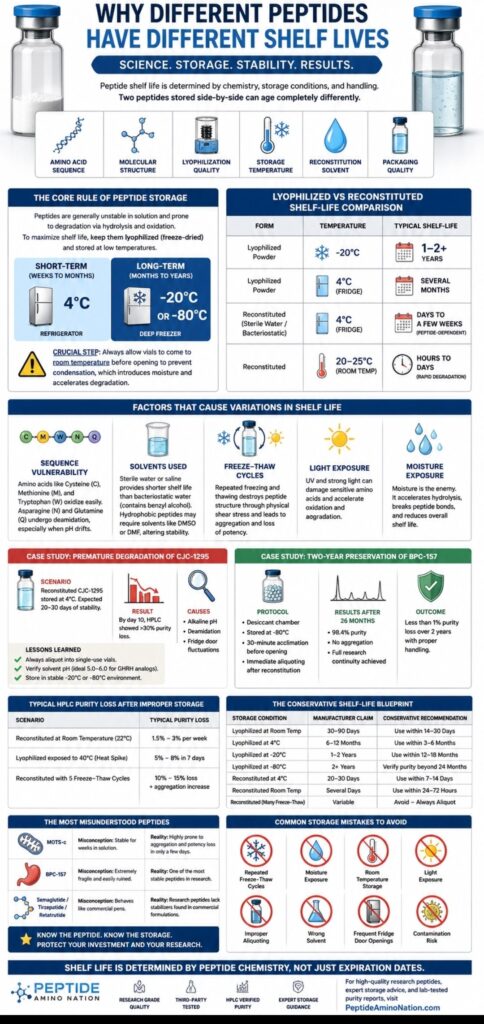
Table of Contents
1. Why Different Peptides Have Different Shelf Lives
2. The Core Rule of Peptide Storage
3. Lyophilized vs. Reconstituted Peptides
4. The Science Behind Peptide Stability
5. The 6 Major Factors That Affect Peptide Shelf Life
6. Case Study: Premature Degradation of CJC-1295
7. Case Study: Two-Year Preservation of BPC-157
8. The Most Misunderstood Peptides
9. Individual Peptide Stability Analysis
10. Conservative Shelf-Life Recommendations
11. Common Storage Mistakes
12. Frequently Asked Questions
13. Final Thoughts
Why Different Peptides Have Different Shelf Lives https://pubmed.ncbi.nlm.nih.gov/
The reason why different peptides have different shelf lives comes down to chemistry.
Every peptide contains a unique amino acid sequence. Some amino acids are naturally stable, while others are highly vulnerable to oxidation, hydrolysis, deamidation, and aggregation.
For example:
• Methionine is highly susceptible to oxidation.
• Cysteine can form unwanted disulfide bonds.
• Asparagine is vulnerable to deamidation.
• Glutamine can degrade under unfavorable pH conditions.
As a result, peptide stability varies significantly even under identical storage conditions.
The Core Rule of Peptide Storage
https://peptideaminonation.com/blog/
The golden rule is simple:
Store peptides as lyophilized powder whenever possible.
Peptides are naturally unstable in solution.
When stored as a freeze-dried powder and protected from moisture, oxygen, heat, and light, degradation slows dramatically.
Recommended Storage Conditions
| Form | Temperature | Typical Shelf Life |
| Lyophilized Powder | -20°C | 1–2+ Years |
| Lyophilized Powder | 4°C | Several Months |
| Reconstituted Peptide | 4°C | Days to Weeks |
| Reconstituted Peptide | Room Temperature | Hours to Days |
One critical step many researchers overlook is allowing frozen peptide vials to reach room temperature before opening.
Opening a cold vial immediately introduces condensation, which accelerates peptide degradation.
Lyophilized vs. Reconstituted Peptides
https://peptideaminonation.com/peptide-reconstitution-guide/
One of the biggest reasons why different peptides have different shelf lives is the dramatic difference between dry and liquid states.
Lyophilized peptides remain chemically dormant.
Once reconstituted, hydrolysis begins immediately.
This explains why a peptide that remains stable for years as a powder may only remain viable for days or weeks after reconstitution.
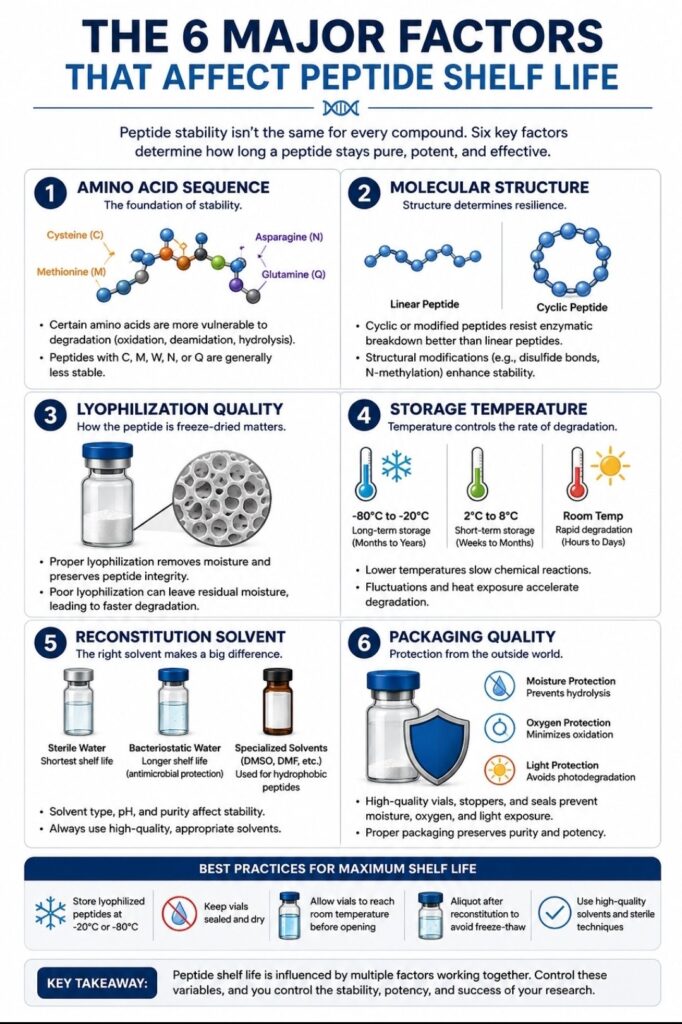
The 6 Major Factors That Affect Peptide Shelf Life
1. Amino Acid Sequence
A peptide’s amino acid composition is its most important stability factor.
Peptides containing methionine, cysteine, Asparagine, or Glutamine often degrade much faster than peptides lacking these vulnerable residues.
2. Molecular Structure
Linear peptides are generally less stable than cyclic peptides.
Structural reinforcement often improves resistance to degradation.
3. Lyophilization Quality
Poor freeze-drying leaves residual moisture.
Residual moisture accelerates hydrolysis and oxidation.
4. Storage Temperature
https://peptideaminonation.com/why-impurities-form-during-peptide-synthesis/
Temperature directly impacts reaction rates.
Lower temperatures dramatically slow degradation.
5. Reconstitution Solvent
Sterile water provides a shorter shelf life.
Bacteriostatic water often improves storage stability due to antimicrobial protection.
6. Packaging Quality
Inferior vial seals allow oxygen and moisture ingress.
Premium packaging significantly extends peptide shelf life.
Case Study: Premature Degradation of CJC-1295
A research laboratory reconstituted CJC-1295 without DAC and stored it in a refrigerator at 4°C.
They expected 20–30 days of stability.
By Day 10, HPLC analysis showed more than 30% purity loss.
What Went Wrong?
Several factors contributed:
• Slightly alkaline bacteriostatic water
• Accelerated deamidation
• Frequent refrigerator door openings
• Continuous micro-temperature fluctuations
Lesson Learned
The laboratory implemented:
• Immediate aliquoting
• pH verification
• Dedicated freezer storage
• Single-use handling protocols
These changes dramatically improved stability outcomes.
Case Study: Two-Year Preservation of BPC-157
A biotechnology laboratory needed long-term storage of a 99% pure BPC-157 batch.
Their goal was maintaining consistent material for a 24-month study.
Storage Protocol
• Secondary containment jars
• Silica gel desiccants
• Ultra-low temperature storage at -80°C
• Strict acclimation procedures
• Immediate aliquoting after reconstitution
Results
After 26 months:
• Initial Purity: 99%
• Final Purity: 98.4%
• No aggregation detected
• Full research continuity maintained
This demonstrates how proper storage can dramatically extend peptide shelf life.
The Most Misunderstood Peptides
MOTS-c
Many researchers mistakenly assume MOTS-c behaves like BPC-157.
It does not.
MOTS-c is highly prone to aggregation and potency loss in solution.
BPC-157
BPC-157 is frequently considered fragile.
Actual laboratory data suggests it is among the most stable research peptides available.
Semaglutide, Tirzepatide, and Retatrutide
Commercial formulations contain stabilizers.
Research-grade versions often do not.
This creates major differences in real-world shelf life.
Peptide Stability Comparison
| Peptide | Stability Rating | Storage Difficulty |
| BPC-157 | Excellent | Easy |
| Ipamorelin | Very Good | Easy |
| TB-500 | Good | Moderate |
| Semaglutide | Good | Moderate |
| Tirzepatide | Good | Moderate |
| Retatrutide | Moderate | Moderate-High |
| Tesamorelin | Moderate | High |
| CJC-1295 | Fragile | High |
| MOTS-c | Very Fragile | Very High |
| PT-141 | Very Fragile | Very High |
Common Storage Mistakes
https://peptideaminonation.com/how-humidity-affects-lyophilized-peptides/
The most common causes of peptide degradation include:
• Repeated freeze-thaw cycles
• Moisture exposure
• Room-temperature storage
• Direct light exposure
• Poor-quality solvents
• Improper aliquoting
• Frequent refrigerator access
Avoiding these mistakes can dramatically improve peptide stability.
Frequently Asked Questions
Why do different peptides have different shelf lives?
https://peptideaminonation.com/peptide-formulation-challenges/
Every peptide has a unique amino acid sequence and molecular structure that affects its susceptibility to degradation.
Does refrigeration stop peptide degradation?
https://peptideaminonation.com/how-humidity-affects-lyophilized-peptides/
No. Refrigeration slows degradation but does not stop it completely.
Is lyophilized powder always more stable?
Yes. Lyophilized peptides generally remain stable far longer than reconstituted peptides.
Which peptide is most stable?
BPC-157 consistently ranks among the most stable research peptides.
Which peptide is most fragile?
https://peptideaminonation.com/shop/
MOTS-c and CJC-1295 are among the most storage-sensitive peptides.
Final Thoughts
https://peptideaminonation.com
Understanding why different peptides have different shelf lives can save researchers significant time, money, and frustration.
The reality is simple:
Storage practices often matter more than the peptide itself.
Temperature control, moisture prevention, proper aliquoting, solvent selection, and careful handling can dramatically improve peptide longevity.
At peptideaminonation.com we continually educate researchers on peptide stability, storage, HPLC interpretation, and quality verification so they can make informed decisions and protect the integrity of their research compounds.
Remember:
Two peptides stored side-by-side can age completely differently.
Understanding the science behind peptide stability is the key to protecting purity, potency, and research results.
NOTE;
Different peptides do not behave the same under storage conditions, which is why stability can vary significantly. Why different peptides have different shelf lives is mainly influenced by their structure, formulation, and storage environment. In practice, why different peptides have different shelf lives comes down to how each molecule reacts to temperature, moisture, and oxidation over time. Understanding this is essential, because why different peptides have different shelf lives ultimately determines how effectively each compound maintains its potency and research value during storage.
