Peptide Volume and Concentration: The Complete Guide to Accurate Research Preparation

Peptide Volume and Concentration are among the most important factors affecting research peptide preparation, solution accuracy, and experimental reproducibility. Whether you are working with BPC-157, TB-500, CJC-1295, Ipamorelin, or Retatrutide, understanding how volume influences concentration can mean the difference between reliable data and misleading results.
Many researchers focus exclusively on peptide quantity while overlooking critical variables such as purity correction, dilution accuracy, adsorption losses, syringe measurement errors, and peptide degradation. These seemingly minor factors can create significant discrepancies in concentration and ultimately affect experimental outcomes.
Having worked extensively with peptide preparation protocols since 2003, I’ve seen firsthand how small calculation mistakes can quietly compromise entire research projects. In this guide, we’ll examine the relationship between peptide volume and concentration, explore real-world case studies, and discuss practical strategies used by experienced researchers to achieve consistent and reproducible results.
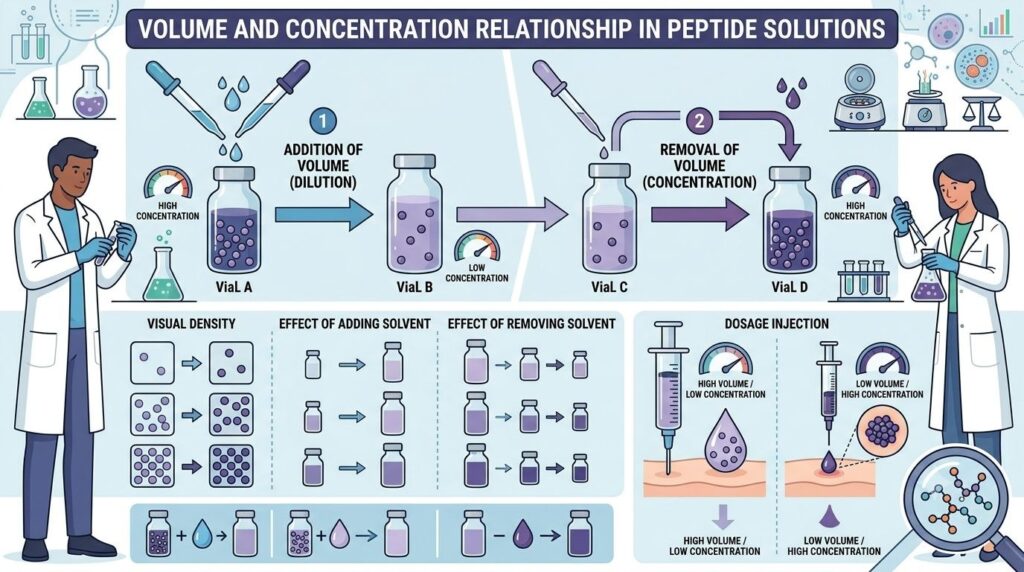
Table of Contents
1. What Is Peptide Volume and Concentration?
2. Why Peptide Volume and Concentration Matter
3. The Fundamental Concentration Formula
4. Beginner-Friendly Calculation Examples
5. Intermediate Peptide Concentration Calculations
6. Advanced Concentration Considerations
7. Common Errors That Affect Peptide Volume and Concentration
8. Real-World Case Study: When Verification Prevented Failure
9. Hidden Factors Most Researchers Ignore
10. Best Practices for Accurate Peptide Preparation
11. Frequently Asked Questions
12. Final Thoughts
What Is Peptide Volume and Concentration?
Peptide Volume and Concentration describe the relationship between the amount of peptide present and the volume of liquid used to dissolve it.
In simple terms:
• Volume = Amount of liquid added
• Concentration = Amount of peptide per unit volume
As volume increases, concentration decreases.
As volume decreases, concentration increases.
Understanding this relationship is fundamental to preparing solutions accurately and maintaining consistency across experiments
Why Peptide Volume and Concentration Matter
Every research peptide solution is ultimately defined by its concentration.
An inaccurate concentration can result in:
• Inconsistent experimental outcomes
• Failed reproducibility
• Misinterpreted biological responses
• Wasted reagents
• Incorrect dosing calculations
Even small concentration errors may create subtle data distortions that become apparent only after multiple experiments have been completed.
For this reason, experienced researchers treat concentration calculations as seriously as any other laboratory procedure.
The Fundamental Peptide Volume and Concentration Formula
https://pubmed.ncbi.nlm.nih.gov/
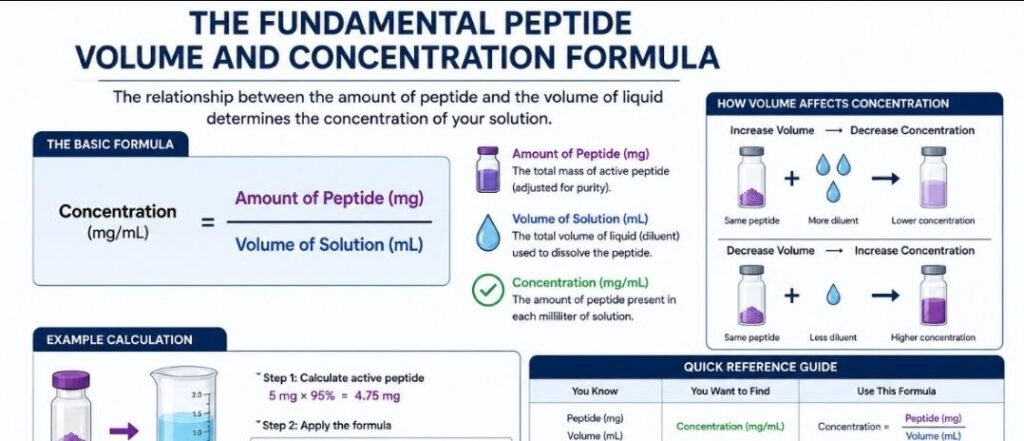
The basic formula is straightforward:
Concentration = Amount of Peptide ÷ Volume of Solution
Example:
• Peptide amount = 5 mg
• Diluent volume = 2 mL
Calculation:
5 mg ÷ 2 mL = 2.5 mg/mL
The resulting concentration is:
2.5 mg/mL
This value becomes the foundation for all subsequent measurements.
Beginner-Friendly Calculation Examples
Example 1: BPC-157
Suppose you have:
• 5 mg BPC-157
• 2 mL bacteriostatic water
Calculation:
5 mg ÷ 2 mL = 2.5 mg/mL
Every milliliter contains:
2.5 mg of BPC-157
Example 2: TB-500
Suppose you have:
• 10 mg TB-500
•4 mL diluent
Calculation:
10 mg ÷ 4 mL = 2.5 mg/mL
Again, concentration equals:
2.5 mg/mL
Notice how concentration depends on both peptide quantity and volume.
Intermediate Peptide Volume and Concentration Calculations
Converting Milligrams to Micrograms
Many researchers work in micrograms.
Remember:
1 mg = 1,000 mcg
Example:
5 mg peptide dissolved in 2 mL
Concentration:
2.5 mg/mL
Converted:
2.5 × 1,000
= 2,500 mcg/mL
This means:
0.1 mL = 250 mcg
0.2 mL = 500 mcg
0.4 mL = 1,000 mcg
Understanding these conversions improves measurement precision.
Advanced Peptide Volume and Concentration Considerations
Molarity Calculations
Advanced research often requires molar concentration rather than simple mass concentration.
Formula:
M = Mass ÷ (Molecular Weight × Volume)
Where:
M = Molarity
Mass = Peptide amount
Molecular Weight = Peptide molecular weight
Volume = Solution volume
This approach is especially useful when comparing biological activity between different peptides.
Accounting for Counter-Ions
One commonly overlooked issue involves peptide salt forms.
Many peptides contain:
• TFA salts
• Acetate salts
These contribute additional molecular weight.
Ignoring counter-ion content can produce concentration errors significant enough to affect experimental interpretation.
Common Errors That Affect Peptide Volume and Concentration
The following mistakes are among the most common causes of concentration inaccuracies.
Table
– Purity Neglect
Using total vial weight rather than active peptide content.
Produces a solution more dilute than intended and can create persistent data bias.
Volume Misreading
Confusing measurement units or misreading syringe markings.
May result in severe over- or under-concentration.
Surface Adsorption
Peptide molecules adhere to glass or plastic surfaces.
Final concentration becomes lower than calculated.
Degradation
Exposure to improper temperatures or excessive handling.
Biological activity decreases despite peptide presence.
Common Errors That Affect Peptide Volume and Concentration
The following mistakes are among the most common causes of concentration inaccuracies.
| Table | Description | Consequences |
| Purity Neglect | Using total vial weight rather than active peptide content. | Produces a solution more dilute than intended and can create persistent data bias. |
| Volume Misreading | Confusing measurement units or misreading syringe markings. | May result in severe over- or under-concentration. |
| Surface Adoption | Peptide molecules adhere to glass or plastic surfaces. | Final concentration becomes lower than calculated. |
| Degradation | Exposure to improper temperatures or excessive handling. | Biological activity decreases despite peptide presence. |
Real-World Case Study: When Verification Prevented Failure
The Situation
A researcher prepared a stock solution for a sensitive cell assay.
The primary concentration calculation was performed manually and appeared correct.
However, the resulting biological response curves differed significantly from expected outcomes.
The Discovery
After extensive troubleshooting, investigators discovered that the molecular weight calculation failed to account for counter-ion content associated with the peptide.
The calculation assumed pure peptide mass without considering the contribution of the peptide’s salt form.
The Consequence
The actual molarity was approximately:
15% lower than expected
This shifted the dose-response curve enough to create false-negative findings.
How the Problem Was Identified
Researchers eventually traced the issue through:
• Inconsistent experimental trends
• Failed reproducibility studies
• Independent calculation verification
• HPLC analysis
• Mass spectrometry verification
Hidden Factors Most Researchers Ignore
Dead Space Loss
Every syringe contains a small dead-space volume.
Some peptide solution remains trapped and never reaches the final container.
Over multiple preparations, these losses can become significant.
Surface Adsorption
Certain peptides naturally bind to container surfaces.
This phenomenon is often invisible but can substantially lower effective concentration.
Low-binding laboratory tubes help minimize these losses.
Human Error During Reconstitution
https://peptideaminonation.com/how-humidity-affects-lyophilized-peptides/
Even experienced researchers occasionally:
• Misread syringe markings
• Use inconsistent units
• Skip verification steps
• Record measurements incorrectly
Standardized workflows dramatically reduce these risks.
Best Practices for Accurate Peptide Volume and Concentration
Verify Purity Before Calculating
Never assume:
• 5 mg vial = 5 mg active peptide
Always check the Certificate of Analysis (CoA).
Standardize Units
Avoid switching between:
• mg
• mcg
• mL
• μL
without verification.
Consistency prevents calculation errors.
Use Low-Binding Tubes
Low-binding tubes reduce peptide adsorption and improve concentration accuracy.
Verify Critical Calculations
Always perform:
• Manual calculation
• Independent verification
• Calculator confirmation
before preparing valuable solutions.
Prepare Single-Use Aliquots
Repeated freeze-thaw cycles accelerate degradation.
Aliquoting immediately after preparation helps preserve peptide integrity and concentration consistency.
Frequently Asked Questions
Does adding more volume reduce peptide concentration?
https://peptideaminonation.com/peptide-reconstitution-guide/
Yes. Increasing volume while keeping peptide quantity constant lowers concentration.
Why is peptide concentration important?
Concentration determines the amount of peptide present in a given volume and directly influences experimental consistency.
Can purity affect peptide concentration?
Absolutely. A peptide with 95% purity contains less active peptide than a peptide with 99% purity, requiring adjusted calculations.
Should researchers verify concentration calculations?
https://peptideaminonation.com/peptide-dosing-molar-concentration-mg-to-mm/
Yes. Independent verification helps identify calculation mistakes before they affect experimental outcomes.
Final Thoughts
Peptide Volume and Concentration are the foundation of accurate peptide preparation. While the basic calculations appear simple, experienced researchers understand that purity corrections, counter-ion content, adsorption losses, degradation, and human error can all influence the final concentration.
The most successful laboratories do not rely solely on theoretical calculations. They verify measurements, standardize workflows, review Certificates of Analysis, and implement procedures that minimize preventable errors.
By understanding the true relationship between peptide volume and concentration, researchers can improve reproducibility, increase confidence in their data, and avoid many of the hidden pitfalls that compromise experimental results. Learn more from peptideaminonation.com
