Description
Product Overview
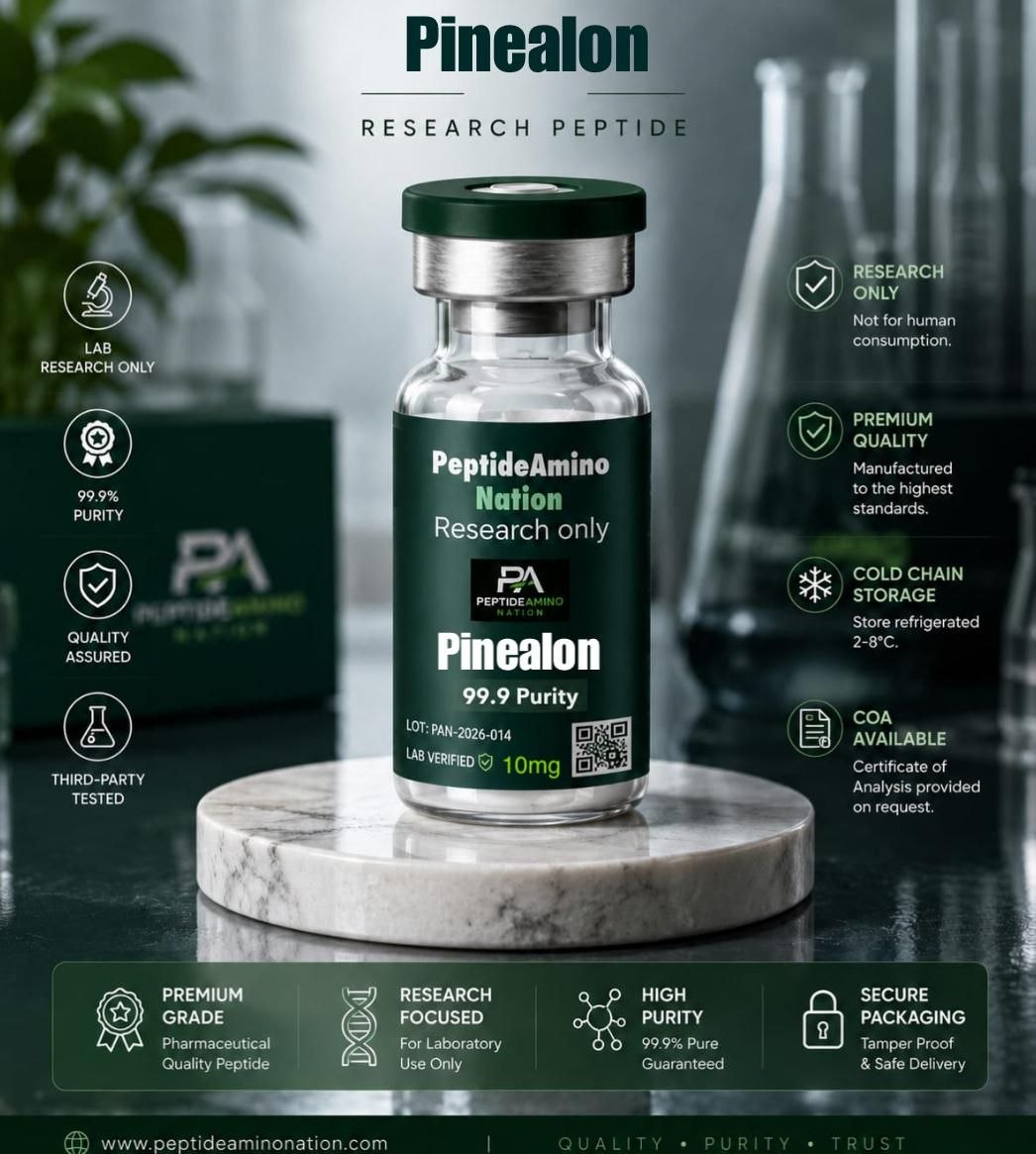
Pinealon Peptide is a premium-quality synthetic tripeptide consisting of the amino acid sequence Glutamic Acid–Aspartic Acid–Arginine (Glu-Asp-Arg or EDR). Developed through advanced peptide synthesis technologies, Pinealon has become an important research compound within neuroscience, gerontology, molecular biology, and cellular aging studies.
Recognized as one of the well-known ultra-short Khavinson bioregulator peptides, Pinealon has attracted scientific interest because of its potential interactions with genetic regulatory mechanisms involved in neuronal survival, oxidative stress response, protein synthesis, and cellular metabolism. Unlike larger peptide molecules, Pinealon’s compact tripeptide structure allows researchers to investigate how small signaling peptides may influence intracellular pathways involved in aging and neurological function.
Our Pinealon Peptide is manufactured exclusively for scientific investigation using advanced solid-phase peptide synthesis followed by rigorous purification using High-Performance Liquid Chromatography (HPLC). Every production batch undergoes extensive analytical verification through Mass Spectrometry (MS) and HPLC testing to confirm identity, purity, consistency, and molecular integrity.
This product is supplied as a sterile, lyophilized white powder designed to provide exceptional stability during storage and reliable reproducibility across laboratory experiments.
Research Profile
Molecular Formula
C₁₅H₂₆N₆O₈
Molecular Weight
418.4 g/mol
Amino Acid Sequence
Glu-Asp-Arg (EDR)
CAS Number
934335-51-6
Purity
≥98% (HPLC Verified)
Appearance
White Lyophilized Powder
Source
Chemical Synthesis
Research Classification
Research Grade Peptide
What Is Pinealon Peptide?
Pinealon belongs to the family of ultra-short regulatory peptides originally developed through gerontological peptide research. These peptides are believed to participate in intracellular signaling processes that regulate gene expression and cellular communication.
Its simple three-amino-acid structure makes Pinealon particularly attractive for molecular biology research because researchers can investigate peptide-DNA interactions without the structural complexity found in larger proteins.
Experimental investigations suggest that Pinealon may influence several biological pathways associated with neuronal function, oxidative stress defense, mitochondrial activity, and age-related cellular regulation. Laboratory studies have also explored its potential role in modifying transcriptional activity within neurons exposed to oxidative injury or hypoxic conditions.
Although these findings continue to generate scientific interest, Pinealon remains strictly a research compound and is supplied exclusively for laboratory investigation.
Research Grade Notice
Important Notice
This product is supplied exclusively as a Research Grade Peptide.
Pinealon is intended solely for:
● Laboratory research
● Scientific investigations
● Molecular biology studies
● Cell culture experiments
● In vitro research
● In vivo laboratory studies
This product is NOT approved for human consumption, therapeutic use, diagnostic applications, veterinary use, or clinical treatment.
Researchers are responsible for ensuring compliance with all local regulations governing laboratory chemicals and research materials.
Scientific Interest in Pinealon Peptide
Growing scientific literature has identified multiple areas where Pinealon continues to be investigated in experimental models.
Neuroprotection Research
One of the most active research areas focuses on neuronal protection against oxidative injury.
Laboratory investigations have explored whether Pinealon influences molecular pathways associated with neuronal survival during oxidative stress, ischemic injury, and aging. Researchers continue examining its relationship with apoptotic signaling proteins, mitochondrial stability, and cellular repair mechanisms.
These investigations may provide valuable insight into the biological regulation of neuronal resilience under experimentally induced stress conditions.
Oxidative Stress Research
Oxidative damage remains one of the primary contributors to cellular aging.
Experimental studies continue evaluating Pinealon’s influence on oxidative stress biomarkers including reactive oxygen species (ROS), antioxidant enzyme expression, and mitochondrial function.
Scientists are interested in determining whether the peptide assists cellular defense mechanisms during periods of elevated oxidative challenge.
Gene Expression Studies
One distinguishing feature of Khavinson peptides is their proposed interaction with genetic regulatory regions.
Research models suggest Pinealon may bind selectively to DNA sequences involved in regulating protein synthesis and cellular metabolism.
Scientists continue investigating whether these interactions contribute to altered expression of genes involved in:
● Cellular repair
● Stress adaptation
● DNA maintenance
● Protein synthesis
● Neuronal metabolism
● Cell survival pathways
Understanding these mechanisms remains an important objective within peptide biology research.
Circadian Rhythm Research
Another promising field involves Pinealon’s potential relationship with circadian biology.
Preclinical investigations have evaluated how Pinealon may influence the pineal gland and biological timing mechanisms under laboratory conditions.
Researchers continue studying possible interactions with melatonin-related pathways in aging models and experimentally disrupted circadian systems.
Cellular Aging Research
Pinealon has become increasingly relevant in gerontology research due to its association with cellular longevity pathways.
Experimental investigations explore how ultra-short peptides may affect:
● DNA stability
● Protein synthesis
● Cellular repair
● Age-related oxidative damage
● Tissue regeneration
● Cellular communication
These studies contribute to the broader understanding of biological aging processes.
Cognitive Function Research
Various experimental models have explored Pinealon in studies involving cognitive decline and neurological recovery.
Researchers continue investigating molecular pathways associated with:
● Synaptic function
● Learning models
● Memory-associated proteins
● Neuronal plasticity
● Neurodegenerative mechanisms
Current evidence remains limited to laboratory research and should not be interpreted as demonstrating therapeutic effects.
Why Researchers Choose Our Pinealon Peptide
Selecting a high-quality research peptide is essential for generating reproducible scientific data.
Our Pinealon Peptide is manufactured under strict quality assurance procedures designed to provide researchers with exceptional product consistency.
Every production batch is carefully synthesized using advanced peptide chemistry before undergoing extensive purification and analytical validation.
Researchers benefit from:
● ≥98% HPLC-verified purity
● High batch-to-batch consistency
● Advanced peptide synthesis technology
● Comprehensive quality control
● MS identity confirmation
● Reliable laboratory performance
● Excellent peptide stability
● Secure packaging for research laboratories
● Low impurity profile
● Consistent experimental reproducibility
Technical Specifications
Physical Appearance
Pinealon is supplied as a white to off-white lyophilized powder or compact peptide cake. The freeze-dried format improves long-term stability while minimizing degradation during storage and transportation.
Solubility
The peptide demonstrates excellent solubility under standard laboratory conditions and readily dissolves in sterile laboratory-grade solvents, including sterile water, bacteriostatic water, and phosphate-buffered saline (PBS). Researchers should always prepare solutions using validated laboratory protocols appropriate for their experimental design.
Storage Conditions
For maximum stability, unopened lyophilized Pinealon may remain stable at room temperature for short shipping periods of up to approximately 90 days. Long-term storage is recommended between −20°C and −80°C to preserve peptide integrity.
After reconstitution, the solution should be refrigerated at 2°C to 8°C and used within 7–14 days, depending on laboratory handling practices and experimental requirements. Avoid repeated freeze-thaw cycles, as these may reduce peptide stability.
Quality Control and Analytical Testing
Every batch undergoes comprehensive quality assessment using industry-standard analytical methods. High-Performance Liquid Chromatography (HPLC) verifies peptide purity at 98% or greater, while Mass Spectrometry (MS) confirms molecular identity and structural accuracy. These testing procedures help ensure consistency and reproducibility for scientific research.
Manufacturing Source
Pinealon is produced through advanced chemical synthesis using modern solid-phase peptide synthesis techniques under strict quality control standards. The manufacturing process is designed to deliver a highly pure research peptide suitable for molecular biology, neuroscience, and laboratory investigations.
Packaging
Our Pinealon Peptide is carefully packaged to preserve product integrity throughout storage and transportation. Each vial is sealed under controlled laboratory conditions to minimize moisture exposure and maintain the stability of the lyophilized peptide until use in research settings.
Quality Commitment
Every vial of Pinealon Peptide supplied by Peptide Amino Nation is manufactured with a commitment to scientific excellence, product consistency, and analytical accuracy. Our quality assurance process emphasizes purity, stability, and reliability, helping researchers obtain dependable materials for demanding experimental applications.
Frequently Asked Questions (FAQs)
What is Pinealon Peptide?
Pinealon is a synthetic tripeptide (Glu-Asp-Arg) belonging to the Khavinson bioregulator peptide family and is primarily investigated in neuroscience, aging, and molecular biology research.
What purity does this Pinealon Peptide have?
Each batch is verified to have a minimum purity of 98% using High-Performance Liquid Chromatography (HPLC).
How should Pinealon be stored?
Store the lyophilized peptide at −20°C to −80°C for long-term preservation. Once reconstituted, refrigerate at 2°C to 8°C and use within 7–14 days.
What laboratory applications is Pinealon commonly researched for?
Researchers investigate Pinealon in studies related to neuroprotection, oxidative stress, gene regulation, circadian rhythm biology, cellular aging, and molecular neuroscience.
Is Pinealon approved for human use?
No. Pinealon is supplied strictly as a Research Grade Peptide and is not approved for human consumption, therapeutic use, or clinical applications.
Reviews
There are no reviews yet.