Description
Why Researchers Choose Cortexin Peptide
Cortexin Peptide is widely recognized for its broad research potential across numerous neurological applications. Unlike many synthetic peptides that target a single receptor, Cortexin provides multiple biologically active peptide fractions capable of influencing several neurobiological pathways simultaneously.
Researchers value Cortexin because it may help investigate:
• Neuroprotective cellular responses
• Neuronal repair mechanisms
• Synaptic plasticity
• Memory and learning pathways
• Oxidative stress reduction
• Cerebral metabolism
• Recovery following ischemic injury
• Experimental traumatic brain injury models
• Neurodegenerative disease mechanisms
• Brain aging research
Its broad spectrum of biological activity makes Cortexin Peptide an attractive research compound for modern neuroscience laboratories.
Research Profile
Primary Research Focus
• Neuroprotection
• Neurogenesis
• Cognitive enhancement research
• Brain metabolism
• Synaptic plasticity
• Cellular repair
Proposed Research Mechanisms
Experimental studies suggest Cortexin Peptide may influence:
• Blood-brain barrier (BBB) penetration
• Neurotransmitter regulation
• GABA signaling
• Glutamate modulation
• Neurotrophic factor production
• Antioxidant defense pathways
• Intracellular protein synthesis
• Energy metabolism
Target Systems
• Central Nervous System (CNS)
• Cerebral cortex
• Hippocampus
• Cortical neurons
• Glial cells
Common Laboratory Research Areas
• Memory retention studies
• Learning behavior models
• Stroke recovery research
• Cerebral ischemia
• Oxidative stress investigations
• Neurodegenerative disease models
• Traumatic brain injury research
What Makes Cortexin Peptide Unique?
Unlike conventional synthetic peptides, Cortexin Peptide consists of multiple biologically active peptide fractions with relatively low molecular weights.
These naturally derived peptides work collectively to regulate neuronal signaling pathways involved in adaptation, protection, and recovery.
Experimental evidence suggests these peptide fractions may function similarly to endogenous neurotrophic molecules by promoting healthy neuronal communication while supporting cellular resilience under stressful experimental conditions.
This multi-target mechanism distinguishes Cortexin from many single-pathway research compounds.
Biochemical Characteristics
Neurotropic Activity
Cortexin Peptide has been investigated for its potential ability to stimulate neuronal differentiation and promote neurite growth during experimental studies. These characteristics make it valuable in research focused on neuronal development and regeneration.
Neuroprotective Effects
Laboratory investigations suggest Cortexin may reduce neuronal damage associated with oxidative stress, ischemia, excitotoxicity, and inflammatory responses.
Antioxidant Activity
Experimental models indicate that Cortexin may reduce excessive free radical production and support endogenous antioxidant defense systems.
Membrane Stabilization
Researchers continue investigating Cortexin’s potential role in preserving neuronal membrane integrity during conditions of cellular stress.
Cerebral Energy Metabolism
Some studies indicate improved mitochondrial efficiency and enhanced intracellular protein synthesis following experimental exposure to Cortexin.
Technical Overview
One distinguishing feature of Cortexin Peptide is its low molecular weight.
Most peptide fractions measure below 10 kDa, allowing efficient diffusion throughout experimental nervous tissue and facilitating blood-brain barrier penetration in research models.
Following BBB penetration, researchers have observed interactions involving:
• Cortical neurons
• Hippocampal neurons
• Astrocytes
• Glial support cells
Experimental investigations suggest Cortexin may influence endogenous production of important neurotrophic proteins including Brain-Derived Neurotrophic Factor (BDNF) and Nerve Growth Factor (NGF).
Additional laboratory findings indicate modulation of GABAergic neurotransmission alongside regulation of glutamatergic signaling, potentially reducing excitotoxic neuronal injury commonly observed following ischemic conditions.
Researchers continue exploring these mechanisms in both in vitro and in vivo experimental models.
Research Grade Quality
Every production batch is manufactured using strict laboratory procedures designed to ensure outstanding consistency and reproducibility.
Quality assurance includes:
• High-performance liquid chromatography (HPLC) purity testing
• Mass spectrometry confirmation
• Identity verification
• Batch consistency analysis
• Stability assessment
• Contaminant screening
Minimum Purity:
≥98% (HPLC Tested)
These quality standards provide researchers with reliable material suitable for reproducible scientific investigations.
Experimental Reconstitution
Cortexin Peptide demonstrates excellent solubility under appropriate laboratory conditions.
Suitable laboratory solvents include:
- Sterile Water for Injection
- Bacteriostatic Water
- 0.9% Sodium Chloride (Sterile Saline)
For optimal peptide integrity:
• Add diluent slowly.
• Gently swirl the vial until fully dissolved.
• Avoid vigorous shaking.
• Prevent excessive foaming.
• Use sterile laboratory technique throughout handling.
Storage Recommendations
Proper storage is essential for maintaining peptide stability.
Lyophilized Powder
• Store at −20°C
• Protect from moisture
• Protect from direct light
• Keep container tightly sealed
Reconstituted Solution
• Store between 2°C and 8°C
• Avoid repeated freeze-thaw cycles
• Prepare only the quantity required for planned laboratory experiments
• Follow laboratory stability protocols
Product Specifications
Instead of a table, here are the product specifications in an easy-to-read list:
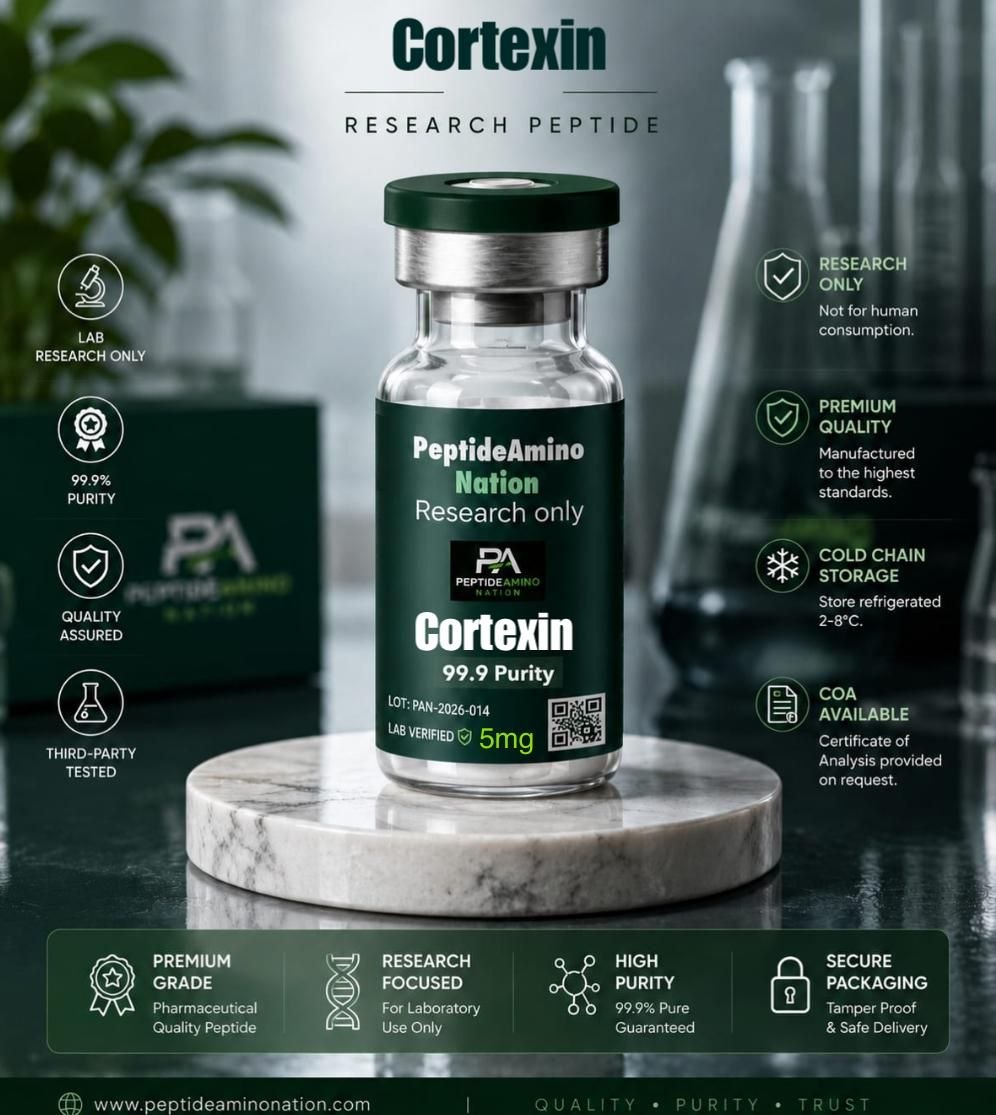
• Product Name: Cortexin Peptide
• Product Form: Lyophilized Cake / Powder
• Purity: ≥98% (Verified by HPLC)
• Source: Tissue-derived peptide fraction complex
• Molecular Weight: Primarily below 10 kDa
• Solubility: Sterile Water, Bacteriostatic Water, or 0.9% Sterile Saline
• Research Applications: Neuroprotection, neurogenesis, cognitive neuroscience, ischemia research, oxidative stress studies, neurodegenerative disease models
• Storage: −20°C (lyophilized); 2°C–8°C after reconstitution
• Quality Testing: HPLC and Mass Spectrometry
• Application: Laboratory Research Use Only
Why Purchase Cortexin Peptide From Peptide Amino Nation?
At Peptide Amino Nation, we understand that reproducible research begins with dependable materials.
Our Cortexin Peptide is manufactured according to rigorous quality standards, ensuring excellent purity, stability, and batch-to-batch consistency for scientific investigations.
Researchers choose our products because we prioritize:
• High laboratory purity
• Comprehensive analytical testing
• Reliable manufacturing standards
• Stable lyophilized formulations
• Strict quality control
• Research-focused customer support
• Consistent product availability
Whether your laboratory is investigating neuronal repair, cognitive function, neuroprotection, or experimental brain disorders, our Cortexin Peptide is manufactured to support dependable research outcomes.
Explore our complete collection of research peptides at peptideaminonation.com for additional compounds designed to support advanced scientific research.
FAQ
What is Cortexin Peptide?
Cortexin Peptide is a research-grade peptide complex composed of low-molecular-weight peptide fractions. It is widely used in laboratory studies investigating neuroprotection, cognitive function, neuronal repair, synaptic plasticity, and central nervous system biology.
What is Cortexin Peptide used for in research?
Researchers use Cortexin Peptide to investigate mechanisms involved in neuroprotection, neurogenesis, oxidative stress, cerebral ischemia, traumatic brain injury (TBI), memory formation, learning processes, and neurodegenerative disease models.
What is the purity of Cortexin Peptide?
Our Cortexin Peptide is manufactured to a minimum purity of 98% or higher, verified through High-Performance Liquid Chromatography (HPLC) and supported by rigorous quality control procedures.
Can Cortexin Peptide cross the blood-brain barrier?
Experimental studies suggest that the low-molecular-weight peptide fractions found in Cortexin may efficiently penetrate the blood-brain barrier (BBB), making it valuable for neuroscience research investigating brain signaling pathways.
How should Cortexin Peptide be stored?
For maximum stability, store the lyophilized powder at −20°C. After reconstitution, store the solution between 2°C and 8°C and use it according to your laboratory’s established protocols.
How is Cortexin Peptide reconstituted?
Cortexin Peptide is readily soluble in Sterile Water for Injection, Bacteriostatic Water, or sterile 0.9% Sodium Chloride solution. To preserve peptide integrity, gently swirl the vial during reconstitution and avoid vigorous shaking.
Is Cortexin Peptide intended for human use?
No. Cortexin Peptide is supplied strictly for laboratory research purposes. It is not intended for human consumption, veterinary use, diagnosis, treatment, or therapeutic applications.
Why choose Peptide Amino Nation for Cortexin Peptide?
Peptide Amino Nation provides premium research peptides manufactured under stringent quality standards. Every batch undergoes HPLC and mass spectrometry testing to ensure high purity, consistency, and reliable performance for scientific research.
Research Use Disclaimer
Cortexin Peptide is supplied strictly for laboratory research, analytical, and educational purposes only. This product is not intended for human consumption, veterinary use, therapeutic applications, diagnostic procedures, cosmetic use, or recreational purposes. Purchasers are solely responsible for ensuring compliance with all applicable laws, regulations, and institutional guidelines regarding the handling and use of this research material.
Reviews
There are no reviews yet.